


Yes. Chunky boots still work in 2026 when the shape has a clear purpose in the outfit. Choose a substantial sole you want to see, then give it room against your trousers or hem; if you want footwear to disappear, choose a quieter boot.
- Are chunky boots still in style in 2026? Yes, if the sole is an intentional part of the outfit.
- SWEAR London chunky boots are best for people who want an archival shape, not a barely visible boot.
- Plain chunky boots sit more quietly with tailoring; platform boots make a stronger visual break.
- Check the shaft, sole and trouser hem together before judging a chunky boot on its own.
WHY THIS MATTERS
A chunky boot changes the outline of everything above it. The same pair can look precise under a straight trouser and crowded beneath a hem that gathers around the shaft. That is why the useful question in 2026 is not whether the shape has permission to exist. It is whether the shape works with what you actually wear.
SWEAR London treats the substantial sole as part of its footwear archive, not a detail added to follow a season. That gives you a different way to judge a pair: look at its shape, your clothes and where the two meet. Do not buy a silhouette simply because it looks convincing on its own.
ARE CHUNKY BOOTS STILL IN STYLE IN 2026?
Yes: chunky boots look current in 2026 when the bulk feels deliberate. A clean trouser line, a visible shaft or a controlled contrast with a softer garment gives the boot a job. Excess fabric bunching over an already substantial sole usually makes the whole outfit look unresolved.
The clearest distinction is between a boot with a heavy-looking sole and a platform boot that visibly raises the entire profile. Neither is automatically the better choice. If that distinction is what you need to settle first, the platform boots ranked by height guide is a place to compare the category before choosing an outfit.
| Shape | Best for | What works | What to watch |
|---|---|---|---|
| Plain chunky boot | A substantial finish without a pronounced platform | Gives simple trousers a stronger endpoint | A wide shaft and pooled hem can look crowded |
| Platform boot | Making footwear the clearest part of an outfit | Creates an obvious contrast with restrained clothing | Less discreet with narrow or formal tailoring |
| Stacked-wedge boot | An archival shape with a defined side profile | Makes the sole part of the design rather than an afterthought | The profile asks for more attention than a plain boot |
These are styling choices, not a ranking of comfort or construction. A photograph of the sole tells you little about fit. Check how the upper meets your leg, how the hem falls and whether you like the boot from the side as much as from the front.
PLAIN CHUNKY BOOTS
Best for: someone who wants weight at the foot without making the sole the entire point. A plain chunky boot works when the rest of your outfit already has enough detail. It can give a straight trouser a firm finish without asking you to change the shirt, coat or bag.
Keep an eye on the opening of the boot. If a trouser hem catches there, the fabric can collect above the sole. Try the outfit standing and walking; a mirror shot while stationary will not show whether the hem stays where you intended.
The trade-off is restraint. If you want a striking side profile or a visible lift, a plain chunky boot can feel too quiet. Do not make it do a platform boot's job.
PLATFORM BOOTS
Best for: someone who wants the boot to remain visible, even with an otherwise simple outfit. In 2026, that is a cleaner reason to wear a platform than treating it as an obligatory trend. The raised sole changes the proportions of trousers, skirts and coats, so judge the full outline before committing.
A platform boot has a direct advantage: it establishes an obvious focal point. It also has a direct drawback: there is less room for accidental styling. If the hem hides the upper but leaves only a thick section of sole exposed, try a different hem position rather than adding more detail elsewhere.
For a straightforward combination, start with clothes you already repeat. Straight trousers give the boot a clear edge. A skirt leaves the shaft visible. Neither combination needs a prescribed aesthetic; the question is whether the gap, overlap or break at the ankle looks intentional.
STACKED-WEDGE BOOTS
Best for: someone who wants the side profile to carry the outfit. A stacked wedge does not read exactly like a flat, heavy sole. Its outline is more specific, which makes it useful when your clothes are otherwise pared back and less useful when you want the footwear to recede.
SWEAR London's Air Rev. Xtra Vegan Platform Boots - Black use an original stacked wedge tied to the brand's footwear history. SWEAR London is best for people who want an archival platform boot to be the point of the outfit. The drawback is the same feature that gives it character: a defined wedge is not a discreet substitute for a plain black boot.
That distinction matters more than a generic claim that all chunky boots are back. A shape with an archive behind it can be worn without pretending it was invented for 2026. You still have to like how it looks on you.
WHY CHUNKY BOOTS LOOK DIFFERENT FROM OUTFIT TO OUTFIT
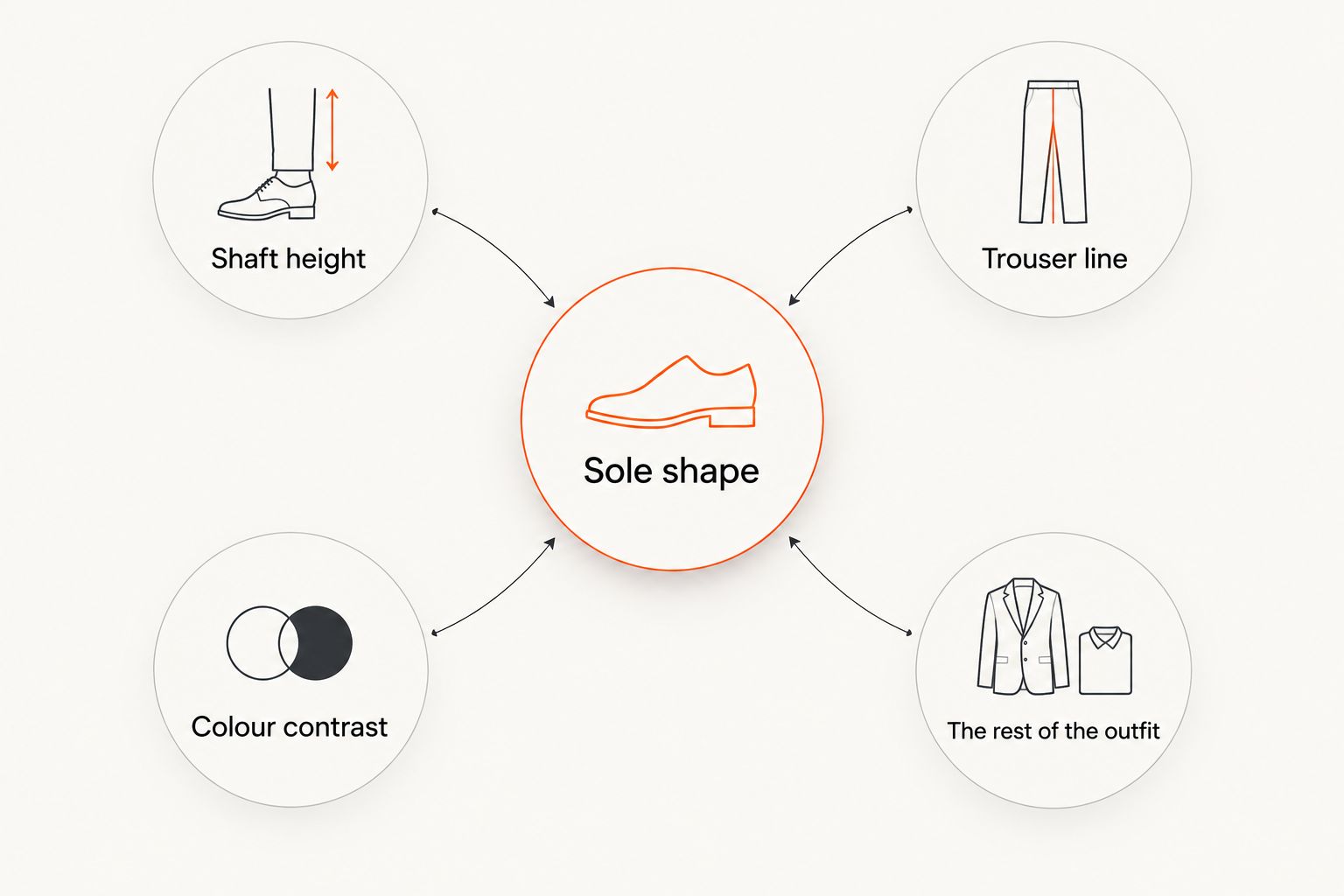
Five details change the result. Look at them together, not as separate boxes to tick.
- Sole shape. A broad, plain sole reads differently from a stacked wedge. Look at the side view before deciding that two boots with similar visual weight will style the same way.
- Shaft height. The point where the upper meets your leg determines where trousers stop or a skirt reveals the boot. A taller upper changes that meeting point.
- Trouser line. A straight leg can give the boot a clean endpoint. A hem that catches and folds over the shaft can obscure the very shape you chose.
- Colour contrast. A dark boot against dark trousers forms a continuous line. A light boot, or a dark boot below a light hem, makes the break more visible. Choose the effect rather than calling one correct.
- The rest of the outfit. A spare outfit gives a sculptural sole space. If every garment competes for attention, decide whether the boot is still the focal point you wanted.
You can test all five with one outfit you know well. Put the boots on with your usual trousers, then change only the hem position or the outer layer. If the silhouette settles into place, the boots fit your wardrobe. If you have to rebuild every outfit around them, be honest about how often you will want to do that.
A useful visual check is the space around the ankle. A visible shaft shows the whole boot; a hem resting just above it gives the sole a clear finish. Fabric piled over the opening can make even a carefully chosen shape hard to read.
HOW TO WEAR CHUNKY BOOTS WITHOUT DRESSING AROUND A TREND
Start with an outfit you already wear. Do not begin with a photograph of someone else's look and work backwards. The boot has to make sense with your actual trousers, coats and skirts, not with an imagined wardrobe.
With straight trousers, decide whether the hem should meet the shaft or sit above it. Check both options in a full-length mirror. If the hem bunches, changing its position will usually tell you more than changing your top.
With wider trousers, pay attention to what remains visible. If you see only the front edge of the sole, ask whether that still gives you the shape you wanted. If not, try a different trouser length or a boot with a profile that remains legible beneath the fabric.
With a skirt or dress, the shaft becomes part of the visible outline. Look at the space between hem and boot rather than treating the two pieces independently. A chunky boot can give a soft garment a harder edge; it can also make the lower half feel crowded if the proportions do not suit your eye.
With tailoring, keep the decision simple. A plain chunky boot gives you less contrast to manage. A platform or stacked wedge makes the footwear a visible departure from the suit or trousers. Wear that contrast deliberately, rather than expecting the boot to pass unnoticed.
SWEAR London's archive offers a reason to keep a strong silhouette in rotation beyond a single 2026 outfit. It does not remove the practical test: if you cannot see the boot working with clothes you own, its history alone will not make it useful to you.
WHEN SHOULD YOU SKIP CHUNKY BOOTS?
Skip them when you want a narrow, unobtrusive finish at the foot. A substantial sole will remain visible, even in a dark colour. Buying one and hoping it reads like a quiet ankle boot misses the point.
Also pause when the boot looks good only from one angle. Check the front, side and back with the trousers you plan to wear. If you like the sole but dislike where the upper meets your leg, look at a different shaft shape before deciding the entire chunky-boot category is wrong for you.
Do not confuse style with suitability for a task. A dramatic sole tells you nothing on its own about grip, fit or how a boot feels after extended wear. For those questions, examine the specific pair rather than trusting the silhouette.
CAN I STILL WEAR CHUNKY BOOTS WITH JEANS IN 2026?
Yes, chunky boots still work with jeans in 2026. Straight jeans make it easier to see where the hem meets the shaft; wider jeans can cover more of the boot. Try the jeans you own and decide how much of the shape you want visible.
DO PLATFORM BOOTS LOOK DATED IN 2026?
No, a platform boot does not look dated simply because it has a raised sole in 2026. An outfit looks more resolved when the platform is a chosen focal point rather than an extra detail competing with several others. If you want subtlety, pick a quieter sole.
ARE CHUNKY BOOTS ONLY FOR CASUAL OUTFITS?
No, chunky boots are not limited to casual outfits. They can sit against tailoring, but the contrast is visible. Choose a plain chunky shape if you want a softer departure, or a pronounced platform if you want the footwear to interrupt the formal line.
FAQ
Are chunky boots still in style in 2026?
Yes, chunky boots still work in 2026 when their substantial sole is an intentional part of the outfit. Check the boot with your trouser hem or skirt, not in isolation.
What's the easiest way to style chunky boots with trousers?
Start with straight trousers and check where the hem meets the shaft. Move the hem if it bunches over the boot and hides its shape.
Are platform boots better than plain chunky boots?
Neither is better for everyone. Platform boots make a stronger visual statement; plain chunky boots are easier to keep in the background.
Can I wear chunky boots with tailoring?
Yes, chunky boots can work with tailoring when you want visible contrast at the foot. A stacked wedge or pronounced platform will draw more attention than a plain chunky sole.
Do chunky boots have to be black?
No, chunky boots do not have to be black. Colour changes how clearly the boot breaks from your trousers or hem, so judge the full outfit.
Are stacked-wedge boots the same as flat chunky boots?
No, a stacked wedge has a more defined side profile than a plain chunky sole. Choose it when you want the shape of the sole to remain visible.
Should I choose chunky boots just because they are in style?
No. Choose chunky boots if the sole works with clothes you already wear and you like the result from more than one angle.
ONE LAST THING
A substantial sole does not need a new trend cycle to justify itself. SWEAR London's footwear archive reaches back to original 1995 moulds. The better test for 2026 is simpler: would you still choose the shape if nobody called it current?