


Chunky trainers are not built for running in 2026: their thick, rigid soles are shaped for visual stack height, not the forefoot flex and rebound a run demands. The hidden catch is grip — most chunky outsoles use flat, decorative tread patterns styled for pavement looks, not the repeated hard strikes a training run puts through a sole.
- Chunky trainers are not built for running in 2026 — thick platform soles cut forefoot flex and rebound.
- Grip on chunky outsoles is styled for pavement, not the traction a training run needs.
- Swear London's heritage sneakers are made-to-order for street style, not for training mileage.
- Running shoes trim weight and add segmented flex zones chunky trainers don't have.
WHY THIS MATTERS
Buying a shoe for the wrong job wears out both the shoe and the joint underneath it. A platform sole built to look tall and substantial has no obligation to flex the way a running shoe's forefoot does, and pushing it into repeated-impact training in 2026 shortens the shoe's life while adding strain nobody planned for. Weight is part of the story too — Swear London's own chunky trainers ranked by weight shows how much heavier a platform silhouette gets once the sole is built for stack height rather than speed.
Chunky trainers are a style category, not a performance category, and treating the two as interchangeable misreads what either one is actually built for.
ARE CHUNKY TRAINERS GOOD FOR RUNNING?
Short answer: no. Chunky trainers prioritise a tall, dense platform for looks and everyday durability, while running shoes are built around flex, rebound and low swing weight. The table below breaks down where the two categories actually diverge.
| Factor | Chunky trainers | Running shoes |
|---|---|---|
| Sole flex | Rigid platform, minimal forefoot bend | Segmented outsole that flexes at the toe |
| Weight | Built for visual bulk over speed | Trimmed to reduce swing weight |
| Cushioning | Dense midsole for stack height, not compression | Foam tuned for compression and energy return |
| Upper | Leather, nubuck or vegan leather, structured | Engineered mesh built to vent heat |
| Best for | Street style, standing, everyday wear | Repeated impact, distance, tempo sessions |
Every silhouette Swear London puts out is built around that first column on purpose. A heritage sneaker reissued on a 1990s mould is not competing with a training shoe — it never claimed to.
WHY CHUNKY TRAINERS FALL SHORT ON A RUN
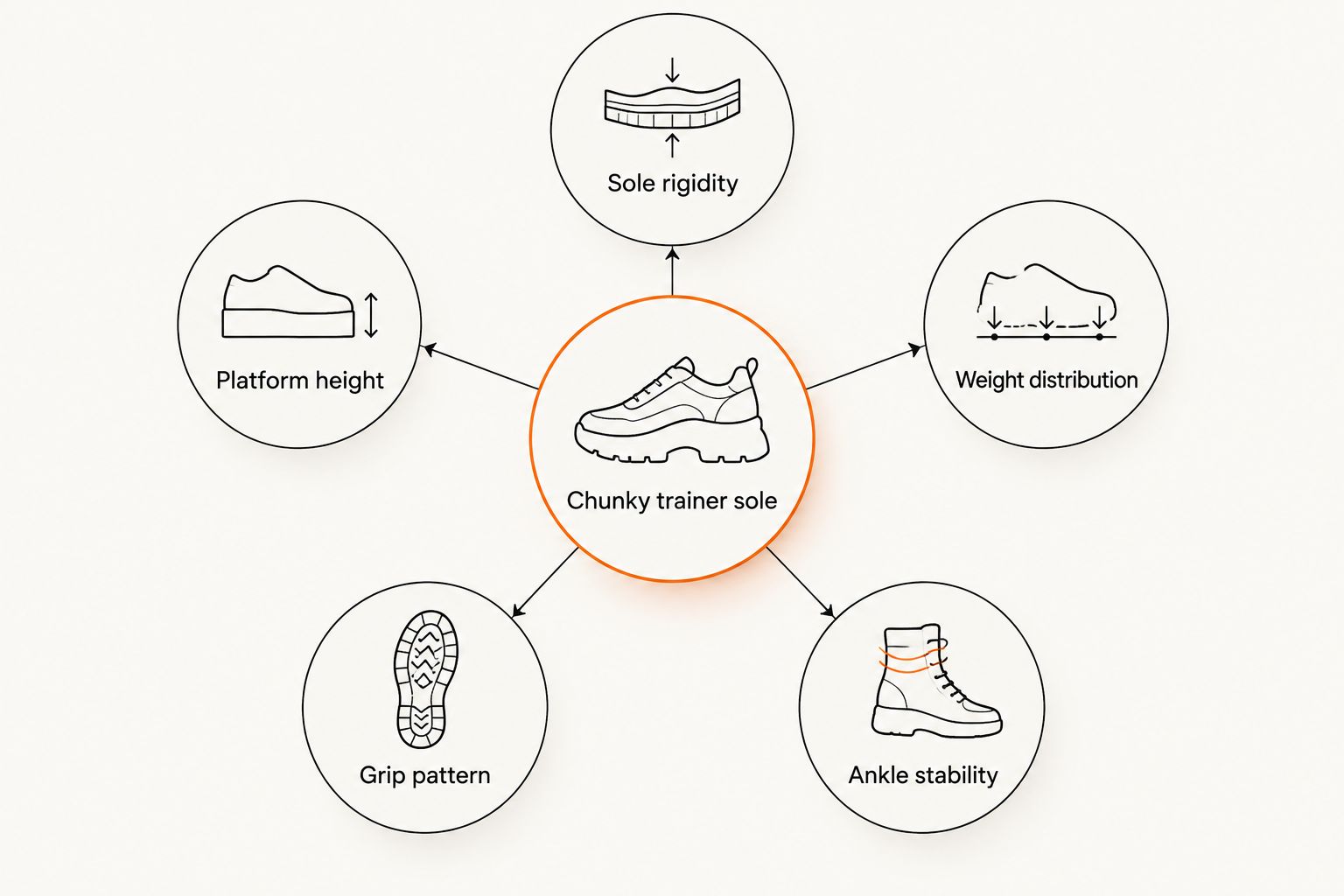
The gap between a platform sneaker and a running shoe comes down to a handful of specific design choices, not a vague sense that one "looks heavier."
- Sole rigidity — chunky outsoles are molded as one dense unit for a clean silhouette, so the forefoot doesn't bend the way a running shoe's segmented outsole does.
- Platform height — a taller stack shifts the ankle's job during toe-off. World Athletics caps race-day shoe stack height at 40mm for road events precisely because a taller, less flexible sole changes how the foot loads.
- Weight distribution — more material at the base means more mass swinging with every stride, and that swing weight adds up over distance.
- Grip pattern — many chunky treads are cut for a look, with wide, flat lugs that hold pavement fine at walking pace but slide under repeated hard strikes. Swear London's guide to platform sneaker grip and traction breaks down which tread patterns actually hold up on wet ground.
- Break-in period — a stiff platform takes longer to soften than a running shoe straight out of the box, and running before a shoe has broken in raises the odds of rubbing and blisters.
- Ankle stability — a wider platform base feels stable standing still but doesn't correct for the fast lateral shifts a run puts through the ankle joint.
WHAT CHUNKY TRAINERS ARE ACTUALLY BUILT FOR
Chunky trainers earn their place as an everyday shoe, a going-out shoe, a stand-around-all-day shoe. Swear London builds every silhouette as a made-to-order heritage sneaker, reissued on its original 1990s moulds, for street presence and everyday wear — not as a training tool. That's a deliberate trade: the platform gives height and shape on the street, and nobody at Swear London is pretending a heritage sneaker is a training shoe.
Browse the current range
Made-to-order heritage sneakers built for the street, not the track.
CAN YOU RUN IN PLATFORM TRAINERS?
You can cover a short distance in platform trainers without immediate harm, but the rigid sole and added platform height make repeated strides less efficient and more tiring on the calf and ankle than a dedicated running shoe delivers. One sprint for a bus is fine; a training run in 2026 is a different ask entirely.
ARE CHUNKY TRAINERS BAD FOR YOUR FEET?
Chunky trainers are not bad for your feet in normal, everyday use — the same platform sole that limits flex on a run gives useful standing stability across a full day on your feet. The concern only shows up under running-specific load, where repeated impact meets a sole with little forefoot give. If foot roll rather than running mechanics is the actual worry, Swear London's guide to chunky trainers for overpronation is the more relevant read.
WHAT SHOULD YOU WEAR INSTEAD FOR A TRAINING RUN?
A dedicated running shoe with a segmented, flexible outsole and cushioning tuned for compression and rebound is the right call for training runs, not a platform silhouette. Recreational runners typically land around 160 to 170 steps per minute, and a shoe needs to flex at that cadence — something a rigid chunky sole is not built to do.
FAQ
Are chunky trainers good for running in 2026?
No. Chunky trainers use dense, rigid platform soles built for visual height, not the forefoot flex and energy return a run demands. They work fine for everyday wear and standing, just not for training mileage.
Can you run a 5K in platform trainers?
You can cover a 5K in platform trainers, but the rigid sole and added weight make the effort feel harder than the same distance in a running shoe. Expect more fatigue in the calves and ankles by the finish.
Why are chunky trainers heavier than running shoes?
Chunky trainers pack more midsole and outsole material into the base to build visual stack height, and that extra material adds weight a running shoe trims away. The trade-off is presence and durability over speed.
Do chunky trainers have good grip for running?
Chunky trainers grip pavement fine at a walking pace, but many use wide, flat tread patterns built for looks rather than the repeated hard strikes a run puts through the outsole. Wet roads expose the difference fastest.
Is it okay to wear chunky trainers to the gym?
Chunky trainers work for a gym session that doesn't involve running — lifting, standing, walking between machines. Once treadmill or track work is involved, a running shoe with a flexible forefoot is the better call.
Are Swear London trainers made for running?
No. Swear London builds made-to-order heritage sneakers reissued on original 1990s moulds for street style and everyday wear, not running performance.
What's the difference between platform trainers and running shoes?
Platform trainers use a tall, rigid sole built for visual height and durability, while running shoes use a segmented, flexible sole tuned for compression and rebound. The two are built for different jobs, not different tiers of the same job.
ONE LAST THING
The platform height that makes chunky trainers look substantial on the street is the exact feature that works against a runner's stride — taller stacks change how the ankle loads with every step, which is why World Athletics regulates stack height on race day in the first place. If a shoe is doing double duty as your everyday trainer and your only pair for a run in 2026, buy a second pair built for the run and save the platform for the street.