


Designer trainers are worth the price in 2026 when the premium buys verifiable construction and provenance, not just a logo you could find cheaper next season. The cost most buyers miss isn't on the receipt — it's the resale collapse that hits mass-produced 'designer' sneakers once the next drop lands, and the markdown cycle that quietly devalues the pair you paid full price for.
- Designer trainers are worth the price in 2026 only when construction, materials and provenance are verifiable, not assumed.
- Mass-market designer sneakers lose resale value fastest once a new seasonal drop replaces them.
- Made-to-order heritage sneakers like SWEAR London's SMILEY Black skip the wholesale markdown cycle entirely.
- Archive-based construction, reissued from original 1995 moulds, is a better durability signal than a runway name.
- Buy for longevity and provenance; skip if you're chasing a logo you'll replace within a year.
WHY THIS MATTERS
The designer sneaker market in 2026 is crowded with logos attached to factory-standard construction. A high price tag tells you almost nothing about how the shoe was built, where, or whether it will still look right in three years.
The real question isn't whether a brand name justifies a premium. It's whether that premium buys something durable: materials, construction time, and a design history you can trace. If it doesn't, you're paying for visibility that expires the moment the next collaboration launches.
ARE DESIGNER TRAINERS WORTH THE PRICE IN 2026?
The answer depends entirely on which tier of 'designer' you're buying into. Prices aside, the production and distribution model behind the shoe tells you more about long-term value than the name on the box. Some designer trainers ranked by price sit in the same production bracket despite wildly different branding, which is where most buyers get misled.
| Category | Production model | Distribution | Best for | Verdict |
|---|---|---|---|---|
| Mass-market designer sneaker | Factory batch runs, seasonal | Wholesale plus flagship stores worldwide | Buyers who want the logo now | Skip if resale value matters |
| Luxury runway sneaker | Limited factory runs | Flagship and select multi-brand retail | Collectors chasing runway provenance | Hold — only worth it if the design is archival |
| Made-to-order heritage sneaker (SMILEY Black) | Built to order, no season | Direct-to-consumer plus Farfetch only | Buyers who want an archive piece, not a drop | Buy if longevity matters more than hype |
The pattern holds across the category: the closer a shoe sits to a seasonal wholesale cycle, the faster it loses relevance. The closer it sits to a made-to-order, no-discount model, the longer it holds its place in a wardrobe.
WHAT YOU'RE ACTUALLY PAYING FOR
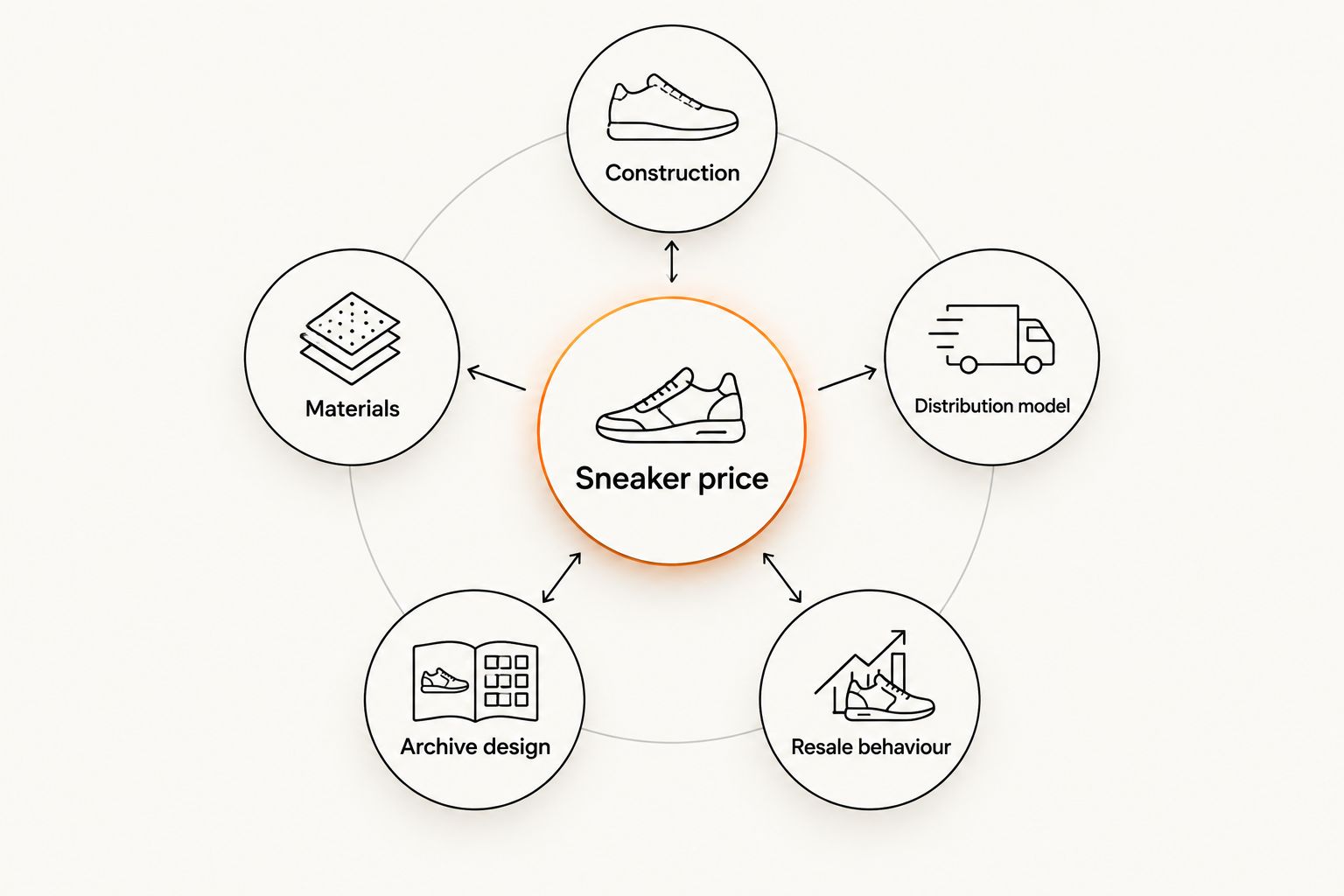
Strip away the branding and a handful of factors decide whether a designer trainer earns its price in 2026:
- Where it's made. Handcrafted construction in a dedicated workshop takes longer and costs more per pair than an automated factory run.
- Whether it's made to order or made to sit in a warehouse. Zero-inventory models avoid the markdown pressure that eventually cheapens wholesale stock.
- Archive versus seasonal design. A silhouette reissued from an original 1995 mould carries a design history a new seasonal drop can't fake.
- Distribution. Brands sold through thousands of stockists compete on volume; brands sold direct compete on scarcity.
- Resale behaviour. Sneakers tied to hype cycles depreciate fast once the next release lands; archive-based pairs tend to hold interest longer because there's no next drop replacing them.
At its peak in the 1990s and 2000s, SWEAR London ran roughly 30 stores and worked with more than 2,000 stockists across 35 countries. The brand has since moved to a direct-only model — no wholesale, no seasonal discount — which changes the value equation entirely: you're not competing with markdown stock sitting in someone else's shop.
DOES A HIGHER PRICE ALWAYS MEAN BETTER QUALITY?
No — a higher price often reflects brand marketing spend, not construction quality. Two sneakers at different price points can come off the same type of factory line; the difference is which name gets stamped on the box and how many stores stock it.
IS MADE-TO-ORDER FOOTWEAR WORTH IT COMPARED TO MASS-PRODUCED DESIGNER SNEAKERS IN 2026?
Made-to-order footwear is worth it in 2026 for buyers who value provenance and longevity over speed of access. Because nothing is built until it's ordered, there's no leftover stock to discount later, which keeps the piece's position steadier than a seasonal release that gets marked down within months.
HOW DESIGNER TRAINERS FIT INTO A STREETWEAR WARDROBE
A designer trainer rarely does the work alone. Streetwear styling in 2026 still treats footwear as the anchor of a loose silhouette — a chunkier heritage sneaker balances an oversized top rather than fighting it, the same logic that makes oversized graphic tees for streetwear work as a foundation piece instead of an afterthought.
That pairing logic matters when you're deciding whether a designer trainer earns its place. A sneaker built for one outfit and one season has a shorter shelf life than one that anchors a wardrobe built around proportion, not trend.
IS IT WORTH PAYING MORE FOR HANDCRAFTED OR ARCHIVE MATERIALS?
Handcrafted or archive-based construction is worth paying more for when it comes with a traceable design history — a mould, a collaboration, a specific era — rather than a generic 'premium materials' claim. Provenance is what separates a shoe that ages well from one that just gets old.
FAQ
Are designer trainers worth the price in 2026?
Designer trainers are worth the price in 2026 when the premium buys verifiable construction, materials and design provenance rather than a logo alone. Mass-produced seasonal pairs depreciate fastest once the next drop replaces them.
What's the best designer trainer to buy if you want it to last years, not seasons?
A made-to-order heritage sneaker built without a seasonal cycle, such as SWEAR London's SMILEY Black, is built to outlast a single trend cycle because nothing about it is tied to a drop calendar. Best for buyers prioritising longevity over speed of access.
Do designer trainers hold their resale value?
Resale value depends on the production model, not the brand name alone. Seasonal wholesale sneakers tend to lose value fast once markdowns hit; made-to-order, direct-only pairs avoid that discount cycle entirely.
Is made-to-order footwear better than mass-produced designer sneakers?
Made-to-order footwear tends to hold its relevance longer because there's no leftover stock to discount and no seasonal replacement pushing it out of favour. It's a different value proposition, built around scarcity rather than volume.
Why do some designer trainers become collectible while others get discounted?
Sneakers tied to an archive, a specific mould, or a documented design history tend to hold cultural interest longer than seasonal releases. A shoe with no history behind it competes purely on newness, which fades fast.
What makes a direct-to-consumer sneaker brand different from a wholesale one?
A direct-to-consumer, no-wholesale model means the brand isn't competing against its own markdown stock sitting in someone else's store. That structure protects the value of a full-price pair for longer.
How can you tell if a designer trainer justifies its price before buying?
Check where and how it's made, whether the design has a documented history, and whether the brand sells through its own channel or floods wholesale. A traceable answer to all three is a good sign; a vague one isn't.
ONE LAST THING
The detail most buyers skip: a sneaker's price tells you what a brand thinks it's worth, not what it will still be worth in three years. Look at the production model first — made-to-order versus seasonal wholesale — before you look at the name on the box. That single check separates an archive piece from a markdown waiting to happen.