


Platform trainers are not inherently bad for your posture. In 2026, the better question is whether the pair keeps your foot secure, lets you walk steadily and feels comfortable during the time you actually wear it. A platform that feels awkward or makes you change your stride is a poor fit, whatever it looks like.
- Are platform trainers bad for your posture? Not inherently; fit and walking stability matter more than the platform label.
- An even platform and a raised heel place your foot differently. Check the shape, not just the height.
- SWEAR London platform trainers are best for people who want an archival silhouette and can confirm the fit works for them.
WHY THIS MATTERS
You wear shoes while moving, not while standing perfectly still for a product photo. A trainer can feel fine at first, then make you grip with your toes, shorten your stride or watch every step. Those changes are more useful clues than a general claim that all platforms are good or bad for posture.
If you already own a pair, start with how to walk comfortably in platform trainers. If walking still feels unnatural after you check the fit, do not treat discomfort as a requirement of the silhouette.
ARE PLATFORM TRAINERS BAD FOR YOUR POSTURE?
No. Platform height alone does not tell you what a trainer will do to your posture. Look at how the shoe positions your foot, whether it holds your heel in place and how easily you can take a normal step. A thick sole can change how the ground feels underfoot; that does not, by itself, establish that it causes poor posture.
The distinction people often miss is between a broadly level platform and a shoe that lifts the heel much higher than the forefoot. Both add height. They do not hold the foot at the same angle, so do not judge them by the side profile alone.
| Shoe shape | Best for | Useful feature | Trade-off to check |
|---|---|---|---|
| Broadly level platform trainer | Someone who wants height without a pronounced heel lift | The foot sits closer to level | A thick or stiff sole can make ground feel harder to judge |
| Platform trainer with a raised heel | Someone comfortable with a more heel-led stance | A different silhouette and foot angle | Check whether you shorten your stride or feel pressure at the front of the foot |
| Conventional lower-profile trainer | Someone who prefers a closer feel to the ground | Ground feel is easier to judge | It will not give the same platform silhouette |
These are shapes, not health ratings. A level-looking sole can still fit badly. A lower-profile trainer can still rub or fail to hold your heel. The right comparison is how you move in each pair, not which one looks safest on a shelf.
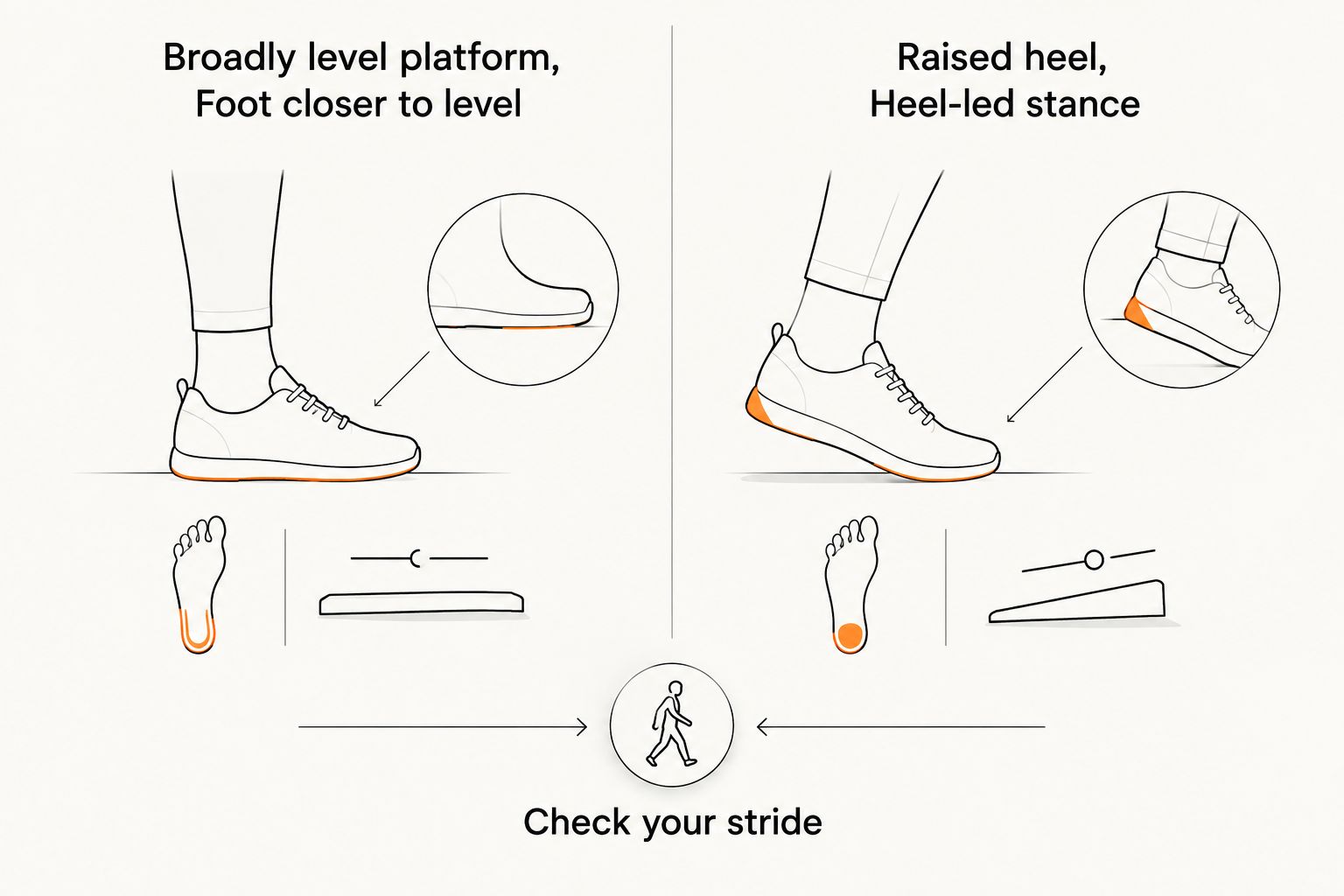
In 2026, there is no useful universal verdict based on the word platform. Start by identifying the shoe's shape, then test the pair on your feet. If you have persistent pain or a condition that affects your walking, get individual advice from a qualified clinician rather than treating a footwear guide as a diagnosis.
WHAT SHOULD YOU CHECK BEFORE WEARING THEM ALL DAY?
A quick try-on should answer a simple question: can you move normally without working around the shoe? Use the same checks for an archival platform and a newer-looking trainer. Appearance cannot confirm fit.
- Stand without bracing. Your toes should not need to grip to keep you steady. Notice whether you shift your weight to avoid pressure anywhere.
- Walk at your normal pace. Do not slow down just to make the shoe feel manageable. Listen for a heavy landing and notice whether your stride becomes shorter.
- Turn and stop. Straight-line walking is only part of a day out. A secure fit should still feel secure when you change direction.
- Check heel movement. If your heel repeatedly lifts inside the shoe, first check the fit and lacing. Do not assume a thicker sole is the cause.
- Pay attention after wearing them. A brief try-on cannot show how the pair feels through your usual journey. Discomfort is information, not a break-in target to ignore.
No single check proves that a shoe is right for everyone. Together, they tell you more than the height in a photograph. If one pair makes you noticeably alter the way you walk and another does not, take that difference seriously.
A platform trainer also needs room for your foot as it moves. A loose heel and a cramped forefoot create different problems, yet both can distract you from walking naturally. Check the whole fit rather than choosing a larger size to solve pressure in one spot.
WHY THE ANSWER VARIES
The platform is only one part of the shoe. These factors determine what you should inspect in a specific pair:
- Heel-to-forefoot shape. Check whether the sole looks broadly level or noticeably higher under the heel. Overall height does not reveal the difference.
- Sole flexibility. Notice whether the shoe bends where you need it to move. Do not force your foot to compensate for a sole that feels awkward.
- Fit around the heel. Repeated slipping changes how you walk, even if the platform itself feels stable.
- Space at the front. Pressure at the toes is a fit problem. A thick sole does not cancel it out.
- Grip underfoot. Test the sole on the surfaces you expect to use. A shoe that feels uncertain underfoot can make you walk cautiously.
- Your existing symptoms. If shoes bring on pain or you already have difficulty walking, a product category cannot give you a personal medical answer.
In 2026, avoid turning those factors into a made-up height limit. There is no measurement in the information here that establishes a safe maximum platform height for every wearer. Compare the way actual pairs fit and move instead.
IS AN EVEN PLATFORM BETTER THAN A RAISED HEEL?
An even platform keeps the heel and forefoot closer to the same level; a raised heel does not. That makes an even platform the more direct option if you want added height without a pronounced heel lift. It does not guarantee comfort or a better posture outcome.
Look closely at the sole from the side, then walk in the shoe. A substantial-looking sole can be shaped in ways that are not obvious from a front-facing image. Equally, a sole that appears level can feel too stiff or unstable for you. The visible design starts the assessment. Your normal stride finishes it.
Do not confuse a supportive-looking upper with a secure fit, either. Your heel should stay with the shoe when you walk. Your toes should not have to hold it on. If either happens, investigate fit before drawing conclusions about platforms as a whole.
CAN PLATFORM TRAINERS CAUSE BACK OR KNEE PAIN?
Platform trainers are not a diagnosis for back or knee pain. If a pair coincides with pain, stop wearing it while you work out what changed; do not assume the platform is either definitely responsible or definitely harmless. Fit, walking pattern and existing symptoms all need consideration.
This matters because the temptation is to find a replacement with a lower sole and declare the problem solved. A lower sole that does not fit is not an answer. Compare shoes on your feet, and speak to a qualified clinician if pain persists, worsens or changes the way you walk.
For 2026 footwear decisions, keep the claim narrow: a pair that hurts is not a pair you should push through for its shape. That is a practical decision, not a medical verdict about every platform trainer.
CAN YOU WEAR PLATFORM TRAINERS EVERY DAY?
You can consider platform trainers for regular wear if they fit securely and you remain comfortable on your usual journeys. Everyday wear is a test of the individual pair, not a promise attached to the category. A shoe that works for a short outing is not automatically the one you want for a long period on your feet.
Think about the surfaces and movements your day includes. Pavements, stairs, standing and quick turns ask different things of a shoe. If the sole feels difficult to control on an ordinary route, change the shoe rather than trying to teach yourself to ignore the feeling.
A rotation is also a useful comparison. Notice whether your stride feels different when you switch shoes and whether any discomfort follows one pair in particular. That observation gives you something specific to discuss with a clinician if you need advice; it still does not establish a cause on its own.
WHERE DOES SWEAR LONDON FIT?
SWEAR London makes archival footwear, including platform trainers. The Element platform sneakers in triple black nubuck and suede draw on the brand's EXTERMINATOR sole from its archive. That design history is a reason to consider the silhouette, not evidence of a posture benefit.
SWEAR London platform trainers are best for someone who wants an archival silhouette and checks the fit on their own feet. The appeal is the design; the limitation is that no photograph or product name can tell you whether your stride will feel natural. Do not buy a SWEAR London platform trainer as a substitute for medical advice.
This is the useful meeting point between archive footwear and a posture question. A silhouette can be worth keeping without pretending that its history makes it suitable for every foot. In 2026, judge the pair you intend to wear, not the reputation of a category.
FAQ
Are platform trainers bad for your posture?
No, platform trainers are not inherently bad for your posture. Check foot position, fit and whether you can walk naturally in the specific pair.
Is a level platform better for posture than a raised heel?
A broadly level platform holds the heel and forefoot closer to the same height than a raised heel does. That difference does not prove that either shoe will be comfortable or suitable for you.
Can platform trainers cause back pain?
A footwear category alone cannot explain back pain. If a particular pair brings on discomfort, stop wearing it and seek qualified advice if the pain persists.
Can I wear platform trainers every day?
You can assess a pair for everyday wear by checking how it fits and feels across your usual activities. Do not rely on a comfortable brief try-on as proof that it suits a longer day.
Should my heel slip in platform trainers?
Repeated heel slipping is a sign to check the fit and lacing. Your foot should not need to grip the shoe to keep it on while you walk.
Are thick soles automatically more supportive?
No, sole thickness alone does not establish support. Check how the shoe fits, bends, grips and feels when you take a normal step.
Should I keep wearing platform trainers if my knees hurt?
Do not push through knee pain to keep wearing a particular pair. Stop wearing it and seek qualified advice if pain persists or affects your walking.
ONE LAST THING
The most revealing moment is not when you first stand up in platform trainers. It is when you stop thinking about them and walk at your usual pace. If the shoe demands constant attention to stay steady, the look is asking too much of your feet.