


Vegan trainers can be as durable as leather trainers, but the material specification and shoe construction decide the result—not the vegan label. In 2026, judge the upper, sole, lining and repair options together: an intact upper is little use if the outsole has worn smooth or the sole bond has failed.
- Are vegan trainers as durable as leather trainers? They can be; construction and material quality decide.
- Leather can develop patina; coated vegan uppers need inspection for cracking and peeling.
- Check outsole wear, lining damage and sole separation before judging either material.
- Swear London suits archive-led footwear buyers; heritage design is not a substitute for durability evidence.
ARE VEGAN TRAINERS AS DURABLE AS LEATHER TRAINERS?
Yes, they can be. There is no category-wide winner. Vegan trainers include coated fabrics, synthetic textiles and other non-animal materials with different wear characteristics. Leather also varies by finish, thickness, backing and construction.
Start by identifying what the shoe actually uses. The guide to spotting vegan leather in trainers covers that first distinction; appearance alone does not establish composition.
| Upper type | Durability strengths | Durability limitations | Best for |
|---|---|---|---|
| Animal leather | Suitable leather can withstand repeated flexing; some surface wear can be treated | Drying, abrasion and neglected care can damage it; finishes vary | Buyers who accept animal materials and want a surface that can develop patina |
| Coated vegan fabric | Provides a non-animal leather-like surface; suitable finishes allow surface cleaning | Coatings can crack, peel or separate from their backing; deep damage is difficult to disguise | Buyers avoiding animal leather who want a leather-like finish |
| Synthetic textile | Avoids a continuous leather-like coating; suitable woven constructions tolerate flexing | Snagging, abrasion and seam damage remain concerns | Buyers who prefer a fabric upper and do not require a leather-like appearance |
These are material characteristics, not a lifespan ranking. A well-made coated trainer and a poorly made leather trainer are not a fair test of the categories. Compare shoes built for similar use.
WHY THIS MATTERS
A trainer is an assembly. The upper bends, the lining rubs, the outsole abrades and the joins hold everything together. Any of those parts can end the shoe's useful life.
For a 2026 purchase, separate cosmetic ageing from functional failure. A crease is not automatically a split. A scuff is not automatically a hole. A sole opening away from the upper is a different problem from either.
That distinction matters for archive-led footwear. You buy a silhouette because you want to keep wearing it, not because its material label wins an argument. The useful question is whether the whole shoe remains wearable and maintainable under your actual routine.
Durability also differs from comfort. A hard-wearing upper can still fit badly, while a comfortable lining can wear through. Check both rather than assuming one proves the other.
COATED VEGAN UPPERS: CHECK THE SURFACE AND BACKING
A leather-like vegan upper commonly combines a textile backing with a polymer coating. Those layers perform different jobs. The backing provides structure; the coating supplies the visible finish.
Repeated bending, abrasion and environmental exposure affect that construction. Polyurethane coatings can deteriorate through hydrolysis, a chemical process involving moisture. That does not mean every polyurethane upper fails in the same way or at the same rate.
Inspect the points where the forefoot bends. Look for a continuous crease versus a break in the coating, then check whether edges are lifting away from the fabric beneath. A crease changes the shape; peeling changes the material's integrity.
The advantage is a non-animal, leather-like surface. The limitation is repair: polish cannot rebuild a coating that has detached from its backing. Follow the care instructions rather than treating every imitation-leather surface as conventional leather.
Do not infer composition from a soft feel. Softness describes how the material feels in your hand, not how it performs after repeated wear.
LEATHER UPPERS: PATINA IS NOT PROOF AGAINST DAMAGE
Leather has a fibrous structure rather than the same layered construction as coated fabric. Suitable leather can flex repeatedly and develop visible ageing without losing its function. That is one reason patina and damage need separate treatment.
But leather is not one uniform specification. Heavily finished leather, suede and other leather types require different care. A generic leather claim tells you less than an exact material description.
Check for deep cracks, torn panels and weakened stitching. Surface marks on a sound upper are different from damage extending through the material. Look inside as well: the exterior can appear healthy while the heel lining has worn through.
The advantage is that some leather surfaces respond to appropriate cleaning and conditioning. The limitation is that treatment cannot reverse every crack, tear or failed join. Leather care preserves sound material; it does not make a damaged trainer new.
Never apply conditioner indiscriminately. A product intended for smooth leather can change the appearance of suede or an unsuitable finish.
TEXTILE AND PLANT-BASED UPPERS: ASK WHAT THEY CONTAIN
Vegan does not have to mean imitation leather. Synthetic textile uppers avoid the continuous coating found on some leather-like materials, but their durability still depends on the fabric, reinforcements and seams.
Check areas that touch the ground or rub against the other shoe. A fabric can bend freely yet remain vulnerable to snagging or abrasion. Flexibility and abrasion resistance are separate properties.
Plant-based descriptions need the same scrutiny. A material can contain plant-derived ingredients alongside polymers or a textile backing. The plant ingredient alone does not establish the finished upper's strength, repairability or environmental impact.
For a 2026 shortlist, ask for the full material description rather than choosing by ingredient name. A named ingredient is not a performance test. The useful evidence concerns the finished material and the completed shoe.
Textile uppers suit buyers who want a fabric finish. Plant-containing leather alternatives suit buyers interested in their stated composition. Neither description earns an automatic durability advantage.
WHY TRAINER DURABILITY VARIES
The vegan-versus-leather comparison becomes useful only when you control for the rest of the shoe. These factors explain why two pairs with similar-looking uppers can wear differently.
- Upper specification. Thickness, backing, coating and finish affect how an upper responds to bending and abrasion. Ask what the material is, not just whether it is vegan.
- Construction. Stitching, panel placement and sole attachment affect the finished shoe. A durable panel cannot compensate for a failing join.
- Outsole wear. The tread contacts the ground regardless of upper material. Uneven wear and smooth contact areas need attention even when the upper looks untouched.
- Fit. Heel movement rubs the lining, while a cramped upper places pressure on the forefoot. Do not buy a poor fit on the assumption that wear will solve it.
- Use and exposure. Pavement abrasion, repeated wetting and contact with rough surfaces create different demands. Compare shoes used in similar conditions.
- Care and storage. Cleaning methods, drying and storage affect material condition. Direct heat and incompatible cleaning products are not shortcuts to longer wear.
These factors interact. A suitable upper, a secure sole and a good fit form a stronger buying case than an isolated material claim.
HOW DO I CHECK A PAIR BEFORE BUYING?
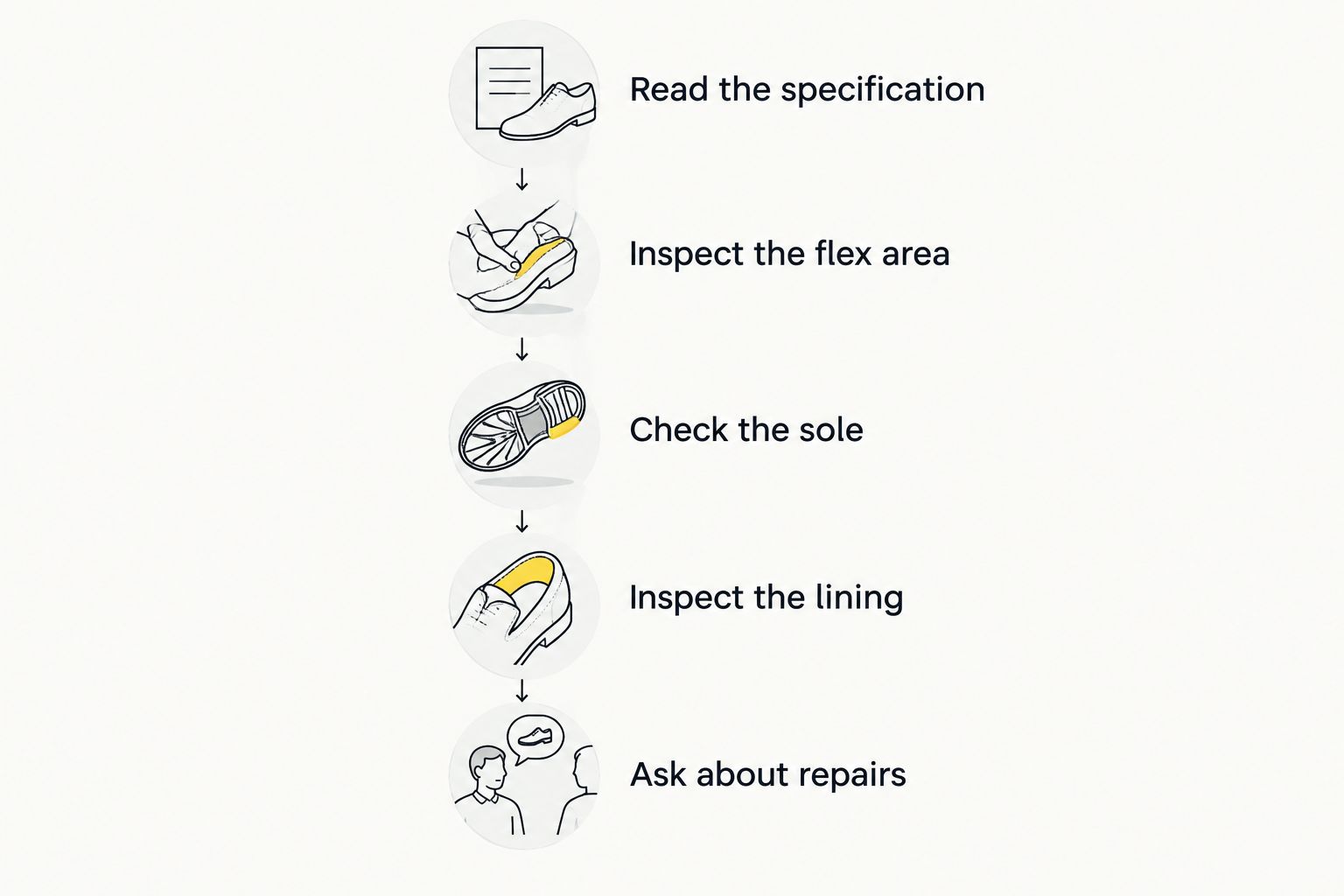
Use the same inspection for vegan and leather trainers. In 2026, photographs and product descriptions should help you identify the construction; they should not replace a fit check or an examination of the actual pair.
- Read the specification. Identify the upper, lining and outsole separately. If the description only says vegan or leather, ask for more detail before treating it as a durability claim.
- Inspect the flex area. Examine the forefoot for cracks, peeling, torn fabric or damaged stitching. On a used pair, distinguish normal creasing from broken material.
- Check the sole. Look at tread wear and the join around the shoe. Do not force the sole apart or sharply fold the trainer to test it.
- Inspect the lining. Check the heel, collar and interior seams. Damage inside the shoe matters even when the exterior photographs well.
- Ask about repairs. Establish whether the actual construction can be repaired. A general statement that trainers are repairable does not answer that question for your pair.
For a second-hand pair, request close photographs of the sole edge, forefoot and heel lining. A distant side view records the silhouette. It does not show all the places where the shoe wears.
For a new pair, inspect both shoes. Uneven joins, loose threads or visible damage deserve a closer look rather than an assumption that the material category explains them.
WHAT DOES THIS MEAN FOR ARCHIVE-LED FOOTWEAR?
Swear London is for archive-led footwear buyers who put silhouette and provenance first. Its made-to-order heritage footwear connects the archive to the broader question of keeping distinctive shoes in use.
The Air Rev. Xtra Vegan Platform Boots – Black are a vegan boot option built around an original stacked wedge. They are boots, not a matched trainer comparison. Their heritage construction story does not establish a measured lifespan against leather trainers.
For a Swear London vegan footwear purchase in 2026, assess the material description, fit and care requirements alongside the silhouette. The benefit is an archive-led design without an animal-leather upper; the limitation is that a vegan designation alone cannot establish wear performance or repair options.
That is the distinction to keep. Choose the design for its identity. Judge durability by the finished shoe. Neither handcrafted production nor archive provenance removes the need to inspect materials and construction.
WILL VEGAN TRAINERS LAST AS LONG WITH DAILY WEAR?
Vegan trainers can withstand daily wear, but daily wear is not a standardised workload. A short commute and a day spent walking place different demands on the same shoe.
Record what actually changes: tread, sole joins, heel lining and upper condition. That gives you a useful basis for judging your pair without turning an anecdote into a rule for all vegan footwear.
CAN LEATHER TRAINERS BE REPAIRED MORE EASILY?
Some leather surface damage is easier to treat than a peeling synthetic coating. Whole-shoe repairs still depend on the construction, condition and access to suitable replacement parts.
Ask a repairer about the exact fault. Repairing a lining, reattaching a sole and replacing an outsole are different jobs; none is guaranteed merely because the upper is leather.
DOES WATERPROOFING MAKE VEGAN TRAINERS LAST LONGER?
A compatible protective treatment can help with surface exposure, but it cannot fix worn tread, failing adhesive or a cracked coating. Use only products suitable for the stated upper material.
Water resistance also differs from waterproof construction. A surface that sheds droplets does not prove that water cannot enter through seams, openings or the sole join.
FAQ
Are vegan trainers as durable as leather trainers?
Vegan trainers can be as durable as leather trainers, but the material specification and construction decide the result. Compare the upper, outsole, lining and sole attachment rather than relying on either label.
Do all vegan leather trainers peel?
No, peeling is not an inevitable outcome for every vegan leather trainer. Coated uppers differ in formulation and construction; inspect lifting edges, cracks and separation from the backing.
Does leather always last longer than synthetic material?
No, leather does not automatically last longer than synthetic material. Leather quality and finish vary, and a trainer can become unusable through sole or lining damage before its upper fails.
Can I use leather conditioner on vegan trainers?
Use leather conditioner on vegan trainers only if the manufacturer explicitly recommends it for that material. A leather-like appearance does not establish that the surface needs conventional leather treatment.
How can I tell whether a crease is actual damage?
A crease bends an intact surface; a crack, tear or peeling edge breaks or separates the material. Inspect the area without sharply folding the shoe or pulling at the coating.
Are plant-based vegan trainers automatically more durable?
No, a plant-based ingredient does not establish the durability of the finished trainer. Check the complete material composition and construction rather than treating an ingredient name as performance evidence.
Does Swear London archive footwear need different durability checks?
Swear London archive footwear needs the same whole-shoe checks as other footwear: upper, sole, lining, fit and repair options. Heritage design explains the shoe's identity, not a guaranteed lifespan.
ONE LAST THING
Before cleaning your trainers in 2026, photograph the outsole and heel lining as well as the upper. Repeat that when you notice a change. You will have a record of where your pair is wearing, rather than relying on how clean it looks.
The part you polish is not always the part that ends the shoe's life. Keep an eye on the underside and the interior. That recommendation applies equally to vegan and leather trainers.