


Most vegan trainers are less breathable than leather trainers out of the box, because the upper is a solid polymer coating rather than a porous hide, but construction closes most of that gap. A vegan trainer with a mesh lining, a perforated panel, or an open-cell foam insole can match — sometimes beat — a poorly lined leather shoe. The vegan-or-leather label tells you less about airflow in 2026 than the lining, the insole, and whether the upper has any perforation at all.
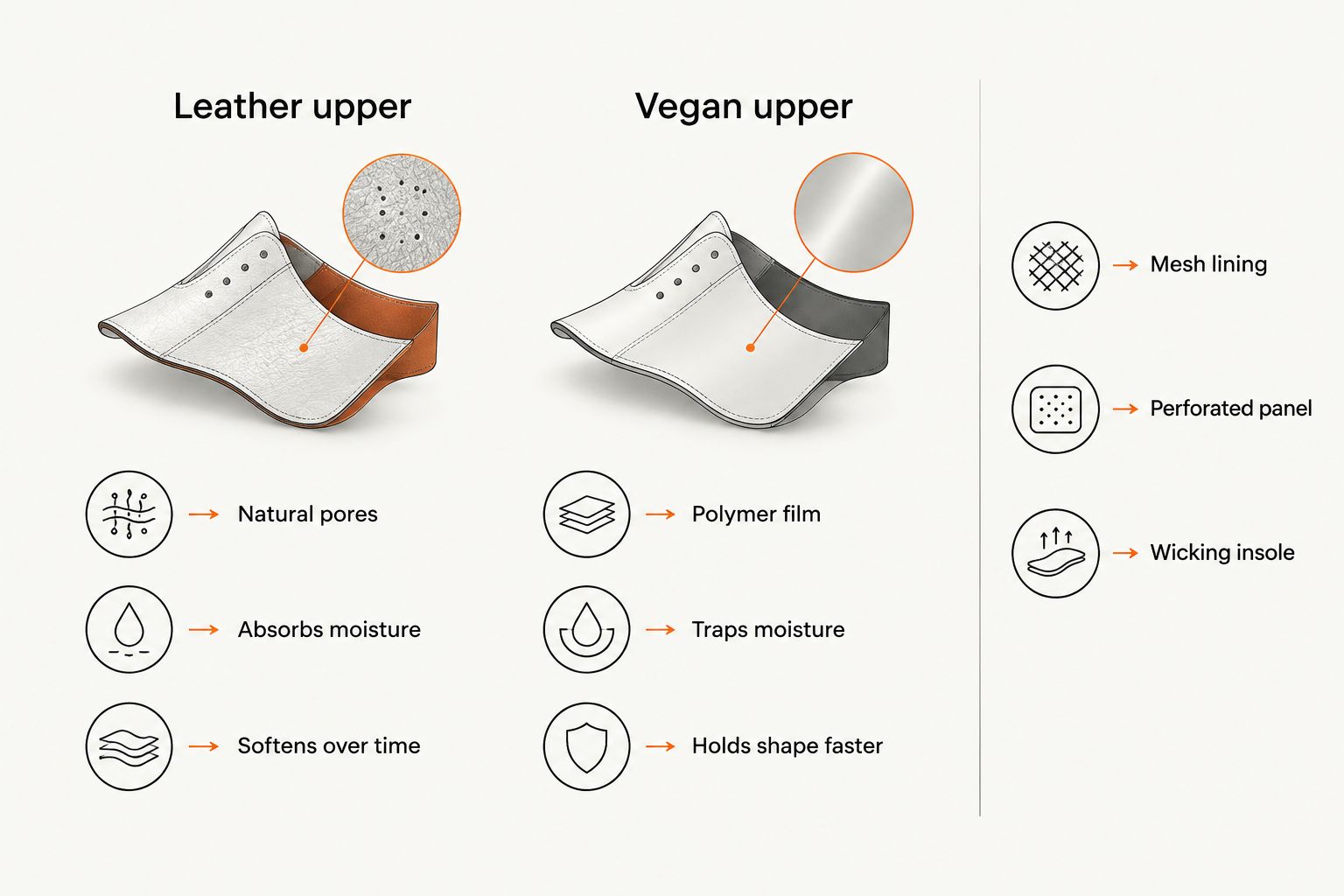
- Leather breathes naturally through microscopic pores; standard vegan leather (PU or PVC-coated) does not, so heat and moisture build up faster in a solid vegan upper.
- Mesh linings, perforated panels, and moisture-wicking insoles close most of the breathability gap between vegan trainers and leather trainers.
- SWEAR London's vegan platform boots use a stretch synthetic upper like most vegan footwear — lining and sock choice matter more than the vegan label alone.
- Buying decision for 2026: check construction details, not just the vegan/leather split, before judging how hot your feet will get.
WHY THIS MATTERS
Breathability isn't cosmetic. A trainer that traps moisture all day leads to sweaty feet, faster odour build-up, and a shoe that takes longer to dry between wears. For anyone comparing SWEAR London footwear against a leather alternative, the real question isn't "vegan or not" — it's what sits behind the upper.
Leather has been the default performance material for exactly this reason: it's a natural fibre structure with tiny pores that let air and moisture pass through. Standard vegan leather — polyurethane (PU) or PVC coated onto a fabric backing — is a continuous polymer film. Air doesn't move through it the way it moves through hide. That's a material-science fact, not a brand claim, and it applies to every vegan trainer on the market in 2026, not just one label.
ARE WOMEN'S VEGAN TRAINERS AS BREATHABLE AS LEATHER TRAINERS?
No, not by default — but the gap depends entirely on what's built around the upper. Here's how the two compare on the factors that actually decide how hot your feet get:
| Factor | Leather trainers | Standard vegan trainers | Vegan trainers with mesh/perforation |
|---|---|---|---|
| Upper structure | Natural pores, breathes passively | Solid polymer film, low natural airflow | Polymer upper + open panels for airflow |
| Moisture handling | Absorbs and releases sweat | Traps moisture against the foot | Lining wicks moisture away from panels |
| Break-in feel | Softens and shapes to foot over weeks | Holds shape faster, less give | Similar to standard vegan, plus airflow |
| Best for | Warm climates, all-day wear | Cooler climates, shorter wear | Warm climates, active daily wear |
A vegan platform boot like the Air Rev. Xtra vegan platform boots uses a stretch synthetic upper, which is standard construction for the category — not a breathability spec on its own. The lining and insole inside the shoe do more work for airflow than the upper material does.
WHY BREATHABILITY VARIES BETWEEN VEGAN TRAINERS
- Lining material — a mesh or cotton lining pulls moisture away from the foot even when the outer upper is sealed polymer.
- Perforation — small holes punched or laser-cut into the upper let air pass through a vegan material that otherwise wouldn't.
- Insole construction — an open-cell foam or breathable footbed matters more for all-day comfort than the upper on its own.
- Upper thickness and coating type — PU coatings tend to breathe better than heavier PVC coatings, which sit closer to a sealed surface.
- Climate and activity level — a sealed vegan upper feels fine on a cool day and uncomfortable on a warm one; leather narrows that swing.
- Sock choice — a wicking sock does more for a hot foot inside a vegan trainer than most people expect.
DOES A VEGAN PLATFORM SHOE FEEL DIFFERENT FROM A LEATHER ONE DAY TO DAY
Yes — a vegan platform trainer tends to feel warmer on a long day out and cooler within the first few wears before the upper has had any chance to soften, because it doesn't stretch and breathe the way leather does. That difference shrinks fast once a mesh lining or perforated panel is part of the build, which is standard on most current vegan sneaker construction in 2026.
Anyone weighing this trade-off against a made-to-order pair is also weighing fit and finish, not just airflow. The Air Rev. Xtra vegan platform boots sit on an original stacked-wedge mould, so the comfort question is as much about the sole geometry as it is about the upper material.


CAN YOU MAKE A VEGAN TRAINER MORE BREATHABLE AFTER BUYING IT
Yes, to a point — a wicking insole swap and a breathable sock do more for a sealed vegan upper than anything applied to the outside of the shoe. Leather-conditioning tricks don't transfer to vegan uppers because there's no natural fibre to treat; airflow on a vegan shoe comes from what's built in at the factory, not from aftercare.
IS VEGAN LEATHER LESS BREATHABLE THAN GENUINE LEATHER IN ALL CASES
No, not in all cases — a heavily perforated vegan upper with a mesh lining can outperform a leather shoe with a solid, unlined leather tongue and vamp. Material label alone in 2026 is a weaker predictor of comfort than lining, perforation, and insole construction combined.
For a deeper material-by-material breakdown across the current SWEAR range, the vegan trainers ranked by breathability guide compares construction details across styles rather than relying on the vegan/leather split alone.
FAQ
Are womens vegan trainers as breathable as leather trainers?
No, standard vegan trainers are generally less breathable than leather trainers because the upper is a sealed polymer film rather than a porous natural material. A mesh lining or perforated panel narrows that gap significantly.
Do vegan trainers make your feet sweat more?
A sealed vegan upper with no lining traps more moisture than leather, so yes, feet can sweat more in that specific construction. A vegan trainer with a wicking lining or perforated panel avoids most of that problem.
Is vegan leather as durable as real leather?
Durability depends on the coating type and how the shoe is used day to day, not on the vegan label alone. The full comparison sits in the guide on whether vegan leather is as durable as real leather.
How can you tell if a vegan trainer will run hot?
Check for a lining material, perforation, or an open-cell insole before buying — a fully sealed upper with a solid lining is the combination most likely to run warm. Reviews mentioning all-day wear are also a useful signal.
How do you spot genuine vegan leather in trainers?
Genuine vegan leather has a consistent coated texture with no natural grain variation, unlike hide. The full method sits in the guide on how to spot genuine vegan leather in trainers.
Do vegan boots smell more than real leather over time?
A sealed vegan upper without a wicking lining can hold odour longer than leather because trapped moisture has less chance to evaporate. Regular cleaning and rotation reduce this regardless of material.
Should you size up in vegan trainers for extra airflow?
Sizing up doesn't add breathability — it just changes fit and can affect how the platform sole sits underfoot. Airflow comes from lining and perforation, not from extra room.
Are platform vegan trainers less breathable than flat vegan trainers?
Platform height itself doesn't change breathability — the upper, lining, and insole decide that regardless of sole thickness. A platform sole changes stability and break-in feel, not airflow.
ONE LAST THING
The vegan-versus-leather breathability debate gets treated as settled when it isn't — construction beats material label every time in 2026. A perforated vegan upper with a mesh lining will out-breathe a sealed, unlined leather shoe, and that's the detail worth checking before assuming either material wins by default.