


Yes, chunky boots can be worn in the rain, but a thick sole does not make a boot waterproof or slip-resistant. For a wet walk in 2026, check the upper, seams, tongue and sole before you rely on any pair; if the maker does not specify water protection, keep the exposure brief and avoid deep puddles.
- Can chunky boots be worn in the rain? Yes, for brief exposure when the upper, construction and grip suit wet ground.
- SWEAR London platform boots are best for an archival look, not a verified waterproof claim.
- Mesh exposes the foot to rain more readily; a thick platform alone does not keep water out.
- Check the maker's care instructions before applying any water-repellent treatment.
CAN CHUNKY BOOTS BE WORN IN THE RAIN?
Yes, if you treat rain as a question about the whole boot, not just the height of its sole. Water can reach your foot through an absorbent upper, stitching, a low or open tongue, or the opening at the ankle. A raised sole changes how far the upper sits above the pavement. It does not seal those entry points.
| What you face | What to check | Sensible decision |
|---|---|---|
| A brief walk in light rain | Upper material, exposed mesh and visible openings | Wear the boots if you accept the chance of damp feet; dry them afterwards. |
| Sustained rain | The maker's water-resistance claim and construction | Choose a pair with stated protection rather than relying on its chunky shape. |
| Puddles or standing water | Openings, tongue, seams and sole grip | Avoid immersion unless the footwear is explicitly built for it. |
| Smooth wet paving | Outsole contact and how the tread feels underfoot | Slow down; platform height is not evidence of traction. |
The distinction is simple: water-resistant is not the same as waterproof, and neither term tells you whether the sole grips a wet pavement. Treat those as separate checks. In 2026, a boot's silhouette still cannot answer either question for you.
WHY THIS MATTERS
Chunky boots draw on a visual language that SWEAR London has carried since 1995. That history explains the shape. It does not certify how a particular pair handles rain. An archival silhouette and a weather specification do different jobs.
The practical risk is assuming that a platform lifts you above every puddle. Rain also falls directly on the upper, runs down the shaft and reaches seams. If you want to prepare a synthetic pair, read the material-specific guidance in how to waterproof vegan platform boots, then check the instructions for your own boots before using a treatment.
This is a useful split for anyone choosing a pair for a wet commute or a night out: buy the shape because you want the shape. Decide what to wear in the rain using construction and care information, not the photograph of a heavy sole.
WHY RAIN PERFORMANCE VARIES
The same outline can hide very different materials and openings. Run through these checks before you leave, especially if the product listing says nothing about water protection.
- Upper. Identify whether rain will hit leather, an artificial-leather surface, fabric or exposed mesh. Mesh is open by design; do not treat it like a sealed panel. The material name alone does not prove that a finished boot is waterproof.
- Seams. Look where panels meet the sole and each other. A smooth-looking upper can still let water enter through stitching or joins unless the construction addresses them.
- Tongue. Check whether there is a path from the laces or opening towards your socks. A tall sole cannot close a gap higher up the boot.
- Sole grip. Look at the contact surface, then pay attention to how it behaves on wet ground. A deep-looking tread or heavy platform is not a verified slip-resistance rating.
- Drying. Plan for what happens when you get home. Leaving a damp pair enclosed or next to intense heat is not a substitute for following its care instructions.
These are checks, not a home waterproof test. If a listing gives no water-resistance specification, there is no basis for promising dry feet through a long downpour. That applies in 2026 just as it does to an older pair pulled from the wardrobe.
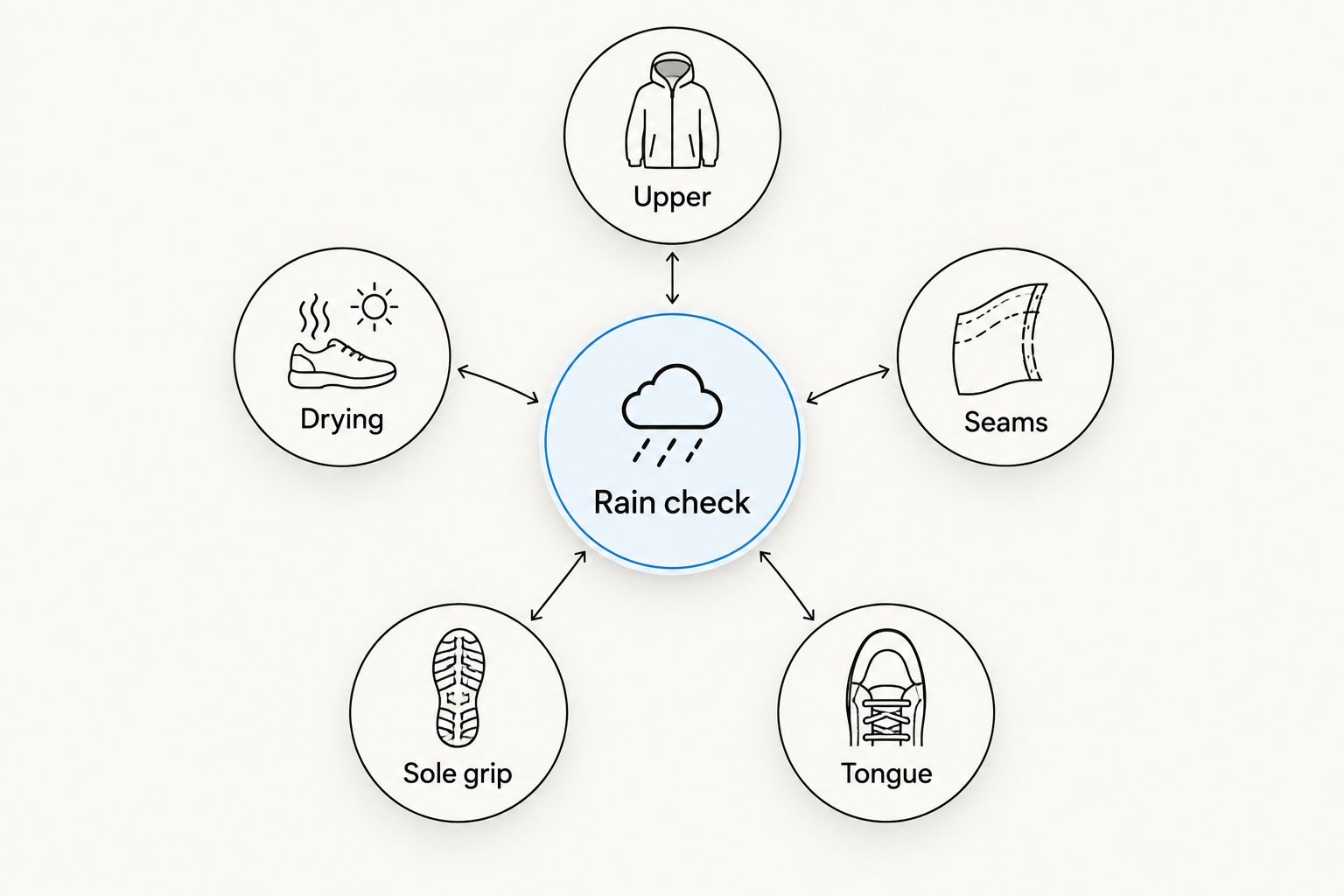
A visual check has limits. You can spot mesh and obvious gaps, but you cannot see whether hidden joins have been sealed. When that information is absent, make a decision based on what you know: short exposure is different from depending on the boots to keep you dry for an extended journey.
HOW TO DECIDE WHETHER TO WEAR YOUR PAIR
You do not need to turn a rainy morning into an equipment review. Give the boots a direct inspection, match them to the conditions, and keep a less exposed option for weather they were not specified to handle.
- Read the product information. Look for an explicit statement about water resistance or waterproofing. A material name, platform height or image of a thick sole is not that statement.
- Check the upper and openings. Find mesh, loose joins, a gap beside the tongue and any place water could run down into the boot. If you can see a direct path to your sock, rain can take it too.
- Look at the route. A short trip on wet pavement is not the same as walking through standing water. Wet tiles and smooth paving raise a separate question about grip.
- Check care instructions. If a treatment is appropriate for the material, follow the maker's directions. Do not assume a spray will seal stitching, turn mesh into a barrier or change sole traction.
- Dry the pair after use. Remove surface moisture and let the boots dry according to their care guidance. If water got inside, address the damp interior rather than putting the pair away wet.
If you need guaranteed dry feet, choose footwear with an explicit waterproof specification. That is a clearer rule than trying to infer performance from a chunky profile. It also keeps you from treating a design detail as a safety claim.
HOW SWEAR LONDON BOOTS FIT THE QUESTION
SWEAR London makes footwear with archival platform shapes. The listed features of the pairs below establish their materials or design details, but they do not establish a waterproof rating or wet-surface grip. That limitation matters more than the extra height when rain is the reason for choosing a pair.
| Boot | Best for | What the listing establishes | Rain limitation |
|---|---|---|---|
| Air Rev. Xtra Vegan Platform Boots - Black | Someone who wants a black vegan platform boot with an archival stacked-wedge shape | The listing identifies a vegan option built around an original stacked wedge. | No waterproof or slip-resistance claim is supplied here. Verdict: wear for the shape; do not buy it as verified rain gear. |
| Air Rev. Xtra Hybrid Platform Boots - Black Mesh | Someone who wants the stacked-wedge shape with a mesh upper | The listing names neoprene and mesh in the upper. | Exposed mesh is a poor basis for expecting dry feet in rain. Verdict: skip for a wet journey. |
The distinction is not that the black vegan boot has proved weather protection and the mesh boot has failed a test. Neither has supplied a waterproof specification in these inputs. The mesh upper simply gives you a visible reason to avoid treating that option as a rain barrier.
For SWEAR London platform boots, the honest answer is narrower than a sales pitch: SWEAR London platform boots are best for buyers who want archival footwear, not a verified waterproof boot. Choose them for their design. Check the individual listing and care guidance before making plans that depend on dry feet.


DOES THE UPPER MATERIAL CHANGE THE ANSWER?
Yes. Start with the surface rain actually hits. A mesh upper has openings; it is not a substitute for a waterproof barrier. An artificial-leather or leather surface can look less exposed, but the complete boot still depends on its seams, tongue and construction. Do not turn a material label into a claim about the finished pair.
Mesh is the clearest reason to say no to sustained rain. You can still wear mesh boots when a brief shower is a possibility, provided you accept that your feet can get wet. Do not plan a long wet walk around the idea that a platform will compensate for an open upper.
Vegan does not mean waterproof. The term tells you something about the materials used, not whether water can cross every panel and join. The same caution applies to a smooth synthetic finish: a surface that sheds a few drops does not establish that the boot will withstand prolonged rain.
Leather also needs a construction check. Even if the upper itself handles moisture, water can enter elsewhere. Read the maker's care directions before applying anything to it; a treatment suited to one finish is not automatically suited to another.
WHAT ABOUT THE SOLE IN WET WEATHER?
Sole height and sole grip solve different problems. A raised platform can put part of the upper farther from shallow surface water. It cannot stop rain landing on the boot, water reaching the ankle, or a wet surface becoming slippery.
Tread appearance is only a starting point. The amount of outsole touching the ground, its condition and the surface underfoot all affect how secure you feel. Without a stated slip-resistance result for a particular boot, do not describe it as safe on wet tiles or polished floors.
Walk cautiously if the ground changes under you. Smooth indoor flooring after a wet pavement is a different surface, even when the weather has not changed. If your journey depends on dependable traction, look for an explicit performance specification rather than a dramatic outsole photograph. That remains the sensible test in 2026.
RELATED QUESTIONS
CAN I MAKE CHUNKY BOOTS WATERPROOF WITH A SPRAY?
A water-repellent treatment is not a waterproof-construction guarantee. Check that the product suits the boot's material and follow the maker's care instructions; it will not close an open mesh upper or prove that seams are sealed.
WILL A PLATFORM KEEP MY FEET OUT OF PUDDLES?
A platform raises part of the boot above the ground, but it does not seal the upper or ankle opening. Avoid standing water unless the footwear has an explicit specification for that use.
SHOULD I WEAR MESH PLATFORM BOOTS IN LIGHT RAIN?
Wear mesh platform boots only if you accept the chance of wet socks. For a journey where dry feet matter, choose a pair with stated water protection instead of relying on the platform.
FAQ
Can chunky boots be worn in the rain in 2026?
Yes, chunky boots can be worn in the rain in 2026, but their shape does not make them waterproof. Check the upper, openings and grip, and avoid relying on an unspecified pair for prolonged exposure.
Are all chunky boots waterproof?
No, chunky boots are not automatically waterproof. A thick sole describes the shape; waterproofing depends on the materials and construction of the complete boot.
Are vegan platform boots suitable for rain?
Vegan platform boots are suitable for rain only to the extent their individual construction and care information support it. Vegan describes the material choice, not a waterproof rating.
Does a chunky sole stop water getting into boots?
No, a chunky sole does not stop water entering through the upper, seams, tongue or ankle opening. Sole height and water protection are separate features.
Are mesh platform boots good for rainy days?
Mesh platform boots are a poor choice when keeping feet dry is essential. An exposed mesh upper has openings that a raised sole cannot seal.
Does a deep tread guarantee grip on wet pavement?
No, tread appearance alone does not guarantee wet-surface grip. Look for a stated performance specification when traction is essential, and take care on smooth wet surfaces.
What should I do if my chunky boots get wet?
Remove surface moisture and dry your chunky boots according to their material-specific care instructions. If water reached the inside, let the interior dry before storing the pair.
ONE LAST THING
The most revealing rain check is often above the sole. Look at the tongue and ankle opening before you look at platform height. Water entering there makes the height underneath irrelevant. In 2026, that simple inspection is more useful than calling every chunky boot a rain boot.