


Yes, chunky trainers can be resoled, but only when the sole is built as a separate, replaceable layer. Cemented outsoles and stitched or welted soles both accept a fresh sole unit; a single molded platform block fused straight to the upper cannot be swapped out, so it has to be rebuilt or the shoe replaced outright. The detail most owners miss: the chunkier and more "festival-platform" a trainer looks, the more likely its sole is one fused piece rather than a separate layer a cobbler can remove.
- Chunky trainers can be resoled only when the sole is a separate cemented or welted layer, not one molded platform block.
- Molded unit-sole platforms, common on festival and dad-shoe style trainers, can only be rebuilt, not resoled.
- Check the seam where sole meets upper - a stitch or glue line means resole, a seamless block means rebuild only.
- Made-to-order brands like SWEAR London build chunky platform trainers under the same construction rules as any other maker.
WHY THIS MATTERS
More owners are asking this question in 2026 as chunky trainer and platform boot styles stay a wardrobe fixture rather than a passing trend. Knowing whether a sole is separable before paying for a quote saves a wasted repair fee and a wasted trip to the cobbler. Construction, not the brand printed on the box, decides whether resoling is even possible - brands built on a made-to-order, no-season model, like SWEAR London, sit inside this same construction debate as any other chunky trainer maker.
CAN CHUNKY TRAINERS BE RESOLED?
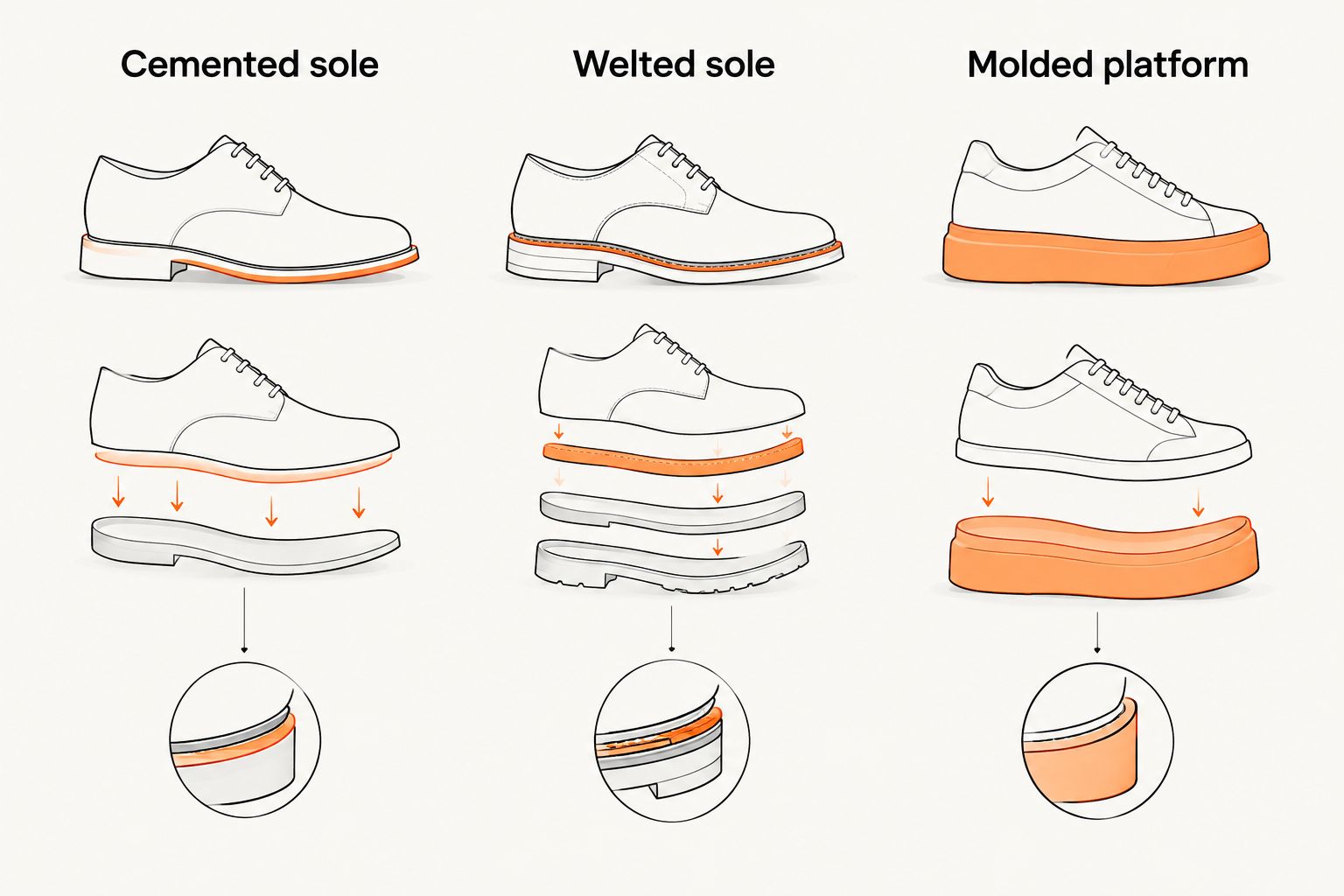
Whether a chunky trainer can be resoled comes down to three sole constructions. Check the seam where the sole meets the upper - a visible stitch line or a clean glue seam means a cobbler can pull the sole and replace it. A platform that looks like one continuous block of foam and rubber with no seam at all is a molded unit sole, and it wasn't built to come apart.
| Sole construction | Where it shows up | Can it be resoled? | Verdict |
|---|---|---|---|
| Cemented (glued) outsole | Most mass-market chunky trainers | Yes - outsole peels off and re-glues | Resole |
| Goodyear welt / stitched sole | Premium leather sneakers, some heritage boots | Yes - sole detaches without damaging the upper | Resole |
| Molded unit sole / fused platform | Festival and "dad shoe" style chunky trainers | No - platform is one piece with the midsole | Rebuild only |
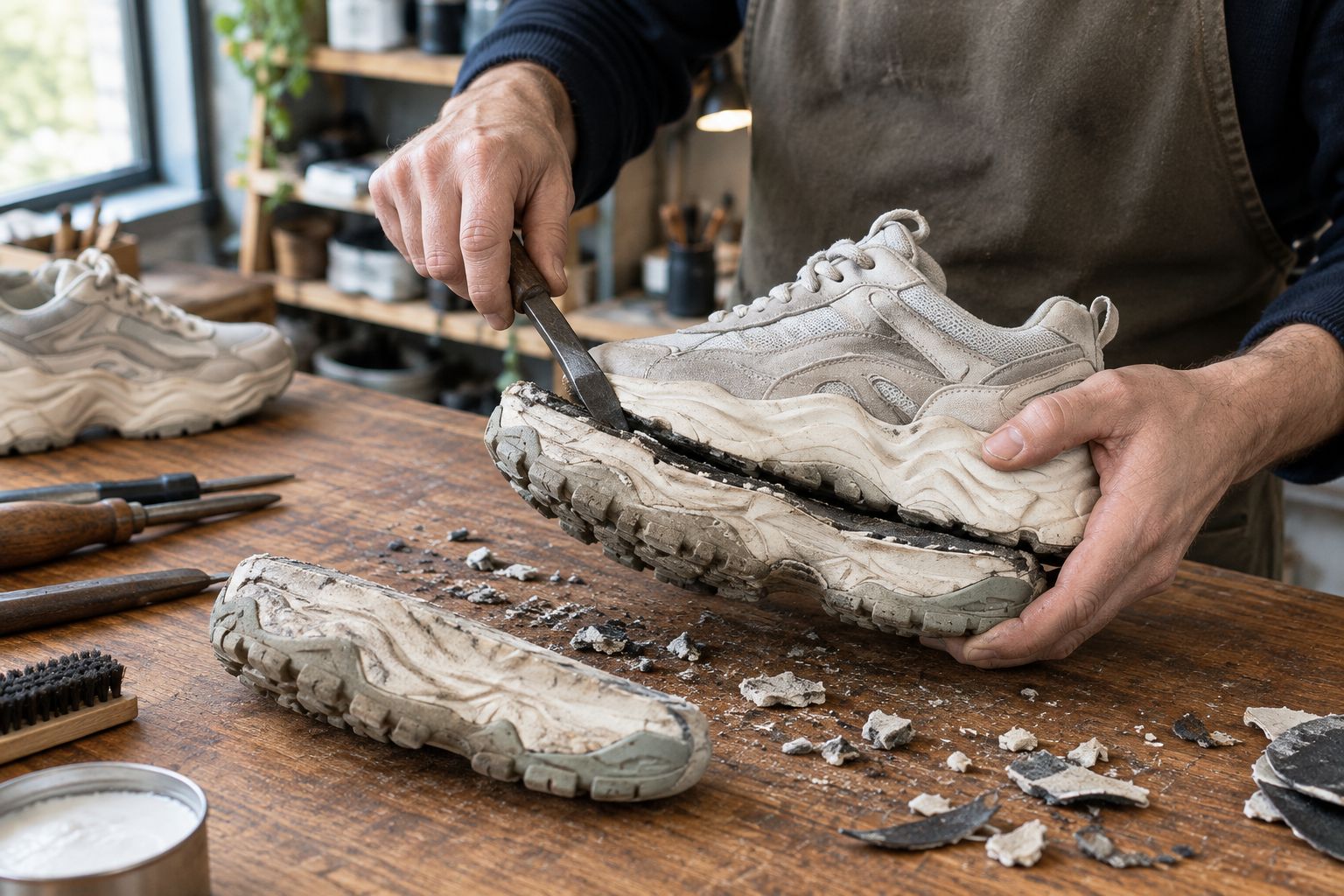
A cemented sole gets a straightforward resole: strip, re-cement, trim. A welted sole is the easiest repair of the three because the stitching was designed to be undone. A fused platform sole is the one that stops most cobblers cold - there's no seam to work with, so the only options are building up worn tread or replacing the whole unit if a matching blank exists.
WHY RESOLEABILITY VARIES BY CONSTRUCTION
- Sole material: dense EVA foam platforms bond permanently during molding; rubber-and-leather cemented soles don't.
- Adhesive type: contact cement releases with heat and solvent, the polyurethane bonds used in molded platforms don't.
- Whether the upper extends directly into the sole unit, as it does on most one-piece platforms.
- Wear pattern: a sole worn evenly is easier to rebuild than one worn through at a single point.
- Availability of a matching sole blank - a cobbler needs the recipe, not just the request.
Most cobblers run through how to resole platform boots as a checklist before agreeing to touch a chunky trainer, because the diagnosis step - separable sole or fused block - is identical on both.
HOW A COBBLER REBUILDS A MOLDED PLATFORM SOLE
- Inspect the upper for damage before touching the sole - a rebuild is pointless if the leather or textile is failing too.
- Strip what's left of the worn tread down to the firm platform base.
- Match or fabricate a replacement sole unit, either from a cobbler's stock blanks or a custom-cast piece.
- Bond and finish the new tread, then check flex and grip before wear.
This isn't a resole in the traditional sense - it's a rebuild, and it costs more cobbler time because there's no factory sole to order in. Some specialist repair shops decline the job outright and recommend replacement instead.
“If the platform is one molded block, there's no sole to swap - only a shoe to rebuild.”
SMILEY BLACK AND MADE-TO-ORDER CHUNKY TRAINERS
SWEAR London builds its platform trainers, including the SMILEY Black, to order rather than stocking bulk inventory - a model built around archive silhouettes reissued on original 1995 moulds rather than seasonal drops. That doesn't change the resole rules above; construction still decides whether any given pair can take a new sole. It does mean a pair bought without a season or discount cycle attached is one you're more likely to want repaired than replaced.
Shop platform trainers built to order
No season, no discount - archive silhouettes made to order.
DO PLATFORM BOOTS RESOLE THE SAME WAY CHUNKY TRAINERS DO?
Platform boots resole the same way chunky trainers do because the deciding factor is identical: whether the sole is a separate layer or one molded block fused to the upper. A knee-high platform boot with a stacked leather heel resoles like any welted shoe. A boot with a fused rubber platform faces the same rebuild-only limitation as a chunky trainer built on the same sole type.
IS IT WORTH RESOLING CHUNKY TRAINERS OR REPLACING THEM?
It's worth resoling chunky trainers when the upper is in solid shape and the sole is a separable cemented or welted type - the repair extends a shoe that's otherwise sound. It's not worth it on a fused platform sole nearing the end of its tread life, because a rebuild often costs more cobbler labor than the trainer's condition justifies. Skip the repair and replace when the upper shows the same wear as the sole.
HOW LONG DOES A REBUILT PLATFORM SOLE LAST COMPARED TO THE ORIGINAL?
A rebuilt platform sole typically lasts close to what the original tread delivered, provided the replacement rubber matches the original density and the bond is done correctly. It won't outlast a factory-molded sole built in one piece under heat and pressure, because a rebuilt sole is bonded after the fact rather than fused during manufacture. Ask the cobbler what tread compound they're using before committing to the job.
FAQ
Can chunky trainers be resoled at home?
Chunky trainers can be resoled at home only for minor cementing jobs on a separable outsole - contact cement and a clamp can reattach a lifting edge. A full sole replacement, or any work on a molded platform, needs a cobbler with the right tools and matching sole stock.
What is the difference between resoling and rebuilding a sole?
Resoling removes an existing separable sole and replaces it with a new one of the same type. Rebuilding adds material to a worn sole that can't be removed, which is the only option on fused platform trainers.
Do all chunky trainers have molded platform soles?
No, not all chunky trainers have molded platform soles - some use a thick cemented outsole that looks bulky but detaches cleanly. Checking for a seam at the upper-to-sole join is the fastest way to tell before assuming a repair isn't possible.
How much wear should a chunky trainer sole show before resoling?
A chunky trainer sole is ready for resoling once the tread pattern flattens in the high-contact zones, typically the heel strike and forefoot, and grip noticeably drops on smooth or wet surfaces. Waiting past that point risks wearing into the midsole foam, which a resole can't fix.
Is resoling cheaper than buying a new pair of chunky trainers in 2026?
Resoling is usually cheaper than buying a new pair of chunky trainers in 2026 when the shoe has a separable sole and a sound upper, since only the tread layer needs replacing. It's rarely cheaper once a rebuild is required, because rebuild labor on a fused platform can approach the cost of a comparable new pair.
Can a cobbler match the original tread pattern on a chunky trainer?
A cobbler can often match the original tread pattern on a chunky trainer when a compatible sole blank exists in their stock, but exact matches aren't guaranteed on niche or discontinued platform designs. Ask to see the blank before the job starts, not after.
Does resoling affect the fit of chunky trainers?
Resoling shouldn't affect the fit of chunky trainers when the new sole matches the original thickness and shape, since the upper and lacing stay untouched. A rebuild can add a few millimeters of height if the cobbler pads the base to restore lost tread depth.
ONE LAST THING
Most cobblers will run the seam test in under a minute, for free, before quoting anything - run a fingernail along the join where the sole meets the upper before you ever book a resole. A visible stitch or a clean glue line means yes, a smooth seamless block means the shoe is heading for a rebuild quote or retirement, not a resole, in 2026 or any other year.