


Yes. Chunky trainers can cause knee pain when their weight, stiffness or fit changes how you walk, although the shoe is rarely the only factor. In 2026, the useful question is whether the pain starts with a specific pair, settles without it and returns when you wear it again.
- Yes: can chunky trainers cause knee pain? Poor fit, added weight and stiff soles can all contribute.
- Heel slip, limited sole flex and an unstable foot position can change how force reaches the knee.
- Stop wearing the pair if pain builds, alters your walk or continues after the shoes come off.
- SWEAR London is best for made-to-order heritage footwear, not as a treatment for knee pain.
WHY THIS MATTERS
Knee pain turns a footwear choice into a movement problem. If a trainer makes you shorten your stride, turn your foot out or avoid bending one knee, continuing to wear it reinforces the altered pattern.
A chunky silhouette is not automatically bad for your knees. The decisive points are fit, sole behaviour, total weight and what you ask the shoe to do. Start with the practical criteria in this guide to platform trainers for bad knees, then judge the individual pair on your own feet.
CAN CHUNKY TRAINERS CAUSE KNEE PAIN?
Yes, chunky trainers can cause or aggravate knee pain when their construction changes your normal gait. A thick sole can reduce your sense of the ground, while a rigid platform can limit the way your foot rolls from heel to toe. Extra shoe weight also increases the effort needed to swing and control the leg.
None of those features proves that a trainer will hurt you. A secure, well-fitting pair can feel stable. A lighter-looking trainer with heel slip or poor width can cause more compensation than a visually heavier design.
| Trainer characteristic | How it can affect movement | What to check |
|---|---|---|
| Stiff platform sole | Restricts natural heel-to-toe movement | The sole bends where your forefoot bends |
| Added shoe weight | Makes the leg work harder through repeated steps | Your stride stays natural as walking time increases |
| Loose heel | Lets the foot lift and slide inside the shoe | The heel stays secure without painful pressure |
| Narrow forefoot | Crowds the toes and encourages compensation | Toes lie flat and can spread naturally |
| Unstable upper | Allows side-to-side movement over the sole | The foot remains centred during turns |
| Unevenly worn outsole | Creates an uneven base under the foot | The sole sits flat and wear is not heavily one-sided |
The shoe-pain link is strongest when one pair reliably starts the symptoms and removing that pair reliably settles them. That pattern is useful evidence, not a diagnosis. Persistent or severe pain needs assessment rather than another footwear experiment.
WHAT DOES TRAINER-RELATED KNEE PAIN FEEL LIKE?
Trainer-related irritation usually appears during walking, after prolonged standing, on stairs or shortly after the shoes come off. It can feel like an ache around the front or sides of the knee, stiffness after sitting, or discomfort that builds as your stride becomes less natural.
The location alone does not identify the cause. Knee pain can come from the joint, surrounding tendons, an existing injury or movement elsewhere in the leg. A trainer can expose the problem without being its sole source.
Watch the sequence instead:
- The discomfort starts after you put on one particular pair.
- It increases as you walk or stand in that pair.
- You begin shortening one stride or shifting weight to the other leg.
- The pain reduces when you return to footwear that previously felt comfortable.
- The same discomfort returns when you retry the chunky trainers.
In 2026, that repeatable pattern is more useful than assuming every thick sole has the same effect. Different pairs distribute weight, flex and hold the foot differently.
WHY KNEE PAIN VARIES BETWEEN CHUNKY TRAINERS
The silhouette gets the blame because it is visible. The less obvious details usually decide how the shoe behaves.
- Overall weight. A heavy trainer demands more effort whenever you lift, swing or slow the foot. Fatigue then makes movement less controlled.
- Sole stiffness. A sole that does not flex with your forefoot changes the roll-through phase of walking. You can compensate at the ankle, hip or knee.
- Heel security. Heel lift forces your toes and lower leg to work to retain the shoe. That changes the chain of movement above the foot.
- Width and volume. A cramped forefoot or excessive internal space stops the foot sitting naturally. Tight lacing does not correct a fundamentally unsuitable shape.
- Platform stability. A broad, level base feels different from a sole that lets the foot tip sideways. Turns, kerbs and uneven ground expose that difference quickly.
- Existing sensitivity. Previous knee pain, weakness or an unresolved injury reduces your tolerance for any footwear that changes your gait.
Walking context matters too. A pair that feels controlled on a short, level route can feel very different on stairs, slopes or broken pavement. Test the conditions you actually use, not just the mirror.
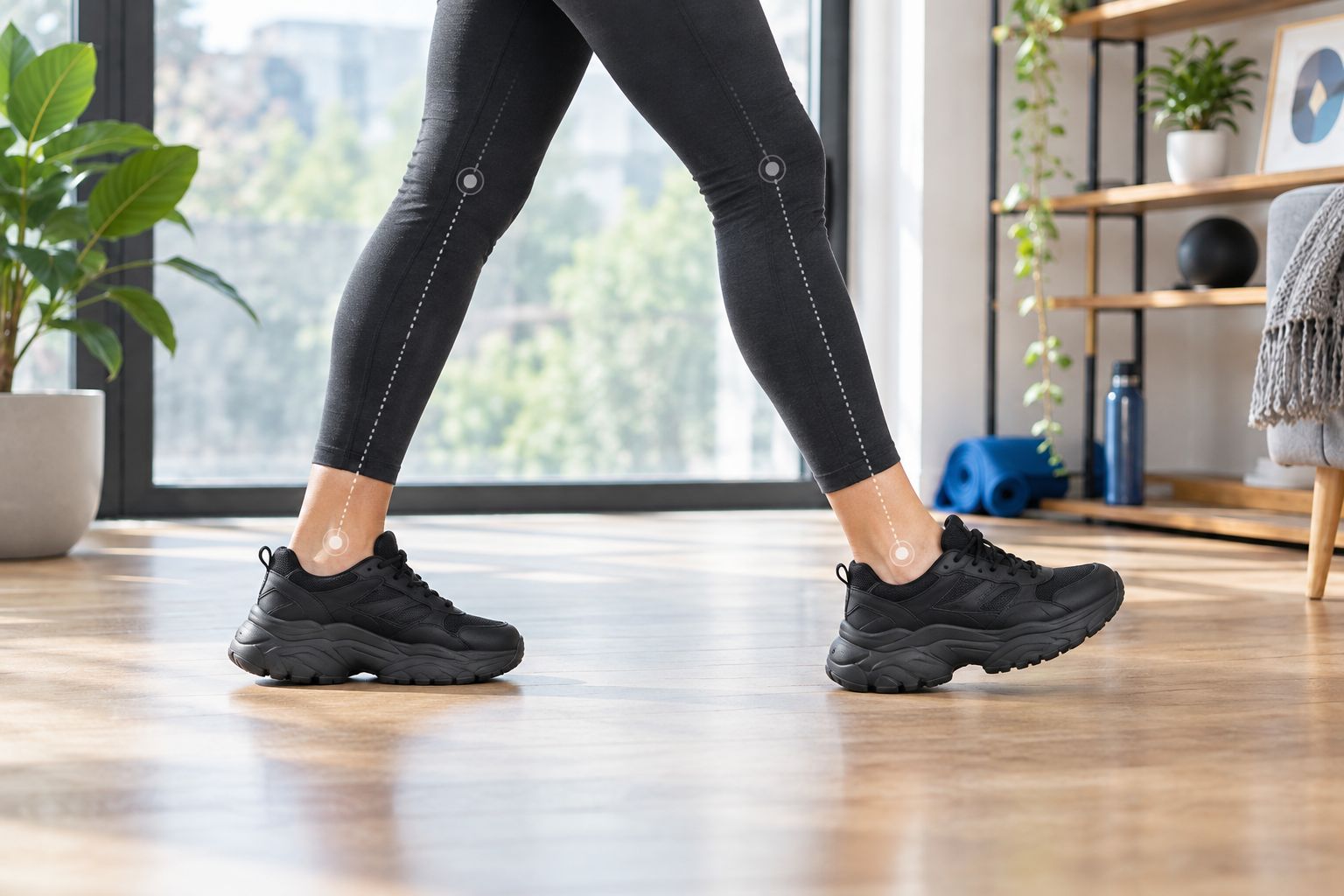
HOW TO CHECK WHETHER THE TRAINERS ARE THE PROBLEM
Start with comparison, not endurance. Wear the chunky pair on a familiar indoor route, then repeat the same movements in shoes that do not normally cause discomfort. Keep the pace and task similar.
Use this sequence:
- Check the standing position. Your weight should feel centred rather than pushed towards the inner or outer edge of either foot.
- Walk at your normal pace. Do not consciously correct your stride to make the trainers work. A shoe that requires performance is already giving you an answer.
- Turn in both directions. The foot should stay centred over the sole without sliding or tipping.
- Use stairs carefully. Pay attention to control while descending, when the knee manages your body weight as you lower yourself.
- Inspect the fit afterwards. Look for heel movement, compressed toes, pressure marks and laces tightened hard enough to distort the upper.
- Compare how your knees feel later. Pain that remains after the shoes come off deserves more caution than brief awareness of an unfamiliar sole.
Do not use pain as a break-in tool. Mild upper stiffness is different from joint pain, limping, swelling or a worsening ache. If the shoe changes your walk, stop the test.
A secure fit has four basic signs:
- The heel stays in place without rubbing.
- The toes lie flat and have room to move.
- The widest part of the foot aligns with the widest part of the trainer.
- The foot remains stable when you turn or step down.
Insoles and lacing can refine a close fit. They cannot make the wrong width, unstable base or unsuitable sole movement right.
BROWSE HERITAGE FOOTWEAR
See SWEAR London's made-to-order heritage trainers and boots.
SHOULD YOU BREAK IN CHUNKY TRAINERS?
Break in the upper gradually if it feels firm but the shoe otherwise fits. Do not try to break in knee pain. Joint discomfort is not evidence that a platform needs more miles before it becomes suitable.
Begin indoors and keep the first outings familiar. Stop when your stride changes, the foot slides or the knee starts aching. Check the outsole as well: debris, damage and uneven wear can change how a broad platform contacts the ground.
A break-in period also will not correct the wrong size. If your heel lifts, your toes curl to grip or your forefoot feels compressed, more wear usually gives the same structural problem a longer audience.
WHEN SHOULD YOU STOP WEARING THE PAIR?
Stop wearing the trainers when pain builds during use, remains after use or makes you limp. Switch to footwear that previously allowed comfortable movement and avoid repeatedly recreating the trigger.
Seek medical advice if the pain persists for a few weeks, keeps returning or affects ordinary activity. NHS guidance also treats marked swelling, an inability to put weight on the knee, locking, giving way, deformity, or heat and redness with fever as reasons to seek prompt help. Use NHS 111 when you need urgent guidance and 999 for a life-threatening emergency.
Do not diagnose the problem from the shoe alone. A clinician or qualified physiotherapist can assess the knee, your gait and whether another part of the leg is contributing.
WHERE SWEAR LONDON FITS
SWEAR London chunky trainers sit in an archival footwear context rather than a clinical one. The brand makes heritage sneakers and boots to order, including silhouettes reissued on original 1995 moulds. That history explains the shape. It does not determine whether the shape suits your knees.
The SMILEY Black is a relevant reference if you are considering a pronounced heritage silhouette. Inspect the current construction information, choose from the options shown on the product page and apply the same fit test described above.
The benefit is clear: you get a distinct made-to-order design rather than footwear built around a passing trend. The limitation is equally clear: handcrafted construction is not a medical feature, and made to order does not mean clinically fitted to your gait.
SWEAR London is best for fashion-conscious wearers who want heritage platform trainers and will judge fit before distance. Anyone seeking footwear to manage diagnosed knee pain should put clinical advice ahead of silhouette.
ARE LIGHTER CHUNKY TRAINERS BETTER FOR KNEES?
Lighter chunky trainers reduce the mass you move with each step, but weight alone does not decide knee comfort. A light pair with poor heel hold, inadequate width or an unstable sole can still alter your gait.
Compare total feel rather than trusting appearance. Some large soles are less heavy than they look, while dense materials can make a less dramatic trainer feel demanding over distance.
CAN A THICK CUSHIONED SOLE REDUCE KNEE PAIN?
A thick cushioned sole can soften how impact feels, but softness does not guarantee stability or suitable movement. Excessively soft foam can feel unstable, while a rigid cushioned platform can still restrict heel-to-toe roll.
In 2026, cushioning is one criterion rather than a verdict. Fit, control and the way your knee responds during normal use remain decisive.
CAN INSOLES FIX KNEE PAIN FROM CHUNKY TRAINERS?
Insoles can adjust comfort or support when the trainer already fits correctly. They do not reliably fix excessive heel movement, insufficient width, an unstable platform or a shoe that is too small.
An added insole also takes up internal space. If it raises your heel or crowds the forefoot, it can create another fit problem while attempting to solve the first one.
FAQ
Can chunky trainers cause knee pain in 2026?
Yes, chunky trainers can cause or aggravate knee pain when their weight, stiffness or fit changes your gait. The link is strongest when symptoms start with one pair, settle without it and return when you wear it again.
Are platform trainers bad for your knees?
Platform trainers are not automatically bad for your knees. A secure fit and stable sole can feel controlled, while heel slip, poor width or limited sole flex can create compensatory movement.
Can heavy shoes make your knees hurt?
Heavy shoes can increase the effort needed to swing and control the leg. Fatigue can then shorten your stride or reduce control, especially during longer periods of walking or standing.
How should chunky trainers fit?
Chunky trainers should hold the heel, leave the toes flat and keep the foot centred over the sole. You should not need to curl your toes or overtighten the laces to retain the shoe.
Should I keep wearing new trainers if my knee hurts?
No, stop wearing new trainers if knee pain builds, changes your walk or continues after the shoes come off. Joint pain is not a normal break-in target.
Can insoles make chunky trainers safer for bad knees?
Insoles can refine support in a trainer that already fits, but they cannot correct the wrong size, width or platform stability. Clinical advice comes first when knee pain is persistent or diagnosed.
When should knee pain be checked by a clinician?
Seek medical advice when knee pain persists for a few weeks, repeatedly returns or limits normal activity. Get prompt help for severe pain, marked swelling, deformity, inability to bear weight, locking, giving way, or heat and redness with fever.
ONE LAST THING
Test the descent, not just the entrance. Walking down stairs demands controlled lowering at the knee, so a shoe that feels acceptable on level ground can reveal poor stability there first.
Use a handrail and stop if you feel unsteady. In 2026, the right SWEAR London trainer is the one that keeps your movement recognisably yours. The silhouette can be loud. Your knees do not need to join in.