


Yes, vegan trainers can be worn in wet weather when their construction suits the conditions; the vegan label alone does not make them waterproof. For rain, check the upper, seams, openings and outsole, and choose footwear explicitly designed for wet conditions when you need dependable protection.
- Can vegan trainers be worn in wet weather? Yes, but vegan materials do not establish waterproof performance.
- Water resistance and wet-surface grip are separate checks; a dry foot does not guarantee secure footing.
- Swear London suits archive-footwear buyers; assess each vegan model’s rain suitability separately.
- Follow material-specific care instructions, avoid soaking, and let wet trainers dry before wearing them again.
CAN VEGAN TRAINERS BE WORN IN WET WEATHER?
Yes, but match the shoe to the exposure, not just the material label. A short walk through light rain is different from standing outside in sustained rain or walking through puddles. Your route matters as much as the forecast.
Use this 2026 guide to separate occasional rain wear from footwear you can rely on throughout a wet day. For cleaning and drying after the walk, see how to care for vegan trainers.
| Conditions | Best for | Advantage | Limitation | Recommendation |
|---|---|---|---|---|
| Light rain with shelter nearby | Short journeys with an indoor destination | You can limit exposure and dry the shoes afterwards | Water can still enter through openings or seams | Check the shoe’s specification and condition before wearing |
| Sustained rain | Footwear with an explicit waterproof specification | Waterproof construction addresses water entry rather than appearance alone | Rain can still enter over the collar | Choose a documented wet-weather design |
| Standing water or flooded paths | Avoiding the water or using purpose-built footwear | Keeps ordinary trainers out of conditions beyond their intended use | A trainer’s upper and openings remain vulnerable to immersion | Do not rely on an ordinary vegan trainer |
There is no category-wide safe exposure time. A vegan trainer with an open mesh upper and a waterproof vegan walking shoe are not interchangeable. Neither the word vegan nor the thickness of the sole settles the question.
WHY THIS MATTERS
Vegan footwear describes a material choice. Wet-weather performance describes how the whole shoe behaves when water reaches it. Confusing the two turns a useful shopping label into a promise it does not make.
For Swear London, the relevant connection is archive footwear and deliberate ownership: choosing a silhouette you want to keep wearing, then caring for it according to its construction. Swear London is best for buyers seeking made-to-order heritage footwear, not buyers choosing solely on a waterproof claim.
In 2026, use the same rule for any footwear purchase: buy the design for its stated purpose. If keeping your feet dry throughout a wet commute is essential, make waterproof construction a requirement before considering colour or shape.
WATER-RESISTANT IS NOT THE SAME AS WATERPROOF
Water-resistant footwear offers some resistance to water penetration. Waterproof footwear is designed to prevent water entering under its stated conditions of use. Neither term should be inferred from a smooth finish or a substantial-looking sole.
Read the wording carefully. A water-resistant upper is a statement about one part of the shoe, not necessarily the assembled trainer. Stitching, the tongue, closures and the join between the upper and sole all deserve attention.
Water entering over the collar is another issue entirely. Even a waterproof shoe cannot keep out water that flows through its opening. Avoid puddles rather than treating a product description as permission to step into them.
A vegan claim is not a waterproof claim. Keep those checks separate when reading product information in 2026, particularly when a description concentrates on styling, heritage or material feel.
WHY WET-WEATHER SUITABILITY VARIES
These factors explain why vegan trainers behave differently in rain. Assess the complete shoe rather than trying to rank every vegan material under one label.
- Upper construction. Open mesh, perforations and exposed fabric create different routes for water from a continuous coated surface. A smooth appearance alone does not establish protection.
- Seams and joins. Stitching and upper-to-sole joins are potential entry points. Waterproof performance depends on how those areas are constructed, not whether they look substantial.
- Tongue and collar. Water can enter around an ordinary tongue or through the shoe opening. Upper protection does not close those gaps.
- Outsole and condition. Wet-surface grip depends on the sole, the surface and contaminants. Worn tread or trapped debris deserves attention before you leave.
- Exposure. Light rain, repeated splashes and immersion are different demands. A route with shelter gives you different options from a long walk with nowhere to stop.
- Care and damage. Cracking, peeling or a separating sole join calls for inspection. A protective treatment does not repair damaged construction.
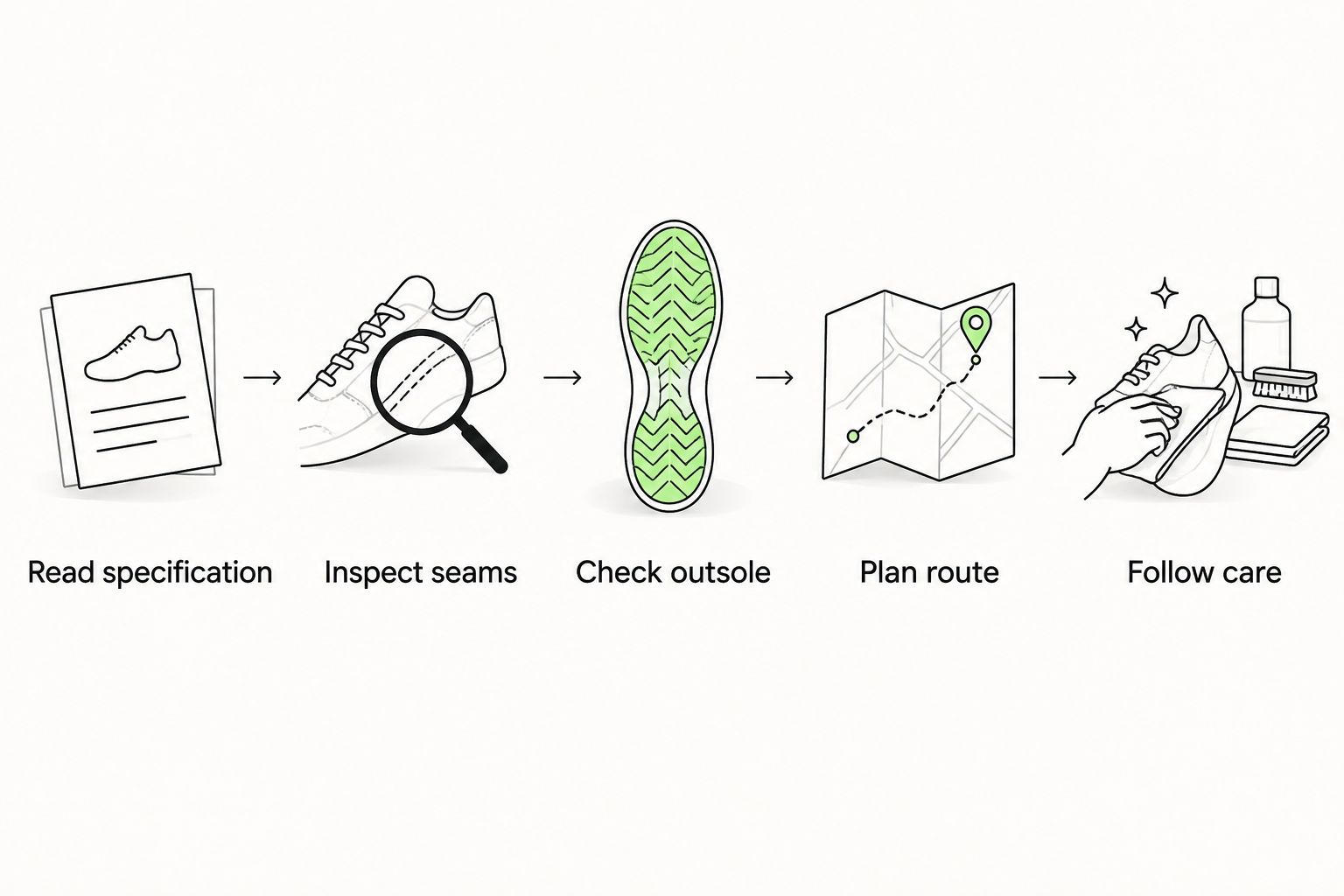
HOW DO YOU CHECK VEGAN TRAINERS BEFORE A WET WALK?
Use these checks before heading out. They organise the decision; they are not a substitute for a manufacturer’s waterproof specification or slip-resistance information.
- Read specification. Look for an explicit statement about waterproofing or water resistance. Check whether it refers to the upper alone or the complete shoe, and read the care instructions alongside it.
- Inspect seams. Examine the upper, stitching and sole join for visible damage. Do not take peeling, cracks or separation as cosmetic issues when deciding whether to expose the pair to rain.
- Check outsole. Remove loose dirt and debris using the recommended cleaning method. Inspect wear, and do not assume a chunky sole provides dependable grip on wet surfaces.
- Plan route. Consider shelter, puddles, steps and slick flooring at your destination. Choose a different pair when the journey demands protection your trainers do not explicitly offer.
- Follow care. Know how you will clean and dry the shoes afterwards. Avoid improvising with a spray, washing machine or heat source simply because the upper is synthetic.
The useful outcome is a clear decision: wear the pair within its stated use, or choose footwear better suited to the conditions. Do not perform a soaking test on a shoe that was never intended for immersion.
DOES A PLATFORM SOLE KEEP YOUR FEET DRY?
A platform raises the foot above the ground. It does not seal the upper, tongue or collar. Water can reach those areas through rain and splashing regardless of how substantial the sole looks.
Grip needs a separate judgement. A tall sole is not evidence of slip resistance, and a pronounced tread pattern is not a guarantee on every wet surface. Take particular care where the ground changes from pavement to smooth entrance flooring.
For platform footwear in 2026, keep height and weather protection in separate columns when shopping. Choose the height for the silhouette and how you walk in it. Choose rain protection from explicit construction information.
Do not use a wet journey to discover whether an unfamiliar platform feels stable. Get used to the shoe on dry ground first, and use another pair when the route or conditions exceed your confidence in it.
WHERE VEGAN ARCHIVE BOOTS FIT
Swear London’s vegan archive footwear gives you a design choice, not a shortcut around weather checks. The models below are relevant if you are considering a boot silhouette instead of a trainer. Their stated design features should not be read as waterproof specifications.
| Model | Stated design feature | Best for | Advantage | Rain-use limitation |
|---|---|---|---|---|
| Air Rev. Xtra Vegan Platform Boots - Black | Gothic-inspired design built around an original stacked wedge | Buyers seeking a gothic-inspired vegan platform silhouette | Connects a vegan option with the archive wedge design | The design description does not establish waterproofing or wet-surface grip |
| Air Revive Vegan Boots - Triple Black | Original stacked wedge with a soft stretch artificial leather upper | Buyers seeking a vegan boot with a stretch artificial leather upper | Gives a stated upper material and archive-derived shape | An artificial leather upper alone does not establish whole-shoe water protection |
Choose either model for its stated design features, then verify its suitability for your intended conditions. If prolonged rain protection is the deciding factor, ask about that directly rather than inferring it from the boot shape.
Neither model should be presented as an all-weather alternative on the basis of its name. A boot and a trainer can share the same practical limitation: water has access wherever the construction leaves an entry point.
CAN YOU USE PROTECTOR SPRAY ON VEGAN TRAINERS?
Use protector spray only when both the footwear instructions and the treatment instructions confirm compatibility with the upper. Vegan footwear includes different materials, so a treatment suitable for one pair is not automatically suitable for another.
Check whether the instructions cover coated artificial leather, textiles or the specific material named for your shoe. If the treatment calls for a hidden-area test, follow it before treating a visible surface. Do not substitute a leather treatment merely because the trainer resembles leather.
Protector spray does not turn every trainer into waterproof footwear. A surface treatment does not close an open collar or repair a separating sole join. Follow the stated application and drying instructions rather than inventing a routine.
WHAT SHOULD YOU DO WHEN VEGAN TRAINERS GET WET?
Follow the manufacturer’s care instructions first. Remove surface moisture with a soft cloth where that method is permitted, loosen the laces and let the shoes dry with ventilation. Remove insoles only if they are designed to come out.
Keep wet trainers away from direct heat unless the care instructions explicitly allow a drying method that uses it. Do not use a radiator, hairdryer or tumble dryer as an improvised shortcut. Material-specific instructions take priority over generic trainer advice.
Clean dirt with the recommended method rather than scrubbing harder or soaking the shoe. Let the pair dry before wearing or storing it, and check the inside as well as the outside. A dry-looking upper does not tell you whether the lining is still damp.
Before the next wear, inspect the upper and sole join again. If you find lifting, peeling or other damage, seek suitable repair advice. Continuing to expose a damaged pair to water is not a care strategy.
ARE VEGAN TRAINERS BETTER THAN LEATHER TRAINERS IN RAIN?
Neither category is automatically better in rain. Material, construction, condition and intended use determine the useful comparison. Vegan status and animal-leather content do not establish a whole-shoe waterproof specification.
Compare like with like: upper coverage, seam construction, openings, outsole information and care requirements. Reject a comparison that treats every artificial leather as identical or every leather trainer as waterproof.
For a 2026 buying decision, ask which specific shoe suits your journey. That question produces a more useful answer than asking which entire material category wins.
FAQ
Can vegan trainers be worn in wet weather every day?
Vegan trainers can be worn in wet weather when the specific shoe is suitable for that use. For repeated rain exposure, check its waterproof specification, outsole information and care instructions, and let it dry between wears.
Are vegan leather trainers automatically waterproof?
Vegan leather trainers are not automatically waterproof. A coated upper does not establish water protection at seams, joins, the tongue or collar.
Will rain ruin my vegan trainers?
Rain does not automatically ruin vegan trainers. Follow the pair’s care instructions after exposure, and inspect it for damage before wearing it again.
Can I wear vegan trainers through puddles?
Do not rely on ordinary vegan trainers for walking through puddles. Water can enter through openings and construction points, so avoid standing water unless the footwear is explicitly designed for those conditions.
Does a chunky sole stop me slipping in the rain?
A chunky sole does not establish slip resistance. Check the specific outsole information, keep it clean and take care on wet or contaminated surfaces.
Can I dry wet vegan trainers on a radiator?
Do not use a radiator unless the footwear’s care instructions explicitly permit that drying method. Follow the recommended process and avoid improvised direct heat.
Are Swear London vegan platform boots a replacement for rain boots?
Do not treat Swear London vegan platform boots as rain boots based on their vegan label or platform shape. Verify the specific model’s weather protection before relying on it in sustained rain.
ONE LAST THING
Dry feet and secure footing are separate requirements. A shoe can resist water yet still be unsuitable for the wet surface under it. Check both before leaving, especially when your route ends at smooth indoor flooring.
Keep the archive silhouette. Change the footwear when the conditions demand it. That is deliberate ownership, not a compromise in taste.