


Best overall: a roomy, secure-fitting chunky Chelsea boot. Best for wide feet: a genuinely wide-fit Chelsea. Best for sensitive ankles: a Chelsea with a soft, lined opening. Best for a statement silhouette: a platform Chelsea that passes your walking checks. This 2026 guide ranks buying configurations by comfort priorities, not by unverified scores; start with the broader chunky Chelsea boots guide if you are still choosing the silhouette.
- Chunky chelsea boots ranked by comfort should prioritise toe room, heel security and an unrestricted stride.
- Wide-fit Chelsea boots are the first option to assess when standard widths squeeze your forefoot.
- Swear London platform boots offer an archive-led alternative, not an automatic Chelsea comfort upgrade.
- Reject persistent pressure or slipping before committing to a chunky sole.
WHY COMFORT COMES BEFORE THE SOLE
A chunky sole tells you how a boot looks. It does not tell you whether the boot fits. A Chelsea also has a specific constraint: elastic side panels replace the adjustment you get from laces.
That makes the relationship between your heel, instep and opening especially important. You need enough room to enter the boot without accepting a loose fit once it is on. Pulling it on successfully is only the first check.
For your 2026 shortlist, separate three decisions: whether you want a Chelsea construction, whether you want a platform, and whether the particular pair fits your foot. Those decisions are related. They are not interchangeable.
Choose the boot that lets you walk naturally, not the boot whose sole looks most cushioned. Keep the visual ambition. Be stricter about the fit.
WHAT MAKES THE BEST CHUNKY CHELSEA BOOTS FOR COMFORT
Use these criteria before comparing styles. Each addresses a different source of discomfort.
- Toe room: your toes should move without being pressed together or hitting the front during normal walking.
- Heel security: check for repeated slipping and rubbing. A spacious forefoot should not require an unstable heel.
- Instep clearance: the upper should hold your foot without a concentrated band of pressure across its top.
- Opening contact: assess the collar and elastic panels while sitting, standing and moving. Notice edges against your ankle.
- Walking behaviour: turn, stop and take stairs where safe. Reject a sole that makes your usual movements awkward.
- Usable interior space: test with the socks and any prescribed orthoses you actually wear. Judge the complete setup, not the empty boot.
For 2026, these remain the useful questions. Material names and outsole descriptions cannot answer them for your feet.
COMFORT PRIORITIES AT A GLANCE
The order below is a decision hierarchy. Move to a specialist configuration when your fit needs demand it, rather than assuming the first row suits everyone.
| Rank and configuration | Best for | Standout consideration | Key limitation |
|---|---|---|---|
| 1. Roomy, secure-fitting Chelsea | Everyday mixed use | Toe space and heel hold together | No lace adjustment for fine-tuning |
| 2. Wide-fit Chelsea | A broad forefoot | Width without relying on extra length | A wider boot still needs a secure heel |
| 3. Soft, lined-opening Chelsea | Sensitivity at the ankle opening | Where the collar and seams touch | A gentle opening does not correct poor internal fit |
| 4. Platform Chelsea | A pronounced silhouette | How the sole behaves during movement | Visual height is not evidence of comfort |
None of these configurations earns a universal comfort score. Your foot shape determines which trade-off matters first. Use the ranking to order your checks, then let the fit decide.
1. ROOMY, SECURE-FITTING CHELSEA: BEST FOR EVERYDAY MIXED USE
A roomy, secure-fitting Chelsea is the default starting point when you want a chunky boot for ordinary walking, sitting and standing. Look for space around the toes alongside a heel that stays controlled during movement. Do not trade one for the other.
The elastic sides make entry straightforward in principle, but they do not give you the independent adjustment of laces. Assess the boot as a complete shape. A pair that feels generous at the front and restrictive across the instep has not passed.
Roomy, secure-fitting Chelsea pros:
- Prioritises the parts of fit you encounter with every step.
- Keeps the slip-on construction central to the choice.
- Lets you assess the chunky silhouette without treating bulk as cushioning.
Roomy, secure-fitting Chelsea cons:
- Elastic panels offer less fine adjustment than laces.
- The same size label does not establish an identical fit across styles.
Best for: you want one chunky Chelsea configuration to assess first, without a specific width or ankle-contact problem taking priority.
Check the fit with your intended socks. Walk rather than only standing in front of a mirror. If your toes grip to keep the boot attached, or your heel rubs repeatedly, reassess the shape instead of accepting the compromise.
Verdict: Buy only when toe room, instep clearance and heel security work together.
2. WIDE-FIT CHELSEA: BEST FOR A BROAD FOREFOOT
A wide-fit Chelsea is the first configuration to assess when standard-width boots press against the sides of your forefoot. The useful distinction is width, not simply a larger size. Extra length is not a reliable substitute for the shape your foot needs.
Check where the extra room sits. A wide opening does not prove a wide toe box, and a spacious toe box does not prove adequate instep clearance. Judge each area separately while keeping the heel secure.
Wide-fit Chelsea pros:
- Makes forefoot space an explicit buying priority.
- Avoids treating sizing up as the only response to side pressure.
- Gives you a clear reason to reject an otherwise appealing silhouette.
Wide-fit Chelsea cons:
- Width labels do not replace an actual fit check.
- A generous forefoot still needs appropriate heel and instep hold.
Best for: your main problem is pressure across the forefoot rather than contact at the ankle opening.
Do not choose the narrowest boot you can tolerate for the sake of a cleaner outline. Equally, do not accept uncontrolled movement because the front finally feels spacious. Comfortable width and secure fit belong in the same pair.
If you have bunions, altered sensation or a diagnosed foot condition, seek individual footwear advice. A fashion category is not a medical recommendation.
Verdict: Buy the width your foot needs; skip extra length used to disguise a width mismatch.
3. SOFT, LINED-OPENING CHELSEA: BEST FOR SENSITIVE ANKLES
A soft, lined-opening Chelsea deserves priority when the top edge is your usual source of rubbing. Inspect the collar, elastic-panel edges and internal seams. The relevant feature is the surface against your ankle, not a broad claim that the whole boot is soft.
Move your ankle while wearing the boot. Sit down, stand up and bend normally. An opening that feels unobtrusive in one position still needs to work through your usual movements.
Soft, lined-opening Chelsea pros:
- Focuses attention on a specific contact point.
- Makes seam placement part of the decision.
- Lets you distinguish ankle irritation from a forefoot fit problem.
Soft, lined-opening Chelsea cons:
- A soft collar cannot correct toe compression or heel slipping.
- Socks change the contact between your skin and the opening.
Best for: the boot fits internally, but its upper edge is the area you need to scrutinise.
Check both boots, not just the easier one to pull on. Wear the socks you intend to use rather than choosing a thicker pair solely to hide rubbing. That extra fabric also changes the space inside the boot.
Persistent rubbing is a reason to stop and reassess. Do not turn a poor opening shape into a compulsory break-in project. The silhouette should not demand an argument with your ankles.
Verdict: Buy only when the opening stays comfortable through movement; skip persistent edge pressure.
4. PLATFORM CHELSEA: BEST FOR A PRONOUNCED SILHOUETTE
A platform Chelsea puts the sole at the centre of the visual decision. That is a legitimate reason to want one. Comfort still depends on the fit and on how the complete boot behaves when you move.
Do not read platform height as a cushioning specification. Examine your stride, turning and foot placement instead. A dramatic profile has to work beyond a stationary photograph.
Platform Chelsea pros:
- Gives the sole a deliberate role in your outfit.
- Preserves the Chelsea's pull-on construction.
- Offers a clear statement option when a restrained profile is not your aim.
Platform Chelsea cons:
- Sole bulk does not establish shock absorption or flexibility.
- A secure upper fit does not automatically establish comfortable walking.
Best for: you specifically want a platform silhouette and will assess movement as carefully as appearance.
Try the boot with the trousers or skirt you intend to wear. Check that the hem does not interfere with walking. Then turn away from the mirror and assess the boot itself: controlled steps, secure heel, no concentrated pressure.
For your 2026 decision, treat visual preference as the reason to shortlist a platform, not the reason to overlook a failed fit check.
Verdict: Hold until the platform passes your movement checks; skip a pair that changes your stride uncomfortably.
HOW THIS RANKING WORKS
The ranking puts general fit first, then addresses forefoot width, ankle contact and a statement sole. Those are distinct buying priorities, not measured differences between named products.
There is no universal winner for every foot. The everyday configuration is the default because it asks you to resolve basic fit before pursuing a specialist feature. If width or ankle contact is already your problem, start with the relevant configuration instead. A specialist need outranks a general recommendation.
CHECK THE FIT IN THIS ORDER
Use the same sequence for every pair on your 2026 shortlist. Consistency makes comparisons more useful than switching socks, surfaces and expectations between boots.
TOE ROOM
Stand normally with your intended socks on. Move your toes and notice pressure at the sides and front. Do not curl your toes to accommodate a short or narrow shape.
HEEL HOLD
Walk at your normal pace. Notice whether the heel stays controlled or repeatedly lifts and rubs. Do not tighten your toes to compensate for a loose boot.
INSTEP PRESSURE
Pay attention to the top of your foot. Distinguish broad contact from a concentrated pressure point. A boot that is easy to enter still needs to feel right once your foot is settled.
WALKING CHECK
Turn, stop and sit down. Use stairs only where safe and permitted. Assess whether the opening and sole let you move comfortably without deliberate compensation.
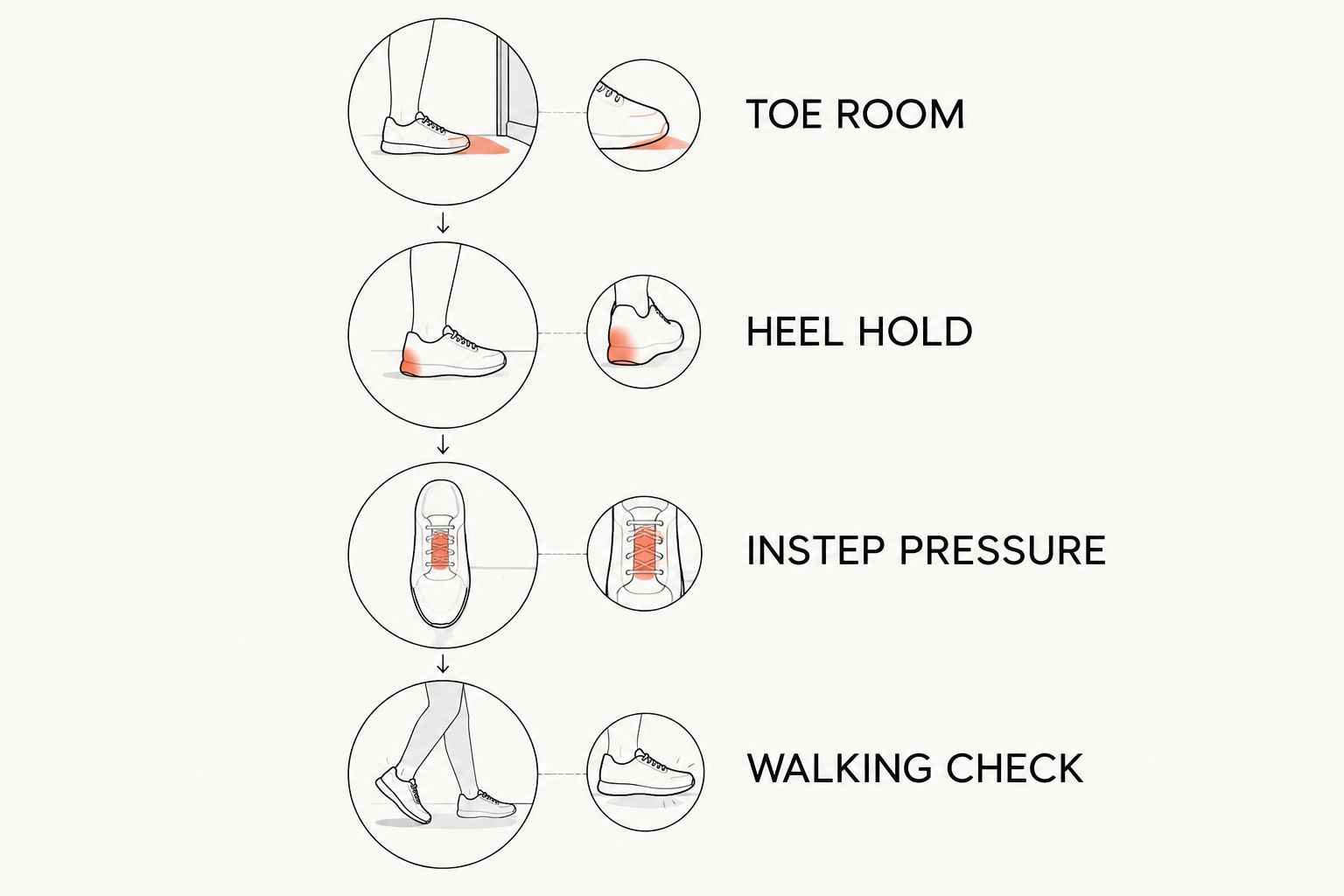
Repeat the sequence on both feet. Stop if you experience pain or numbness. These are selection checks, not an instruction to push through discomfort or a substitute for clinical advice.
WHEN AN ARCHIVE PLATFORM IS THE BETTER STYLE DIRECTION
A Chelsea is not the only way to wear a substantial sole. Swear London platform boots are best for buyers seeking an archive-led silhouette rather than a conventional Chelsea shape. Keep that distinction clear when you compare footwear.
The two options below use original stacked-wedge designs tied to the brand's history. Their stated upper constructions give you something concrete to compare. They do not establish a comfort ranking, a Chelsea construction or a medical benefit.
| Platform alternative | Best for | Stated construction | Comfort limitation |
|---|---|---|---|
| Air Revive Vegan Boots - Triple Black | Buyers seeking a stretch artificial-leather upper | Soft stretch artificial leather; original stacked wedge | Stretch alone does not establish width, support or heel security |
| Air Rev. Xtra Hybrid Platform Boots - Black Mesh | Buyers seeking a neoprene-and-mesh upper | Neoprene and mesh; original stacked wedge | Upper material alone does not establish breathability or walking comfort |
Air Revive Vegan Boots - Triple Black pros: the upper construction is explicitly described as soft and stretch; the stacked wedge connects the design to the archive. Cons: neither feature proves the fit for your foot, and neither is a reason to call it a Chelsea comfort winner.
Air Rev. Xtra Hybrid Platform Boots - Black Mesh pros: neoprene and mesh provide a distinct material direction; the original stacked wedge keeps the heritage shape central. Cons: mesh is not a measured ventilation result, and the construction does not establish suitability for prolonged standing.
Best for: choose between these alternatives by upper preference and actual fit, not an assumed comfort advantage. Swear London platform boots belong on a style-led shortlist when you want the archive silhouette itself.
Verdict for both: Hold until fit and movement meet your needs.
WHICH CHUNKY CHELSEA SHOULD YOU CHOOSE?
For an undecided buyer, start with the roomy, secure-fitting Chelsea. Move directly to a wide-fit configuration if standard widths squeeze your forefoot. Prioritise the opening if ankle contact is the recurring problem.
Choose a platform Chelsea because you want that shape, then demand the same fit standards. If the archive wedge is what interests you instead, assess Swear London as a separate platform direction. Do not force different constructions into the same category to produce a tidy winner.
Your best 2026 choice is the pair that meets your fit needs without asking you to compensate while walking. The chunky silhouette comes after that decision. Keep the order.
FAQ
What's the best chunky Chelsea boot configuration for comfort?
A roomy, secure-fitting Chelsea is the default configuration to assess first. Check toe space, heel hold and instep clearance together; choose a specialist width or opening when your feet need it.
Should I size up in chunky Chelsea boots?
Do not size up automatically. Compare the model's sizing guidance with your fit, and distinguish a width problem from a length problem before choosing.
Are platform Chelsea boots more comfortable than ordinary Chelsea boots?
A platform does not establish greater comfort. Compare the fit and walking behaviour of the actual pairs rather than judging their sole profiles.
Are wide-fit Chelsea boots best for wide feet?
Wide-fit Chelsea boots are the first configuration to assess for a broad forefoot. Check that the additional space is where you need it and that your heel remains secure.
Should chunky Chelsea boots hurt while breaking in?
Do not treat pain as a necessary break-in stage. Stop and reassess pressure, rubbing or slipping instead of planning to endure them.
Does a vegan upper make a boot more comfortable?
A vegan designation does not establish comfort. Material feel, internal shape, seam placement and the complete boot's fit still need separate assessment.
Are Swear London platform boots Chelsea boots?
Do not treat Swear London platform boots as Chelsea boots simply because both categories can have substantial soles. Check the individual construction rather than using the platform silhouette as a category label.
Can I choose chunky Chelsea boots for a diagnosed foot condition?
Get individual footwear advice for a diagnosed foot condition. A fashion comfort guide does not establish suitability for diabetes, neuropathy, persistent pain or prescribed orthoses.
ONE LAST THING
Look at what your toes are doing while you walk. If you are gripping to keep a boot in place, the generous front is not the whole fit story. Reassess heel hold before adding anything inside.
For Swear London or any other chunky boot, the same rule applies: keep the silhouette you want, but reject the fit you have to manage.