


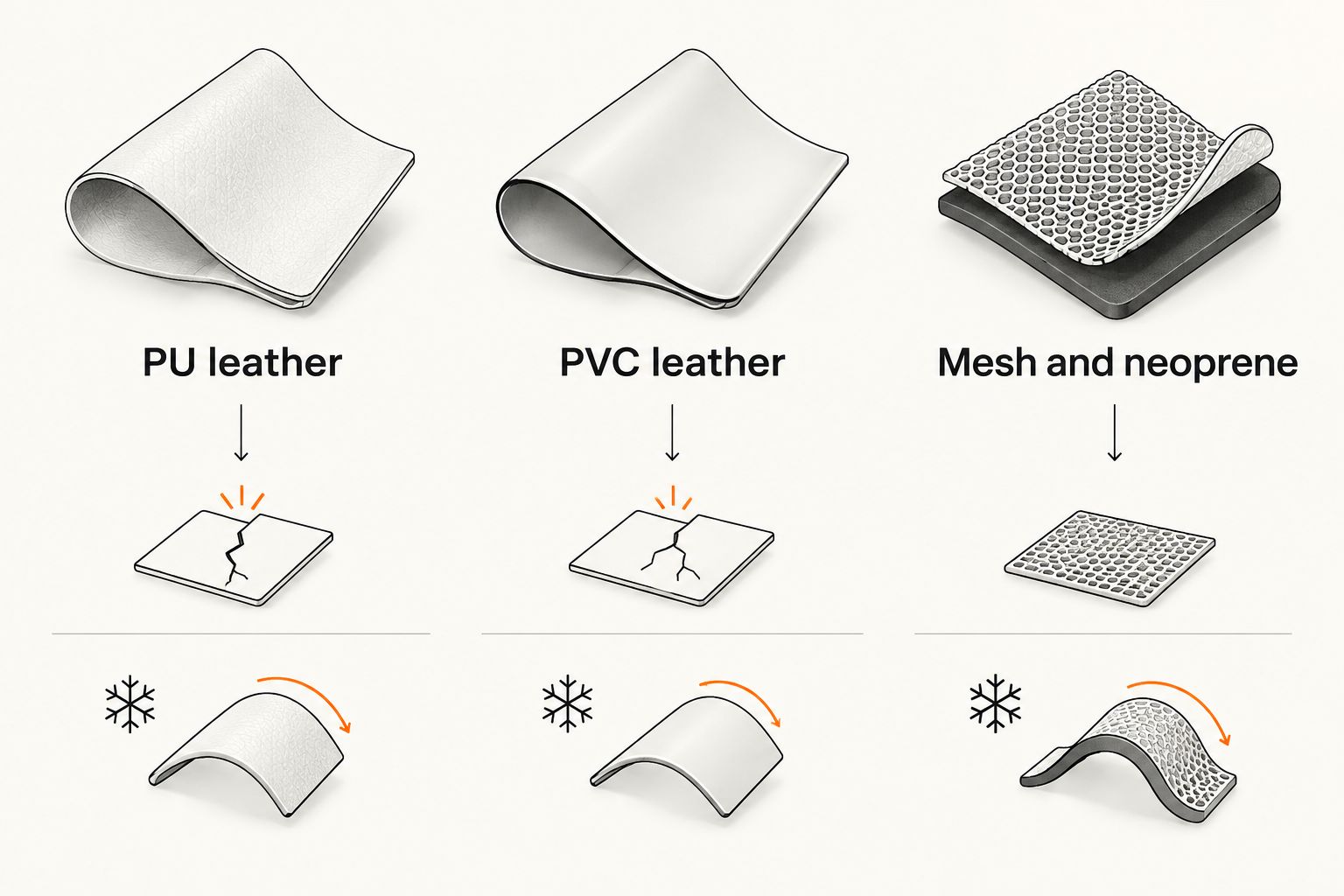
Yes, vegan boots crack over time — most commonly at the flex points, and usually because of the material underneath the finish, not the finish itself. PU-based (polyurethane) vegan leather is the type most prone to surface crazing and cracking as it ages, driven by hydrolysis, UV exposure and repeated folding at the toe and ankle. PVC-based vegan leather resists that specific failure better but stiffens more in cold weather and creases visibly instead. How a pair is stored and cleaned changes the timeline more than the label on the box does.
- Vegan boots crack over time mainly through PU hydrolysis at flex points, not sudden splitting.
- PVC vegan leather resists cracking better than PU but stiffens and creases in cold weather.
- Flat storage away from direct heat slows cracking more than any conditioner applied after the fact.
- SWEAR London's Air Rev. Xtra Vegan Platform Boots use a stretch upper built to flex at the ankle hinge rather than crack there.
WHY THIS MATTERS
Vegan boots get bought for two reasons: the material choice, and the design. Cracking undermines both — a boot that's visibly crazing at the toe after a year looks cheap regardless of what it cost, and it's one of the most common vegan-leather complaints across footwear forums and return reasons heading into 2026.
The confusion comes from treating "vegan leather" as one material. It isn't. PU, PVC, microfibre and mesh or neoprene blends all behave differently under flex stress, heat and time, and each ages on its own curve. The fix is mostly maintenance, not material — see caring for vegan trainers for the specific do's and don'ts.
DO VEGAN BOOTS CRACK OVER TIME?
Yes — but the risk depends entirely on what's under the surface. Cracking complaints logged in 2026 trace back to a small number of material and storage patterns, summarised below:
| Material | Crack risk over time | Cold-weather behaviour | Best for |
|---|---|---|---|
| PU (polyurethane) faux leather | Highest — hydrolysis causes surface crazing and peeling | Moderate flexibility | Everyday wear, indoor use |
| PVC (vinyl) faux leather | Lower — resists hydrolysis better | Stiffens and creases in cold | Wet weather, higher humidity |
| Microfibre / stretch vegan leather | Low if kept clean and dry | Stays flexible | Platform boots with ankle hinge points |
| Mesh / neoprene blends | Low cracking, but abrasion wear instead | Very flexible | Festival and rave-style boots |
PU VEGAN LEATHER: WHERE MOST CRACKING STARTS
Polyurethane coatings break down through hydrolysis — a slow chemical reaction with moisture in the air that happens whether the boots are worn or not. As of 2026, that reaction is still the most cited cause of vegan leather cracking, and it accelerates in humid climates or when boots are stored folded rather than flat. The crazing usually starts at the toe box and any crease the boot forms when it bends.
PVC VEGAN LEATHER: STIFFER, SLOWER TO CRACK
PVC resists that specific hydrolysis failure better than PU, which is why vinyl-based vegan leather often outlasts PU in humid or coastal conditions. The trade-off shows up in the cold: PVC stiffens more than PU does, and repeated folding in low temperatures can crack it along the same crease lines instead. Neither material is immune — they just fail differently.
WHY CRACKING VARIES
Same material, different results. These are the factors that decide whether a vegan boot cracks at twelve months or holds for several years:
- Storage position — folding a boot concentrates stress at one crease; flat or upright storage spreads it out
- Climate and humidity — hydrolysis in PU accelerates in humid or coastal environments
- UV exposure — direct sunlight breaks down PU coatings faster than indoor storage
- Cleaning products — alcohol-based or solvent cleaners strip the plasticisers that keep the coating flexible
- Wear frequency — daily wear at flex-heavy points ages a boot faster than occasional wear
- Sole rigidity — a platform sole that doesn't flex with the foot pushes all the bending stress into one point on the upper
Construction matters here as much as material choice. SWEAR London's Air Rev. Xtra Vegan Platform Boots in black use a stretch upper built to flex at the ankle hinge rather than fold and crease at one spot — the detail that decides whether a platform boot cracks early or holds through several years of wear. It won't stop hydrolysis outright, but distributing flex reduces the single-point stress that causes early cracking.


IS VEGAN LEATHER AS DURABLE AS REAL LEATHER?
Vegan leather is not as durable as full-grain leather in raw material terms — leather ages by softening and developing a patina, while PU and PVC vegan leathers age by cracking or peeling once the coating fatigues. Full-grain leather typically outlasts PU-based vegan leather under the same wear conditions, though microfibre and PVC alternatives close that gap considerably.
HOW LONG DO VEGAN BOOTS LAST?
How long vegan boots last depends on the upper material and how they're stored, with PU-based pairs showing wear signs earliest and PVC or microfibre pairs holding up longer under the same conditions. Daily wear on hard pavement shortens the timeline for any material; occasional wear with flat storage extends it.
CAN VEGAN BOOTS BE RESOLED?
Vegan boots can be resoled in most cases, since resoling is a sole-and-midsole job rather than an upper repair — the same process used on leather footwear applies. Resoling doesn't fix upper cracking, which is a separate issue tied to the coating, not the sole.
FAQ
What causes vegan leather boots to crack?
Cracking in vegan leather boots is caused mostly by the breakdown of the PU coating through hydrolysis, worsened by UV exposure, folded storage and harsh cleaning products.
Is PU or PVC vegan leather more prone to cracking?
PU vegan leather is more prone to cracking than PVC, because PU breaks down through hydrolysis while PVC resists that specific reaction, though PVC stiffens more in cold weather.
How do you stop vegan boots from cracking?
Store vegan boots flat or on a shoe form away from direct heat and sunlight, and skip alcohol-based cleaners that strip the coating's plasticisers.
Do vegan boots crack faster than leather boots?
Vegan boots, particularly PU-based pairs, tend to show cracking earlier than full-grain leather boots, which age by softening rather than by coating breakdown.
Does climate affect how fast vegan boots crack?
Yes, humid and hot climates speed up hydrolysis in PU vegan leather in 2026 conditions just as they did before, while dry, temperate storage slows the process.
Can cracked vegan leather be repaired?
Light surface cracking on vegan leather can sometimes be treated with a leather-safe conditioner or filler, but deep cracks through the coating usually can't be reversed.
Are all SWEAR London vegan boots made from the same material?
No, SWEAR London's vegan boots use different uppers across styles, from stretch microfibre vegan leather to neoprene and mesh blends, each with its own aging pattern.
Does wearing vegan boots every day make them crack sooner?
Yes, daily wear concentrates flex stress at the toe and ankle, which speeds up cracking compared with occasional wear.
ONE LAST THING
The detail most buyers miss going into 2026: cracking isn't purely a wear-and-tear issue, it's a storage issue as much as a material one. A PU vegan boot stored flat in a temperate room can outlast the same boot from the same batch stored folded in a hot cupboard by a wide margin. Check the upper material before assuming a "vegan leather" boot behaves like any other — PU, PVC, microfibre and mesh do not age the same way, and the product tag rarely spells out which one you're getting.