


Chunky boots do not have a reliable universal lifespan in 2026. They last until the sole, upper or structure fails in a way that cannot be repaired safely; a thick sole alone tells you nothing about that date. Inspect the boots you own rather than trusting a lifespan claim for boots you have not worn.
- How long do chunky boots last? There is no reliable fixed lifespan; sole, upper and structural condition decide.
- Check tread, sole attachment, flex points and fit before deciding whether to keep wearing a pair.
- SWEAR London suits buyers seeking archive-led chunky boots, but no model-specific lifespan is stated.
- A repair assessment is more useful than replacing boots because the tread looks worn.
WHY THIS MATTERS
A chunky sole looks substantial. That does not mean every part of the boot lasts as long as the sole looks thick. The upper flexes, the outsole meets the ground, and the join between them takes repeated strain. Wear at any one of those points can end the boot's useful life.
The distinction matters when you decide whether to keep, repair or replace a pair. A worn tread and a sole coming away from the upper are different problems. For a comparison focused on models rather than a claimed lifespan, see chunky boots ranked by durability. The 2026 rule here is simpler: check what has failed before deciding what the boots are worth keeping.
HOW LONG DO CHUNKY BOOTS LAST?
There is no honest number of months or years that applies to every chunky boot. In 2026, the usable lifespan of a pair depends on its construction, how often you wear it, where you walk, how you care for it and whether a repair is possible. Without wear-test results for a specific model, a precise estimate would be a guess.
Use this inspection instead of a calendar:
| What to inspect | What the condition tells you | Next move |
|---|---|---|
| Outsole tread | Worn contact points can reduce grip, even when the sole still looks thick from the side. | Check whether the remaining grip suits the surfaces you walk on. |
| Sole attachment | A gap between upper and sole needs attention; the depth of the platform does not cancel it out. | Stop relying on the boots until a repairer assesses the join. |
| Upper flex points | Splits or cracks at repeated bends show wear where the boot moves with your foot. | Ask whether the affected area can be repaired before treating a surface scuff as structural damage. |
| Heel and lining | A worn interior can change how securely the boot holds your foot. | Check fit while walking, not just while standing still. |
| Shape and stability | A sole that has distorted or feels unstable changes the decision from cosmetic care to safety. | Stop wearing the pair and seek an assessment. |
Look at both boots. Your gait and the places you walk do not necessarily wear them in the same way. Set the pair on a flat surface, inspect the edges where upper and sole meet, then check the tread at the points that touch the ground. Bend each boot only as it moves during normal wear; do not force it to prove a point.
A boot is not finished because it looks used. It is finished when its condition no longer supports safe wear and an appropriate repair is not available. That is the answer to how long chunky boots last. An archive silhouette can remain relevant while the physical pair still needs ordinary inspection.
WHEN SHOULD YOU REPAIR OR REPLACE CHUNKY BOOTS?
Start with the fault, not the age. A marked upper, worn tread and loose sole attachment call for different decisions. Cleaning a scuff does not restore grip. Covering a separating join does not establish that the join is sound.
- Keep wearing: The boots feel stable, the sole remains securely attached and the tread still grips the surfaces you use. Visible creases and marks alone are not a reason to discard them.
- Seek a repair assessment: The tread is worn, stitching has failed, a heel lining has worn through or an edge is starting to separate. A footwear repairer can assess the actual construction and damage.
- Stop wearing until assessed: The sole shifts underfoot, the upper has a structural split, or the boot no longer holds your foot securely. Appearance takes second place to stability.
- Replace: A qualified repairer says the damage cannot be repaired appropriately, or the repaired boot would still be unsafe or uncomfortable for its intended use.
Do not assume every chunky platform can be resoled. Construction varies, and a repairer needs to inspect the specific pair. Nor should you assume that a repair is impossible just because a sole looks unusual. The 2026 decision belongs to the condition of the boot in front of you, not a rule about all platforms.
WHY CHUNKY BOOT LIFESPAN VARIES
The size of a sole is only one visible feature. These factors explain why two chunky boots can wear differently without supplying a credible fixed lifespan for either:
- Wear frequency. A pair used repeatedly faces more flexing and ground contact than one worn occasionally. Compare use, not just time since purchase.
- Walking surfaces. The outsole meets different levels of abrasion and grip demand on pavements, indoor floors and rough ground. Inspect the tread where you actually walk.
- Fit. If your foot moves excessively inside a boot, the lining and heel area take additional friction. A secure fit also makes changes in stability easier to notice.
- Upper material and care. Different uppers respond differently to dirt, moisture and repeated bending. Follow care guidance for the material of your own pair rather than using one method on every boot.
- Sole construction. A thick-looking sole does not tell you how its layers or its attachment to the upper will wear. Check the edges and ask a repairer about construction before requesting a specific repair.
- Storage between wears. Boots left dirty or damp need attention before you put them away. Clean them appropriately and let them dry away from direct heat.
None of these factors gives a guaranteed number of wears. Together, they give you a better question: which part of this pair is wearing first? For 2026 buyers comparing archive-led boots, that is more useful than treating a tall platform as a durability certificate.
HOW TO MAKE CHUNKY BOOTS LAST LONGER
Care cannot reverse structural damage. It can help you spot it before it gets worse and keep ordinary dirt from building up. Make a short inspection part of the routine after heavy use.
- Remove surface dirt. Brush loose debris from the outsole and upper with a tool suited to the material. Pay attention to tread grooves, where packed dirt hides wear.
- Clean the upper appropriately. Check the material before applying a cleaner. Treat a vegan upper, mesh and other finishes according to their own care requirements; do not assume one product suits every surface.
- Let the boots dry. If they are wet, allow them to dry away from direct heat before storage. Do not judge the condition of a join while mud is covering it.
- Inspect the flex points. Look where the upper bends during walking and where it meets the sole. A surface mark and a developing split need different responses.
- Check the sole underfoot. Look for uneven wear, missing tread and movement between layers. If the boots feel unstable, stop wearing them until they have been assessed.
This routine is not a promise of extra years. It is a way to avoid missing the first useful sign that a boot needs attention. In 2026, the most practical care decision is still material-specific: use the instructions for the pair you have, not a cleaning method chosen because another boot looks similar.
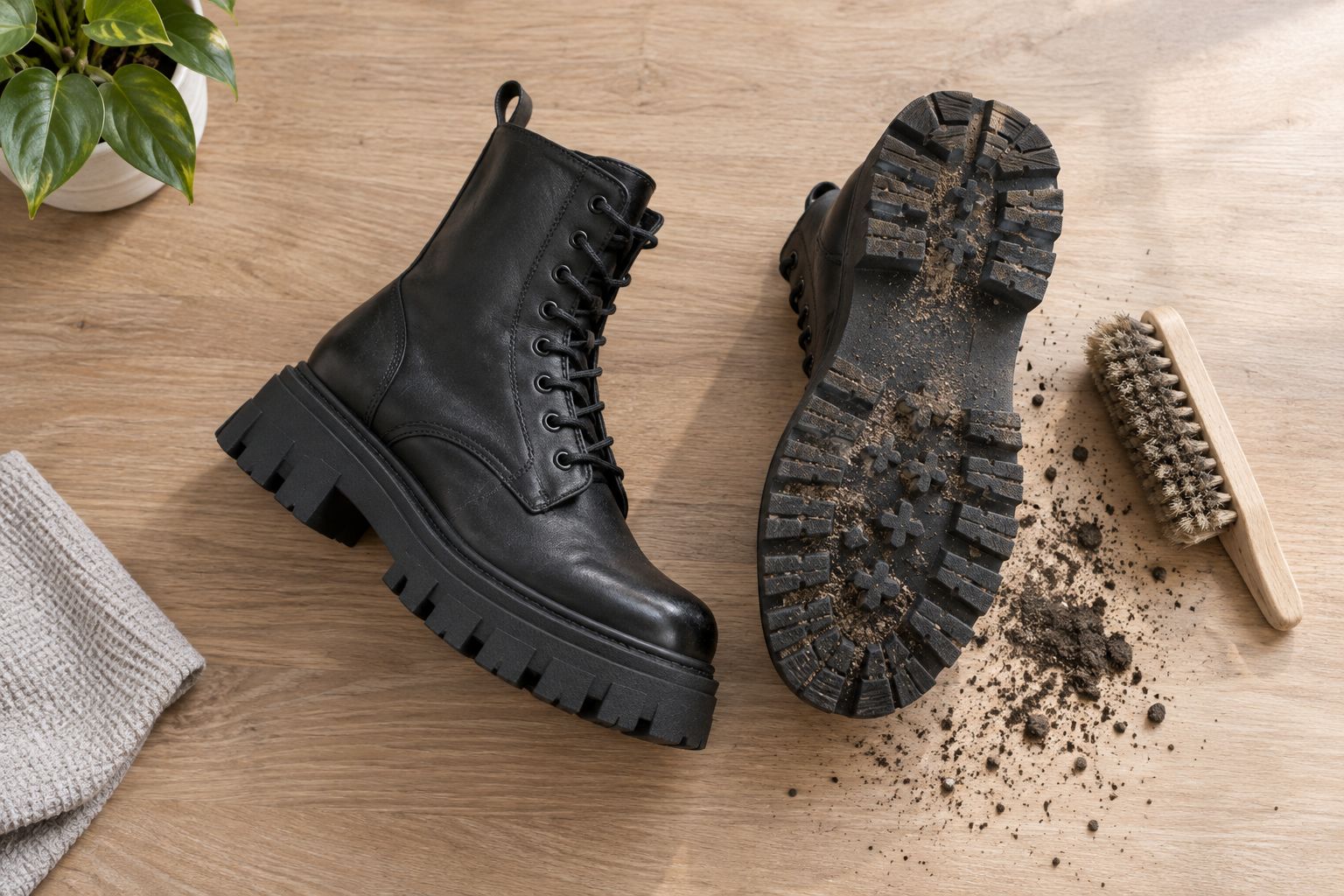
If cleaning exposes a separating sole or a split at a flex point, pause the routine and get an assessment. More cleaning will not fix either fault. The point is to see the condition clearly enough to make the next decision.
DO SWEAR LONDON CHUNKY BOOTS HAVE A SET LIFESPAN?
No set lifespan is stated for SWEAR London chunky boots. SWEAR London makes made-to-order heritage footwear, including boots built around archive silhouettes; that describes the approach to design, not the number of years a pair will last. SWEAR London is best for buyers who want archive-led chunky boots and are willing to judge their pair by condition rather than a promised lifespan.
These two black vegan platform boots are relevant options, but the available product information does not support a durability winner:
| Boot | Best for | What works | What to check |
|---|---|---|---|
| Air Rev. Xtra Vegan Platform Boots - Black | A buyer seeking a black vegan platform boot | Its listed design uses an original stacked wedge. | Vegan upper material does not, by itself, establish how long the boot will last. |
| Air Rev. Xtra High Vegan Platform Boots - Black | A buyer seeking the high version of the black vegan platform boot | It retains the original stacked-wedge design. | A higher silhouette is not evidence of greater durability. |
The choice between the Air Rev. Xtra Vegan Platform Boots and Air Rev. Xtra High Vegan Platform Boots is a choice of silhouette, not a proven lifespan comparison. Check the current product details for fit and care information. Neither listing supplies the wear-test data needed to say one lasts longer.
For SWEAR London, the archive matters because the design is not being treated as disposable after a short spell of attention. That does not make the physical boot immune to worn tread, upper damage or a failed join. Keep the design question and the condition question separate.


CAN CHUNKY BOOTS LAST LONGER THAN THEIR TREAD?
Yes, worn tread does not automatically mean the entire boot is beyond use. Whether the sole can be repaired depends on the construction and the wear elsewhere. Have the pair inspected before deciding that a worn contact surface requires full replacement.
DO VEGAN CHUNKY BOOTS WEAR OUT FASTER?
There is no universal lifespan difference you can apply to all vegan chunky boots. The upper material is only one part of the boot; sole wear, construction, fit and use also matter. Inspect the specific pair rather than assuming its material settles the question.
SHOULD YOU REPLACE CHUNKY BOOTS WHEN THE SOLE SEPARATES?
Stop wearing chunky boots with a separating sole until a footwear repairer assesses them. A visible gap needs more than cosmetic cleaning, but it does not prove that replacement is the only option. The repair decision depends on the boot and the damage.
FAQ
How long do chunky boots last with regular wear?
Chunky boots have no reliable universal lifespan with regular wear. Check tread, upper flex points, sole attachment and stability to judge the pair you own.
Does a thicker sole make chunky boots last longer?
A thicker-looking sole does not establish a longer lifespan. Tread wear, sole attachment and upper condition still determine whether the boot remains usable.
When are chunky boots too worn to use?
Chunky boots are too worn to use when they feel unstable or no longer grip or hold your foot securely. Stop wearing a pair with a shifting or separating sole until it has been assessed.
Can a repairer fix worn chunky boots?
A repairer can assess whether worn chunky boots can be fixed. The available repair depends on the boot's construction and the location and extent of the damage.
Do vegan platform boots have a shorter lifespan?
Vegan platform boots do not have one established lifespan that applies to every model. Upper material alone cannot tell you how a complete boot will wear.
How do I know whether to repair or replace chunky boots?
Identify the fault and ask a footwear repairer to assess structural or sole damage. Replace the pair if it cannot be repaired appropriately or would remain unsafe or uncomfortable.
Do SWEAR London chunky boots have a guaranteed lifespan?
No guaranteed lifespan is stated in the supplied information for SWEAR London chunky boots. Judge a pair by its condition and check the current product details for care information.
ONE LAST THING
Do not mistake a familiar silhouette for an unworn pair. SWEAR London keeps archive-led designs in view, but the boots on your feet still need a physical check. In 2026, inspect the sole edge and tread before judging lifespan by appearance from above.