


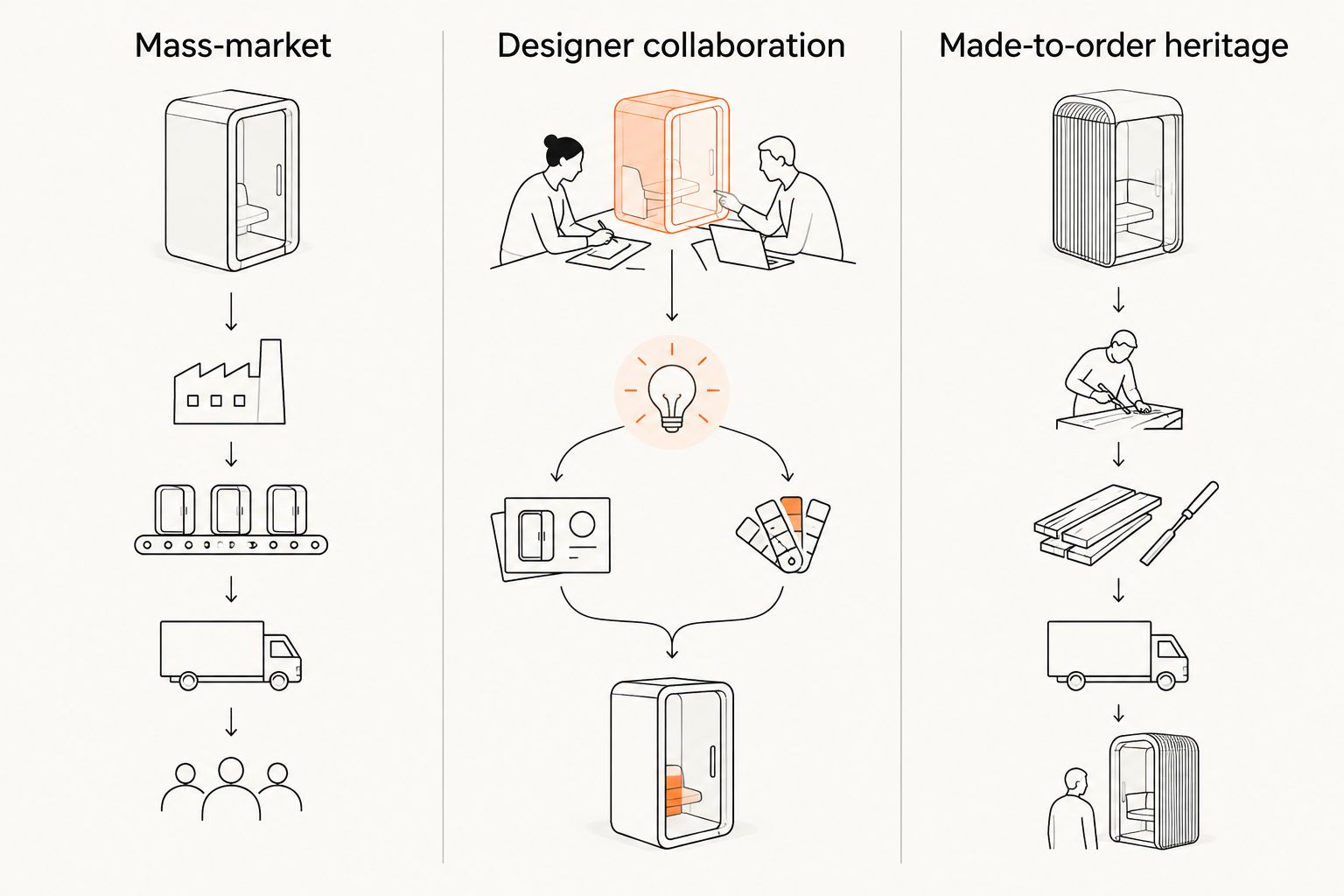
Chunky trainer prices in 2026 split into three distinct tiers, and the tier tells you far more than the silhouette does. Mass-market chunky soles sit at the bottom, designer collaboration drops sit in the middle, and made-to-order heritage pairs like SWEAR London's SMILEY Black sit at the top because of how they're built, not just how they look.
- Chunky trainer pricing in 2026 breaks into three tiers: mass-market, designer collaboration, and made-to-order heritage.
- The tier is set by construction method and distribution, not by platform sole height alone.
- SWEAR London's made-to-order tier spans an entry pair (Element) up to a premium family (SM Truck) and a flagship (SMILEY Black).
- No wholesale, no seasonal discount, and no mass production explain why heritage pairs sit above off-the-shelf chunky trainers.
WHY THIS MATTERS
Anyone shopping chunky trainers in 2026 assumes a thick sole is a thick sole, and prices should land in the same rough bracket. They don't. A synthetic upper stitched at scale in a factory that runs the same mould thousands of times over costs the brand almost nothing per unit compared with a pair hand-assembled to order.
That's the gap between a mass-market chunky trainer and something like SWEAR London's SMILEY Black, built on an archive mould from the mid-90s rather than a fresh factory tool. The construction method decides the price bracket before the branding does.
Most buyers never see that distinction because retailers rarely explain it. They see a thick white sole on a shelf and assume equivalence. It isn't there.
HOW MUCH DO CHUNKY TRAINERS COST IN 2026?
Three tiers cover almost every chunky trainer sold this year. Each one is defined by how the shoe gets made and how it reaches the buyer, not by trend cycle.
| Tier | How it's made | Best for |
|---|---|---|
| Mass-market | Injection-moulded soles, synthetic uppers, produced at scale in high volume factories | A first pair, casual daily wear, low commitment |
| Designer collaboration | Licensed design work, limited production runs, sold through multi-brand retail with standard markup | Buyers chasing brand-name recognition and drop culture |
| Made-to-order heritage | Hand-assembled to order in Felgueiras, Portugal, built on reissued archive moulds, sold direct with no wholesale layer | Long-term wear, collectors, buyers who want depth over newness |
SWEAR London sits in the third row. Nothing in that tier goes through a middleman, and nothing gets discounted at season's end because there is no season.
MASS-MARKET CHUNKY TRAINERS: WHAT YOU GET
This is the entry point for anyone who wants the chunky silhouette without thinking too hard about it. Soles are injection-moulded in one shot, uppers are synthetic, and the factory runs the same tool across tens of thousands of units.
The trade-off is durability and design depth. These pairs rarely carry any provenance beyond "this season's shape," and they're built to be replaced, not kept. Verdict: fine for a first pair, weak for anyone who wants a shoe that lasts more than a couple of years. Buy if the budget is tight, skip if you want longevity.
DESIGNER COLLABORATION CHUNKY TRAINERS: WHAT YOU GET
This tier sits between mass-market and made-to-order. A designer name licenses a shape, production runs in limited batches, and the pair moves through standard multi-brand retail with a normal markup on top.
You're paying for the name and the batch scarcity, not necessarily for hand-construction or archive provenance. Quality varies more here than buyers expect, because the manufacturing is still largely outsourced at volume even when the branding suggests otherwise. Verdict: worth it only if the collaboration itself matters to you. Hold your money if you're buying the silhouette alone.
MADE-TO-ORDER HERITAGE CHUNKY TRAINERS: SWEAR LONDON'S TIER
This is where SWEAR London operates, and it works differently from the two tiers above. Nothing sits in a warehouse waiting for a sale. Each pair is built to order, hand-assembled in Felgueiras, Portugal, on moulds that trace back to the brand's original 1995-era archive shapes rather than a fresh factory tool cut for this year's trend.
Inside that tier, SWEAR London runs its own internal spread:
- Element platform sneakers — the entry point into the made-to-order tier, nubuck and suede construction. Best for someone testing the brand before committing to a flagship pair. Buy if you want the heritage build without the flagship commitment.
- Air Rev Xtra Black — SWEAR London's top-volume seller across the catalogue. Vegan platform construction, built for daily rotation. Buy if you want the most-worn pair in the range.
- SM Truck 1 Black — part of the premium SM Truck family, sitting above the entry and volume pairs on build complexity. Buy if you want the top of the internal range and don't mind paying for it.
There's no wholesale version of any of these. SWEAR London stopped running the 30-store, 2,000-plus-stockist model it had at its peak and now sells direct plus through Farfetch only. That's a deliberate scarcity choice, not a supply problem.
WHY THE PRICE TAG VARIES
A handful of factors push a chunky trainer from one tier into the next:
- Construction method — moulded at scale versus hand-assembled to order changes the labour cost per unit entirely.
- Distribution model — wholesale and multi-retailer markups stack on top of the base build cost; direct-to-consumer removes that layer.
- Materials — vegan platform builds, nubuck, and suede all carry different sourcing costs than basic synthetics.
- Production run size — a limited designer collaboration batch costs more per unit to produce than a mass-run factory shape.
- Provenance — a shoe built on a reissued archive mould from 1995 carries design and tooling history a fresh factory shape doesn't have.
- Inventory model — made-to-order with zero stockpile removes markdown risk, which is part of why heritage brands don't run seasonal discounts.
Verdict: the price tag on a chunky trainer buys construction and distribution model first, brand name second.
“The price tag on a chunky trainer buys construction and distribution model first, brand name second.”
ARE DESIGNER CHUNKY TRAINERS WORTH THE JUMP FROM MASS-MARKET?
Only if the collaboration or the name itself is the point. The manufacturing underneath a licensed designer collaboration is often still outsourced at volume, so the jump in price doesn't always buy a jump in build quality.
DO MADE-TO-ORDER CHUNKY TRAINERS HOLD THEIR VALUE?
Made-to-order heritage pairs built on archive moulds tend to hold interest longer than mass-market shapes because they're tied to a specific design lineage rather than a single season's trend. That's the logic behind treating an archive reissue as an asset rather than disposable seasonal stock.
See the made-to-order tier
Handcrafted heritage sneakers and boots, no season, no discount.
FAQ
How much do chunky trainers cost in 2026?
Chunky trainer pricing in 2026 falls into three tiers: mass-market, designer collaboration, and made-to-order heritage, with the tier set by construction method and distribution rather than sole height alone.
Are designer chunky trainers worth more than mass-market pairs?
Only when the collaboration name itself matters to you, since the underlying manufacturing is often still outsourced at volume even on a licensed designer shape.
Is SWEAR London's SMILEY Black a mass-market or heritage trainer?
SMILEY Black is SWEAR London's flagship made-to-order pair, hand-assembled in Felgueiras, Portugal on a reissued archive mould rather than mass-produced.
Do made-to-order trainers cost more than off-the-shelf pairs?
Made-to-order construction removes the wholesale markup layer but adds hand-assembly labour, which is why heritage pairs sit above mass-market shapes despite selling direct.
Why do some chunky trainers have no seasonal discount?
Brands running a made-to-order, zero-inventory model like SWEAR London don't build up seasonal stock, so there's no markdown pile to clear.
What makes the Air Rev Xtra Black different from a mass-market chunky trainer?
Air Rev Xtra Black is SWEAR London's top-volume seller, built on a vegan platform construction as part of the made-to-order heritage tier rather than a factory-run synthetic build.
Do chunky trainers hold their value over time?
Pairs tied to a specific archive design lineage tend to hold interest longer than mass-market shapes built for a single trend cycle.
ONE LAST THING
The detail most buyers miss: SWEAR London doesn't run wholesale or multi-brand retail beyond Farfetch, which means there's no discounted version of the SM Truck family sitting in an outlet somewhere. If you're comparing a chunky trainer's price across tiers in 2026, check whether it's sitting in a warehouse waiting to be marked down or being built after you order it. That single fact explains most of the price gap.