


Men's platform boots price out in three tiers in 2026 — entry, mid-range and made-to-order — and the tier is set by the sole unit and the production method, not the name printed on the box.
- How much men's platform boots cost in 2026 depends on tier: entry, mid-range or made-to-order, not the brand printed on the box.
- Entry-level platform boots use an injection-moulded sole and a synthetic upper; they fail at the sole edge fastest.
- Mid-range platform boots move to vegan leather and a stacked wedge sole, built for regular wear.
- SWEAR London makes its platform boots to order on original 1995 moulds — no seasonal runs, no discounting.
- Resoling and lead time are the hidden costs buyers forget when comparing platform boot tiers.
WHY THIS MATTERS
Platform boots get judged on looks first and construction second, which is backwards. A taller sole unit puts more strain on the bond between sole and upper, so cheap construction shows up as delamination within months, not years. SWEAR London builds its platform boots to order rather than running seasonal batches, which changes where the cost goes — into the sole and the last, not into a marketing season.
Knowing which tier you're buying into in 2026 tells you what the boot looks like after six months of wear, not just on the day it arrives. That's the gap most price comparisons skip.
HOW MUCH DO MEN'S PLATFORM BOOTS COST IN 2026
Platform boot pricing in 2026 splits into three recognizable bands. What separates them isn't the logo — it's whether the sole is injection-moulded in one shot or hand-lasted around a last, and whether the upper is synthetic PU, vegan leather, or full leather.
| Tier | What you're paying for | Typical construction |
|---|---|---|
| Entry-level | A synthetic upper and a single-shot moulded sole | Injection-moulded platform, cemented upper |
| Mid-range | Vegan leather or technical mesh, a stacked wedge sole | Cemented or Blake-stitched construction |
| Premium / made-to-order | A hand-finished upper on an archive last | Hand-lasted, small-batch production — the model SWEAR London's platform boots use |
WHAT DRIVES THE PRICE OF A PLATFORM BOOT
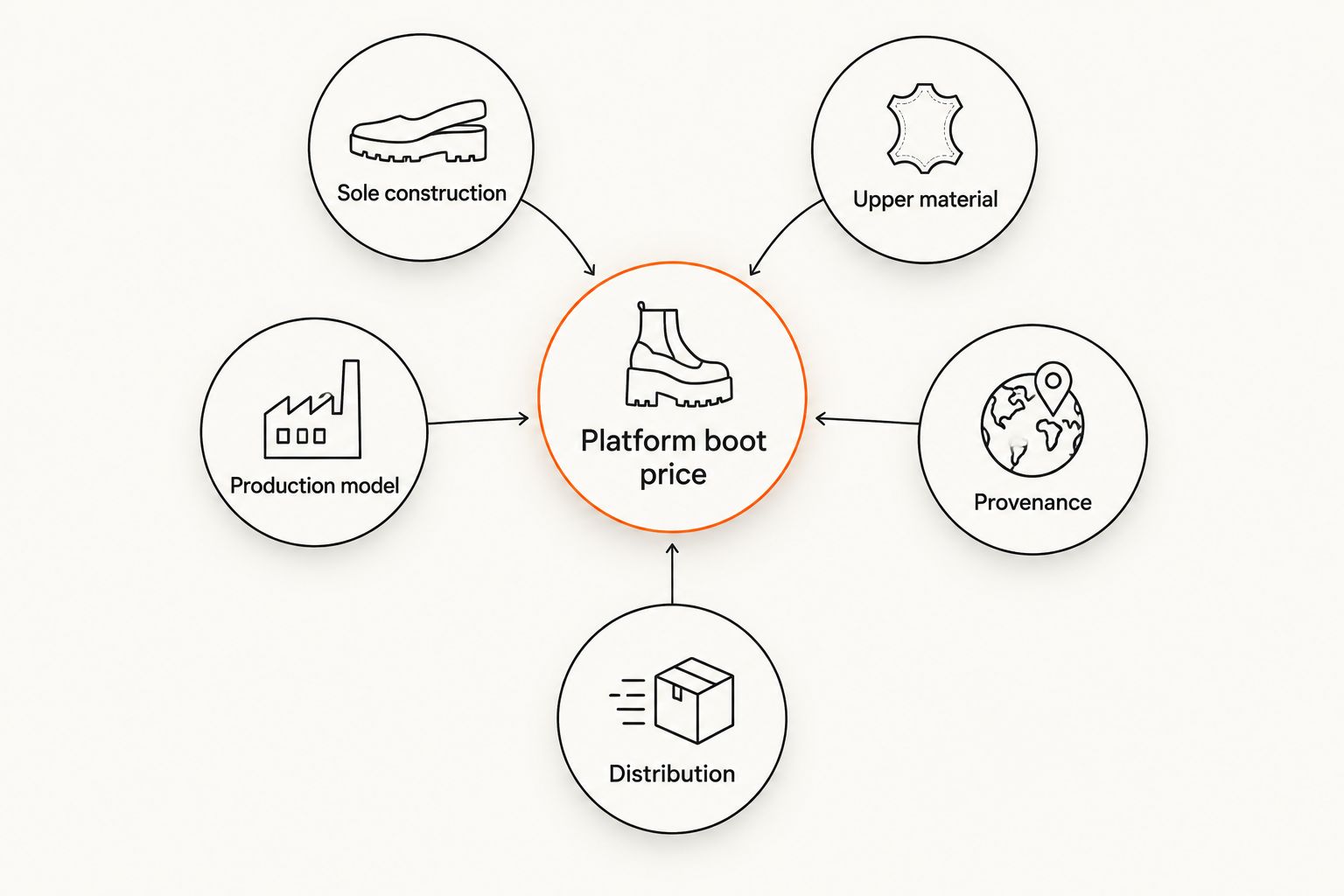
The gap between tiers comes down to a small set of decisions made before the boot ever reaches a shelf:
- Sole unit construction — an injection-moulded sole costs less to produce than a hand-lasted stacked wedge.
- Upper material — synthetic PU sits below vegan leather, which sits below full leather, in production cost.
- Production model — mass seasonal runs spread tooling cost across thousands of pairs; made-to-order production doesn't.
- Provenance — a reissued archive silhouette built on an original mould, like SWEAR London's 1995 moulds, carries tooling and small-batch costs a generic sole never faces.
- Distribution — selling direct without a wholesale margin changes where the cost sits, not whether it exists.
- Aftercare — a boot built to be resoled costs more upfront and less over its lifetime than one that gets replaced whole.
ENTRY-LEVEL PLATFORM BOOTS: MASS-PRODUCED AND SYNTHETIC
Entry-level platform boots use a single-shot moulded sole and a synthetic upper, which keeps tooling and material costs down. That construction works for occasional wear — a festival weekend, a one-off outfit — but the bond between sole and upper isn't built for daily impact.
Once that bond starts to separate, the boot usually can't be resoled, because the sole was never stitched or lasted to begin with. Buy this tier for occasional wear; skip it if you want a boot that survives daily use through 2026 and beyond.
“A platform boot's price is set by its sole, not its logo.”
MID-RANGE PLATFORM BOOTS: VEGAN LEATHER AND BRANDED CONSTRUCTION
Mid-range platform boots move to a stacked wedge sole and a vegan leather or technical mesh upper, cemented or Blake-stitched rather than moulded as one piece. SWEAR London's Air Rev Xtra Black platform boots sit in this band — a vegan upper built around a stacked wedge that traces back to SWEAR's own archive rather than a generic mould.
This is where most buyers land who want a platform boot for regular wear without committing to made-to-order lead times. Buy for regular wear if you want vegan materials without the made-to-order wait.
PREMIUM AND MADE-TO-ORDER PLATFORM BOOTS
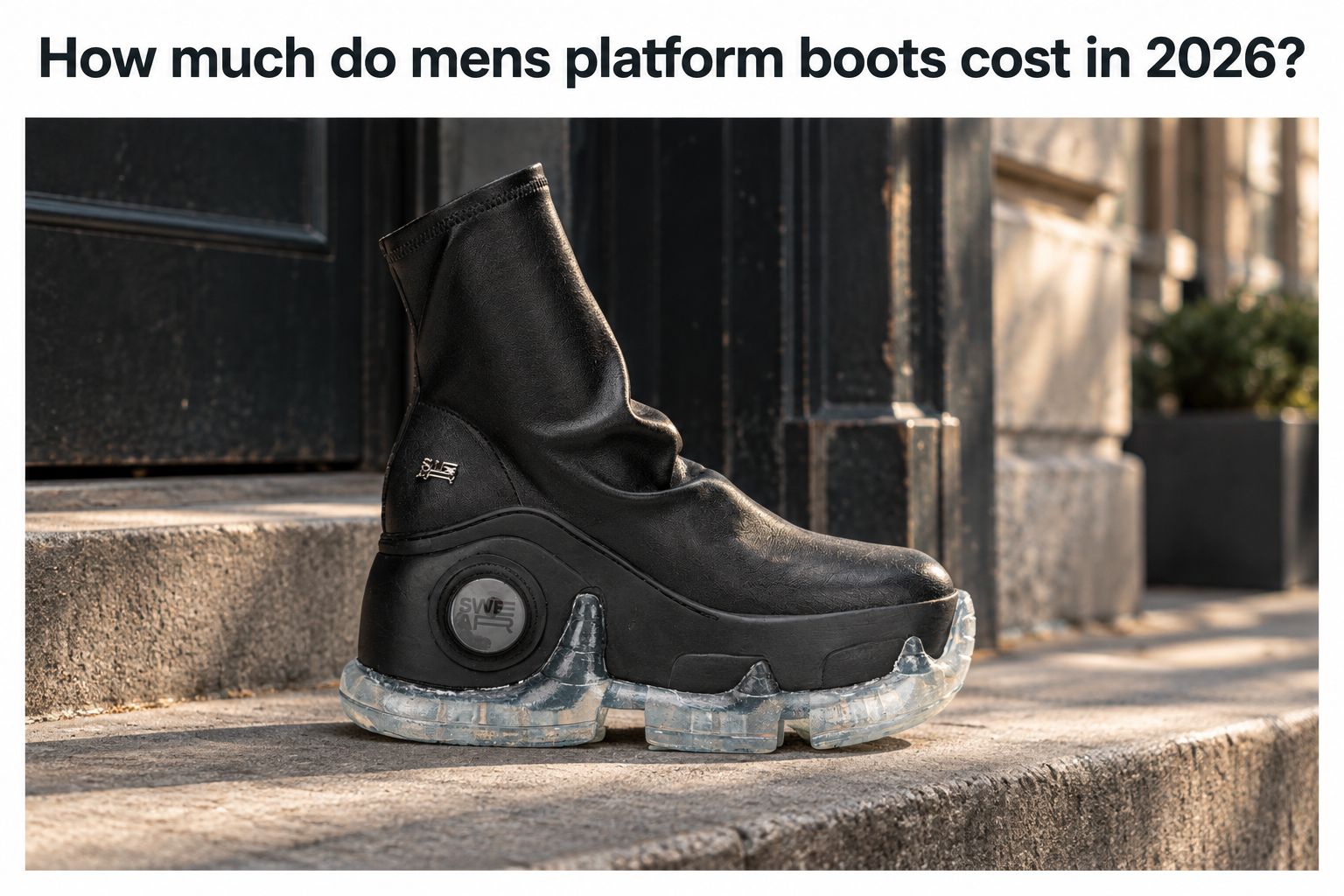
At the top, platform boots move to hand-lasted construction on an archive last, made to order rather than pulled from stock. SWEAR London's SMILEY Black sits here as the brand's flagship, alongside the SM Truck family — both built on original 1995 moulds, handcrafted, with no seasonal run and no discount cycle.
That production model means a longer lead time than an off-the-shelf boot, and it means the silhouette doesn't change from one year to the next. Buy if you want an archive silhouette built to order; wait if you need a pair within days.


OTHER QUESTIONS ABOUT PLATFORM BOOT PRICING
IS IT WORTH PAYING MORE FOR PLATFORM BOOTS IN 2026?
Paying more for a platform boot in 2026 buys hand-lasted construction and a resole option, not just a brand name — see the full breakdown on is it worth buying platform boots in 2026. The entry-level tier can't be resoled at all, which shortens its lifespan regardless of what it cost.
DO CHEAPER PLATFORM BOOTS WEAR OUT FASTER?
Cheaper platform boots wear out faster at the sole-to-upper bond, because a single-shot moulded sole isn't stitched or lasted the way a mid-range or premium boot is. The failure point shows up as separation at the sole edge, not as a worn-through outsole.
CAN A MADE-TO-ORDER PLATFORM BOOT BE RESOLED?
A made-to-order platform boot built on a hand-lasted construction can usually be resoled, because the sole is stitched or cemented to a last rather than moulded as one piece with the upper. That's the main durability advantage the premium tier holds over entry-level synthetic boots.
FAQ
What's the best men's platform boot for everyday wear in 2026?
A mid-range vegan-leather platform boot with a stacked wedge sole handles daily wear best in 2026, because the sole is bonded rather than moulded in one shot. Entry-level synthetic boots flex less and wear at the sole edge sooner.
Is it worth paying more for platform boots in 2026?
Paying more for platform boots in 2026 buys a hand-lasted sole and a resole option, not just a heritage name. Mass-produced boots at the low end typically can't be resoled at all.
How much does it cost to resole platform boots?
Resole cost depends on the cobbler and whether the construction allows it — not every platform boot can be resoled. Check the sole construction before buying if you want the option later.
Are vegan platform boots more expensive than leather ones?
Vegan platform boots sit in the same mid-to-premium range as leather ones in 2026; material choice affects feel and durability more than which tier the boot lands in.
What makes SWEAR London's platform boots different?
SWEAR London builds its platform boots to order on original 1995 moulds instead of running seasonal batches, so the silhouette doesn't change year to year. That production model separates a made-to-order pair from a fast-fashion platform boot.
Do platform boots run true to size?
Platform boots generally run true to size, but the added sole height changes how volume sits around the ankle, so a snug ankle fit matters more than usual. Check the sizing notes on the product page before ordering.
Can platform boots be resoled?
Some platform boots can be resoled and some can't — it depends on whether the sole unit is bonded or stitched, so ask before buying if longevity matters. Hand-lasted, made-to-order pairs are more likely to support a resole.
How does platform boot pricing compare to chunky trainers?
Platform boots typically use a taller, heavier sole unit than chunky trainers, which is a bigger share of the manufacturing cost than a trainer's foam midsole. That's the main reason boot pricing tiers sit differently to trainer pricing tiers.
ONE LAST THING
SWEAR London still builds from its original 1995 moulds rather than redesigning the last every few seasons — that's why the SMILEY Black silhouette looks the same in 2026 as it did in earlier archive photos. If you're comparing platform boots on price alone, ask whether the sole can be resoled before you ask what it costs. A boot that can be resoled is cheaper over five years than one that can't, no matter which tier it starts in.