


Best overall for cold, wet conditions: insulated, weather-protective platform knee-high boots. Best for dry cold: insulated boots with a closed upper. Best for adaptable city wear: lightly lined boots with room for socks. This 2026 guide ranks constructions by their suitability for warmth, not silhouettes by appearance.
- Platform knee high boots ranked by warmth should prioritise insulation, dry interiors and unrestricted fit.
- Insulated, weather-protective knee-high boots are the first choice for cold, wet conditions.
- Swear London platform boots suit archive-led dressing; a stacked wedge is not a thermal rating.
- Check shaft height, lining and sock space before choosing a knee-high silhouette.
WHY THIS MATTERS
A tall shaft covers your lower leg. It does not tell you how warm your toes will stay. The lining, footbed, upper construction and fit all belong in the decision.
Keep platform height separate from shaft height, too. A substantial sole does not make a boot knee-high, and neither measurement establishes insulation. The guide to platform boots ranked by height addresses the height question separately.
For Swear London, platform boots carry an archive story: original stacked wedges and gothic-inspired silhouettes. That is a reason to choose a shape, not a reason to assign it an unsupported cold-weather rating. Choose the silhouette for its character. Choose warmth by its construction.
WHAT MAKES THE BEST PLATFORM KNEE-HIGH BOOTS FOR WARMTH
Use these criteria before reading the ranking. A boot needs to work around your foot and calf, not just look convincing in a photograph.
- Insulation: Look for an explicit description of the insulating lining. A soft interior and a thermal construction are not interchangeable claims.
- Dry interiors: Check whether weather protection is stated. A closed-looking upper does not establish waterproof seams or closures.
- Sock space: Your intended socks need room without compressing your toes or making the instep tight.
- Shaft fit: The upper should accommodate your calf and clothing without pinching or obstructing movement.
- Underfoot construction: Check the footbed and sole information. Platform height alone does not explain how the boot manages heat loss.
- Walking suitability: Warmth is not the only requirement. Assess the closure, sole and fit for the surfaces and distances you actually cover.
For your 2026 shortlist, read these details before choosing a colour. They answer different questions. An insulated lining addresses warmth; a weather-protective construction addresses exposure; the correct fit lets you use both without sacrificing comfort.
WARMTH RANKING AT A GLANCE
This is a buying-priority ranking of constructions, not a measured thermal league table. The first position suits cold, wet exposure. In dry conditions, the second position can be the more relevant choice.
| Rank and construction | Best for | Standout feature | Key limitation |
|---|---|---|---|
| 1. Insulated, weather-protective knee-high platforms | Cold, wet outdoor wear | Combines insulation with stated weather protection | Requires separate checks for traction and indoor comfort |
| 2. Insulated, closed-upper knee-high platforms | Dry cold and outdoor waiting | Insulating lining without treating appearance as proof | Weather resistance must be assessed separately |
| 3. Lightly lined knee-high platforms with sock space | Mixed indoor and outdoor city wear | Lets you adjust your sock choice | Less suited to prolonged cold exposure without sufficient insulation |
| 4. Unlined or ventilation-led knee-high platforms | Indoor-led outfits and milder conditions | Prioritises the silhouette over thermal construction | Not the default choice when warmth is essential |
1. INSULATED, WEATHER-PROTECTIVE BOOTS: BEST FOR COLD, WET WEAR
Insulated, weather-protective platform knee-high boots address two separate problems: retaining warmth and limiting water entry. Put this construction first when your route involves wet pavements, outdoor queues or repeated exposure to cold air.
The useful detail is the stated construction. Look beyond a chunky outsole or a smooth upper and check what the manufacturer says about the lining, seams and closure. A photograph cannot establish those properties.
Insulated, weather-protective boots pros:
- Combine an insulating interior with a barrier against wet conditions.
- Cover the lower leg as well as the foot.
- Give you construction details to assess rather than relying on styling.
Insulated, weather-protective boots cons:
- An insulating interior can feel excessive during extended indoor wear.
- A weather-protective upper does not establish grip on slippery surfaces.
- A close-fitting lining can reduce the space available for thicker socks.
Best for: You spend meaningful parts of your day outside in cold, wet conditions and need warmth to lead the decision.
Check the boot with the socks you intend to wear. If the toes feel squeezed, do not assume that adding another layer will improve matters. Fit is part of the warmth decision, not an adjustment to make afterwards.
Verdict: Buy this construction when cold, wet exposure is the main requirement.
2. INSULATED, CLOSED-UPPER BOOTS: BEST FOR DRY COLD
Insulated platform knee-high boots with a closed upper put the focus on the lining. They are the next construction to consider when you expect cold air but do not need to treat persistent wet exposure as the main problem.
Confirm the lining throughout the foot, not just around the shaft opening. A visible collar does not tell you what surrounds the toes. The same scrutiny applies to decorative padding and plush-looking trim.
Insulated, closed-upper boots pros:
- Put an explicit insulating lining at the centre of the choice.
- Cover exposed lower legs in knee-high outfits.
- Suit a warmth-first brief without depending on platform height.
Insulated, closed-upper boots cons:
- Insulation does not establish waterproofing.
- A bulky lining can change the fit around the instep and calf.
- Outdoor warmth can become indoor overheating.
Best for: Dry cold, outdoor waiting and routes where rain protection is a separate consideration.
For a 2026 purchase, ask the specific question: what is the lining made from, and where is it used? That answer is more useful than a broad description such as cosy or substantial. Then assess whether the shaft closes comfortably over your intended layers.
Verdict: Buy for dry cold; hold if you also need verified protection from wet conditions.
3. LIGHTLY LINED BOOTS: BEST FOR ADAPTABLE CITY WEAR
Lightly lined platform knee-high boots leave more of the warmth decision to your socks and clothing. They belong on a shortlist built around moving between transport, streets and indoor spaces rather than staying outside continuously.
The important feature is usable room. A boot that fits comfortably with thin socks does not automatically accommodate a thicker pair. Try the complete combination rather than choosing the boot and sock independently.
Lightly lined boots pros:
- Let you adapt the sock layer to your route.
- Keep the platform silhouette central to the outfit.
- Offer an alternative when heavy insulation is unnecessary indoors.
Lightly lined boots cons:
- Do not provide the same construction brief as explicitly insulated footwear.
- Depend on enough internal room for your chosen socks.
- Still need separate checks for water protection and traction.
Best for: Indoor-outdoor city dressing where flexibility matters more than maximum insulation.
Keep the calf fit in the same assessment. Tights, socks and tucked clothing all occupy space. A shaft that closes only when everything is pulled tight is not a useful foundation for layering.
Verdict: Buy for adaptable city wear; skip as your default for prolonged cold exposure.
4. UNLINED OR VENTILATION-LED BOOTS: BEST FOR INDOOR-LED OUTFITS
Unlined or ventilation-led platform knee-high boots put less emphasis on insulation. Choose this construction when the outfit and indoor setting matter more than retaining warmth outdoors.
Do not turn a material name into a temperature prediction. Mesh, artificial leather and neoprene describe materials; the complete assembly determines how a particular boot behaves. Coverage, backing and lining all need examination.
Unlined or ventilation-led boots pros:
- Keep the choice centred on silhouette and material expression.
- Avoid making substantial insulation a requirement for indoor wear.
- Leave room to assess layering if the fit permits it.
Unlined or ventilation-led boots cons:
- Are not the first construction to choose for a warmth-first brief.
- Can require a different footwear choice for extended outdoor exposure.
- Cannot be assessed for weather protection from the upper material alone.
Best for: Indoor-led outfits, short transfers and conditions where substantial insulation is unnecessary.
A tall shape does not move this construction above an insulated one. It adds coverage. Keep those benefits separate when you decide what to wear outside.
Verdict: Skip for a warmth-first purchase; buy only when the actual use suits the construction.
WHERE ARCHIVE PLATFORMS FIT
Swear London platform boots are best for archive-led dressers who prioritise an original stacked-wedge silhouette. That is a style verdict, not a claim that an archive construction outperforms insulated footwear.
The following products give you concrete silhouettes to examine. Neither the word high nor a substantial wedge should substitute for checking where the shaft ends on your leg. Confirm knee-high coverage, lining and fit before treating either as an answer to the warmth brief.
| Product | Best for | Stated construction detail | Warmth limitation |
|---|---|---|---|
| Air Rev. Xtra High Vegan Platform Boots - Black | Examining a high vegan archive-platform silhouette | Gothic-inspired design built around an original stacked wedge | The silhouette alone does not establish insulation or knee-high coverage on you |
| Air Revive Vegan Boots - Triple Black | A stretch-upper archive-platform option | Soft stretch artificial leather upper and original stacked wedge | Stretch and softness do not establish thermal or waterproof performance |
AIR REV. XTRA HIGH VEGAN PLATFORM BOOTS - BLACK
The Air Rev. Xtra High Vegan Platform Boots - Black bring the original stacked-wedge language into a high vegan boot. The product description connects the design to gothic inspiration and the archive.
Pros: A named vegan option, an original stacked wedge and a high silhouette to assess against your outfit.
Cons: Height is not an insulation specification. Confirm the shaft position and internal construction rather than assuming that high means knee-high or warmer.
Best for: An archive-platform shortlist where the higher silhouette is the starting point.
Verdict: Hold for a warmth-first purchase until the construction matches your needs.
AIR REVIVE VEGAN BOOTS - TRIPLE BLACK
The Air Revive Vegan Boots - Triple Black pair an original stacked wedge with a soft stretch artificial leather upper. That makes the upper material a clear point of comparison, without assigning it an invented warmth score.
Pros: A described stretch upper, a vegan product identity and a wedge tied to the archive.
Cons: A stretch upper still needs a fit check. Softness does not establish insulation, weather protection or suitable calf coverage.
Best for: Archive-led dressing where you want to examine a stretch-upper alternative.
Verdict: Hold for the knee-high warmth brief; assess fit and construction first.


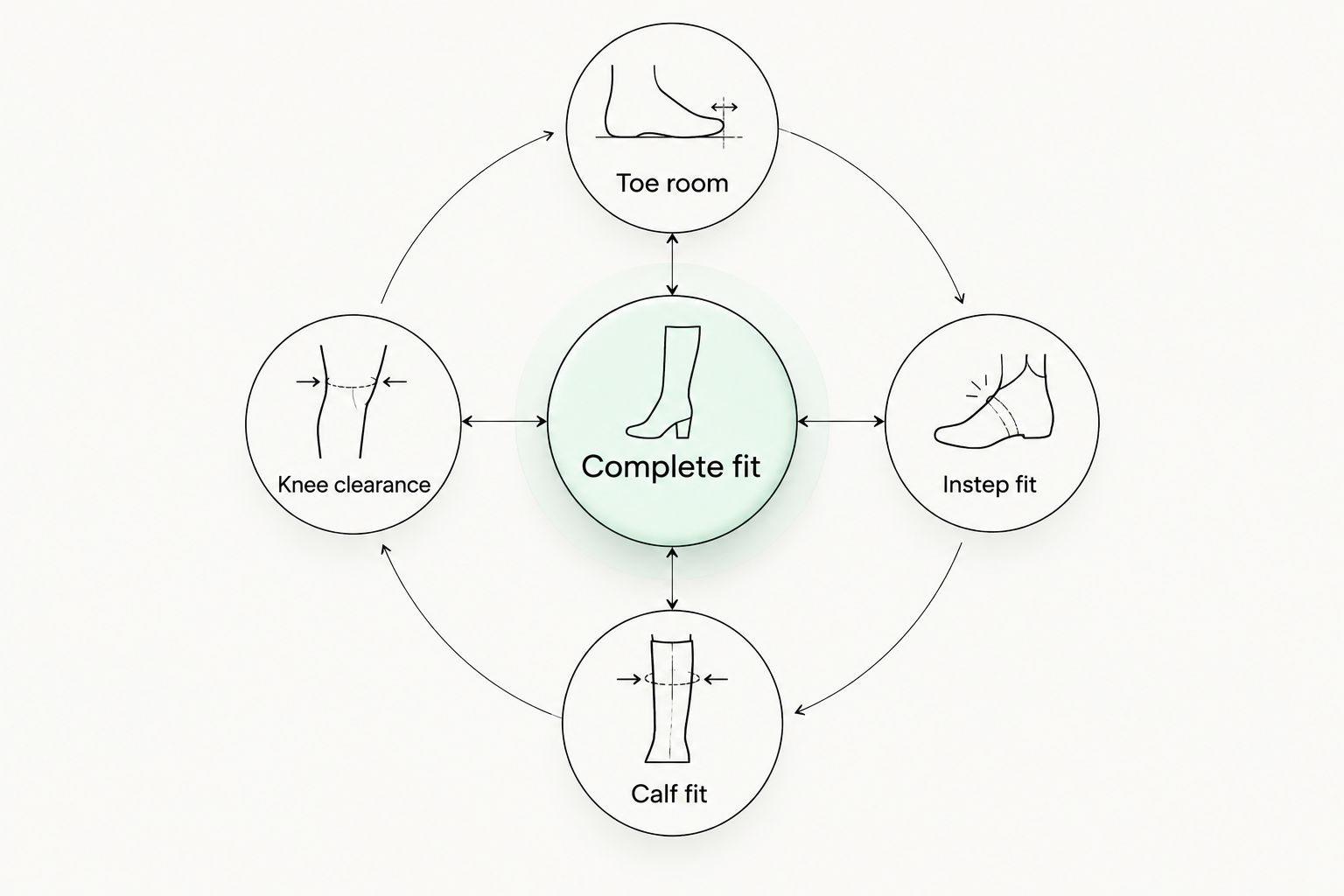
CHECK THE COMPLETE FIT
Before committing to platform knee-high boots in 2026, assess the complete combination. Use your intended socks and clothing, close the boot normally, then stand, walk and sit. Each position tells you something different about the fit.
- Toe room: Check that your toes are not squeezed by the added sock layer.
- Instep fit: Notice pressure across the top of your foot when the closure is fastened.
- Calf fit: Check the shaft with the clothing you actually intend to wear.
- Knee clearance: Sit down and assess whether the shaft edge presses behind your knee.
These checks do not produce a thermal rating. They stop you choosing a supposedly warm construction that becomes uncomfortable once you dress for cold conditions.
HOW THE CONSTRUCTIONS ARE RANKED
The ranking puts insulation and protection from wet exposure ahead of visual mass. Fit follows because your lining and socks need usable space. Shaft coverage matters, but it cannot replace insulation around the foot.
This 2026 guide assigns no temperature thresholds, tested warmth scores or measured differences between named products. Use the order to choose the right construction brief, then assess the individual boot against it.
WHICH PLATFORM KNEE-HIGH BOOTS SHOULD YOU CHOOSE?
Choose insulated, weather-protective knee-high platforms when warmth in cold, wet conditions is non-negotiable. For dry cold, prioritise an explicitly insulated lining. For mixed indoor-outdoor wear, assess a lightly lined construction with your intended socks.
Choose Swear London for the archive-led platform silhouette. Keep that choice separate from weather performance. You do not need to turn every distinctive boot into an all-conditions boot to justify wearing it.
FAQ
What's the best construction for warm platform knee-high boots?
Insulated, weather-protective platform knee-high boots are the first construction to consider for cold, wet conditions. Check the stated lining, weather protection and fit rather than relying on a chunky appearance.
Are knee-high platform boots warmer than ankle boots?
Knee-high boots provide more lower-leg coverage, but shaft height alone does not establish warmer feet. Compare the lining, upper, footbed and fit before judging warmth.
Does a higher platform keep your feet warmer?
A higher platform is not a thermal rating. Sole materials and construction matter, so do not rank warmth by visible height alone.
Are vegan platform boots warm enough for cold weather?
Vegan describes a product choice, not a warmth specification. Assess insulation, weather protection and sock space on the individual boot.
Can I wear thick socks inside platform knee-high boots?
Wear thick socks only when the boot accommodates them without squeezing your foot or calf. Try the complete combination before committing to the fit.
Are the Air Rev. Xtra High Vegan Platform Boots - Black automatically knee-high?
Do not treat the word high as a confirmed knee-high fit. Check the shaft measurement and where the boot ends on your own leg.
Are Swear London platform boots waterproof?
Do not infer waterproofing from a platform sole, vegan designation or closed-looking upper. Check the individual product's stated weather protection before choosing it for wet exposure.
ONE LAST THING
The extra sock is not automatically the better choice. If it turns a comfortable boot into a tight one, change the combination rather than forcing the closure. Usable space beats another layer you cannot comfortably wear.