


Yes, chunky boots can be resoled in 2026, but the shape of the sole does not tell you whether a particular pair can be repaired. A cobbler needs to check how the sole attaches to the upper, whether a suitable replacement exists and whether the rest of the boot is sound. A new sole also will not fix a split upper or a broken platform.
- Can chunky boots be resoled? Yes, if the sole can be replaced without damaging the upper.
- In 2026, a thick platform is not proof that a boot is resoleable; its construction decides.
- A partial tread repair can preserve an otherwise sound sole when a full replacement is unnecessary.
- SWEAR London boots have archival shapes, but their resoling options require a pair-specific cobbler assessment.
WHY THIS MATTERS
Chunky boots carry much of their identity in the sole. Replacing a worn tread while keeping that shape is a different job from rebuilding a damaged platform. If the original sole has an unusual profile, a repair also needs to preserve the balance and appearance you bought the boots for.
Start with the damage, not a promise that every thick sole is replaceable. The guide to resoling platform boots covers the broader process; this page helps you decide what to ask a cobbler about your chunky pair in 2026.
CAN CHUNKY BOOTS BE RESOLED?
Yes, when the upper is sound and the sole can be removed or repaired without destroying the boot. Construction matters more than sole thickness. A stitched attachment can give a repairer a clearer route to removing the sole; a bonded or integrated platform calls for a closer inspection. Neither description, on its own, guarantees the answer for the pair in your hands.
| What the cobbler finds | Possible route | Advantage | Limitation |
|---|---|---|---|
| Worn tread with a sound platform | Replace or add suitable tread material | Keeps more of the existing sole shape | Does not repair structural damage inside the platform |
| A replaceable sole attached to a sound upper | Remove and fit a suitable sole unit | Addresses wear across the sole | The replacement must fit the boot and preserve its balance |
| A bonded sole separating from a sound upper | Assess cleaning and reattachment | Retains the existing profile if the bond can be restored | A failed bond can return if the underlying materials are damaged |
| A cracked platform or damaged upper | Assess structural repair before any resole | Identifies the actual failure | A new tread alone does not solve it |
That table is a triage guide, not a diagnosis. Look at both boots, including the sides of the platform and the point where the upper meets the sole. A photograph of the underside alone leaves out much of what the cobbler needs to see.
A resole also need not mean an exact copy of the original sole. Ask whether the proposed replacement changes the outline, height or feel underfoot. If preserving the silhouette matters more to you than getting any replacement attached, say so before work begins.
CHECK THE BOOTS BEFORE YOU ASK FOR A RESOLE
Take the pair to a footwear repairer for an in-person assessment. You can make that conversation more useful by identifying where the failure starts.
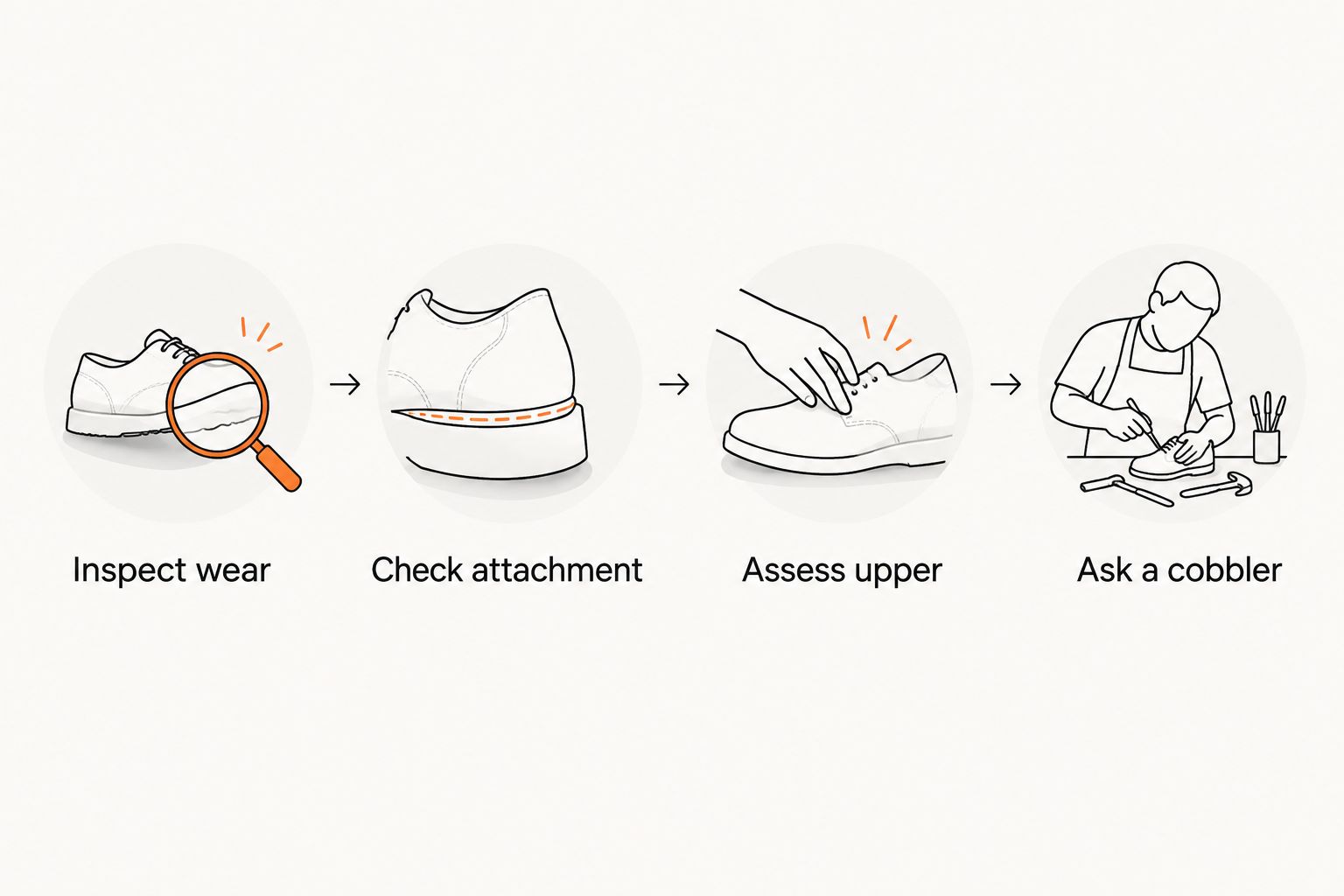
- Inspect wear. Check the heel, forefoot and outer edges of each sole. Note whether the tread is worn down or the platform itself is damaged.
- Check attachment. Look for separation where the sole meets the upper. Do not pull at a loose edge to test it; show the gap to the repairer.
- Assess the upper. Check the area above the sole for splits, tears or material pulling away. Resoling cannot restore an upper that will not hold a new attachment.
- Ask a cobbler. Bring both boots and ask what can be retained, what must be replaced and how the finished profile will differ.
A wear mark and a structural crack call for different work. The distinction matters especially with a platform: new tread beneath a failing structure leaves the failure in place.
Describe what happened without diagnosing the construction yourself. Tell the repairer if the sole has begun to separate, if one boot feels different from the other or if a crack opens when you walk. Those observations help them locate the problem; they do not substitute for examining the pair.
WHY RESOLING OPTIONS VARY
Two boots can look equally chunky and present entirely different repair jobs. These are the factors a cobbler needs to check in 2026:
- Sole attachment. A stitched, bonded or integrated attachment affects how the existing sole can be removed. The visible edge alone does not establish what is happening beneath it.
- Condition of the upper. A sound upper gives a replacement something to attach to. Tears or deterioration along the attachment area complicate that work.
- Condition of the platform. Worn surface tread is not the same as a cracked or unstable platform. Ask which part has failed.
- Replacement shape. A sole that can be fitted must also work with the boot’s profile. An available tread material is not necessarily a match for a distinctive platform.
- Extent of wear. Localised heel or tread wear calls for a different assessment from damage across the entire sole.
- The result you will accept. A functional repair and a close visual match are separate goals. Tell the cobbler which matters before approving either.
Do not choose a repair by sole height alone. Ask the repairer to identify the attachment and the failed component. That is the point at which a yes or no becomes useful.
IS A TREAD REPAIR THE SAME AS A FULL RESOLE?
No. A tread repair addresses the surface that meets the ground; a full resole replaces substantially more of the sole assembly. If the platform remains sound and only its contact surface has worn, keeping the existing structure can preserve more of the boot’s shape. The cobbler must still decide whether new material can be attached securely.
A full resole becomes the question when the existing sole cannot continue doing its job. It is also the more demanding option for a distinctive chunky silhouette. Removing the original unit can change how the boot looks and sits unless a suitable replacement can be fitted.
Ask for the proposed work in plain terms: what stays, what comes off and what material replaces it? Then ask to see an example of the intended sole profile if the repairer has one. Approval should cover the finished shape, not just the fact that the boot will have a new bottom.
Do not treat a patch as a permanent answer to every kind of damage. If the platform is unstable, covering its underside does not resolve that instability. Equally, do not discard a sound platform because one area of tread is worn. The repair should match the fault.
WHAT ABOUT VEGAN OR BONDED CHUNKY BOOTS?
Vegan upper material does not, by itself, decide whether a boot can be resoled. The repairer still needs to inspect the attachment, the upper and the sole unit. A bonded construction does not automatically rule out repair either; the condition of the bonding surfaces matters.
This is relevant to SWEAR London’s vegan platform boots, but the product name and upper material are not a resoling specification. SWEAR London boots suit buyers drawn to archival silhouettes, not buyers seeking a guaranteed resole. Have your particular pair assessed before planning a repair around it.
The Air Rev Xtra vegan platform boots black use an original stacked-wedge shape. That makes the sole profile part of the design decision. It does not establish that a replacement unit exists or that a cobbler can remove the original without changing the boot. Their strength is that distinctive shape; for repair planning, the unanswered question is how much of it can be retained.
Ask a prospective repairer about materials as well as attachment. If keeping a vegan-material specification matters to you, state that before agreeing to replacement parts or adhesives. Do not assume a repair uses the same materials as the original boot.
WHEN SHOULD YOU STOP WEARING THE BOOTS AND GET THEM CHECKED?
Stop wearing a pair when the sole feels unstable, an attachment is opening or a cracked platform changes how you land. Continuing to walk in it can make the damaged area harder to assess and can expose you to an avoidable slip or trip.
You do not need to wait for the sole to detach. Bring the pair in when you first notice separation or uneven wear. Keep both boots together for the assessment: the less-worn boot gives the repairer a reference for the original shape and stance.
Clean away loose dirt before the visit so the wear is visible, but leave a separating sole in place. Do not disguise a gap with a home adhesive application just before inspection. The cobbler needs to see the failed area and decide how to prepare it.
In 2026, the useful question is not whether chunky boots as a category last indefinitely. It is whether this pair’s upper, platform and attachment can support the specific repair you want. Get that answer while the damage is still clear and contained.
CAN A COBBLER KEEP THE ORIGINAL CHUNKY LOOK?
Sometimes, but preserving the look must be part of the brief. A tread repair that retains a sound platform keeps more of the original profile than replacing the entire unit. A full resole depends on the shape of the replacement and how it fits the upper.
Show the cobbler which details you care about: the side profile, the edge around the upper and the way the boot sits on the ground. Ask which of those will change. If the proposed repair alters the silhouette beyond what you want, decline it rather than treating any resole as an automatic improvement.
This is the tension with archival footwear. SWEAR London reissues archive silhouettes on original 1995 moulds, making shape central to the boot’s identity. That history is not evidence that original-style replacement soles are supplied for repair. An archival mould and a repairable sole are different things.
IS IT BETTER TO REPAIR A CHUNKY BOOT OR REPLACE IT?
Repair it when a cobbler confirms that the damaged part can be fixed and the result meets your expectations for function and shape. Replace it when the upper or platform cannot support an acceptable repair. Neither decision follows from the boot being chunky, vegan or designer-labelled.
Before deciding, ask for the repair scope and an account of what will look different. If only the tread is worn, a smaller repair deserves consideration. If several parts have failed, ask whether repairing one will leave the others unresolved. That prevents a tidy-looking sole from masking a boot that still feels wrong underfoot.
For an archival pair, there is another choice: keep it without treating it as everyday footwear if a suitable repair is not possible. That is not the same as declaring the boot fixed. A pair that has lost structural support should not be worn simply because its silhouette is hard to replace.
FAQ
Can chunky boots be resoled in 2026?
Yes, chunky boots can be resoled in 2026 when their construction and condition allow it. A cobbler must inspect the sole attachment, platform and upper before confirming the repair.
Can you resole chunky boots with glued soles?
A glued sole can be repairable, but the adhesive bond and the materials beneath it need inspection. Glued construction alone does not guarantee or rule out a resole.
Can a cracked platform boot be resoled?
A new tread does not repair a cracked platform. A cobbler must assess the platform itself before recommending any sole work.
Can vegan chunky boots be resoled?
Vegan chunky boots can be resoled when their construction and condition permit it. The upper material alone does not tell you whether the sole can be removed and replaced.
Will resoling change the height of chunky boots?
The height can change if the repair requires a different sole unit. Ask the cobbler what will be retained and what the finished profile will be before approving the work.
Is replacing the tread the same as resoling chunky boots?
No. A tread repair addresses the ground-contact surface, while a full resole replaces more of the sole assembly. The right job depends on which part has worn or failed.
Can a cobbler preserve the original shape of archival platform boots?
A cobbler can preserve more of the original shape when a sound platform only needs tread work. Full sole replacement depends on whether a suitable replacement can match the profile.
ONE LAST THING
The thickest-looking part is not always the part that has failed. Before asking for a full resole in 2026, ask the cobbler to separate tread wear, platform damage and upper damage in their assessment. That single distinction tells you whether the repair can preserve the shape you care about.