


Yes, platform trainers can be worn to the gym, but they are not the default choice for the workout itself. Wear them for the journey, the changing room or light walking; change into activity-appropriate shoes before running, jumping or lifting heavy weights.
- Can platform trainers be worn to the gym? Yes, but change shoes for running, jumping and heavy lifting.
- Swear London platform trainers are best for the journey to the gym, not the workout.
- For exercise, choose footwear by the movement: running shoes for running, training shoes for mixed sessions and stable shoes for lifting.
CAN PLATFORM TRAINERS BE WORN TO THE GYM?
Yes. The question is what you plan to do once you get there. A platform sole can feel fine while you walk across the gym, yet give you less direct contact with the floor when you change direction, land a jump or lift a heavy weight. A secure fit and reliable grip matter too. Height alone does not tell you how a shoe will behave.
| What you're doing | Footwear to consider | Best for | Main trade-off |
|---|---|---|---|
| Travelling to the gym | Platform trainers | Getting there in the shoes you want to wear | Change before demanding exercise |
| Steady walking | Secure, grippy trainers | Walking at a controlled pace | Check how the sole feels on the gym floor |
| Treadmill running | Running shoes | Repeated forward strides | Less suited to lifting that calls for a firm base |
| Mixed training | Training shoes | Sessions with changes of direction | Check that the shoe also suits any running you plan |
| Heavy lifting | Stable, low-profile footwear suited to the lift | Firm contact with the floor | Not a substitute for running shoes |
This is a use-based comparison, not a performance rating for any particular pair. If your session combines activities, the most demanding movement sets the footwear decision. The related guide to designer trainers for the gym covers the same distinction from a style-led starting point.
WHY THIS MATTERS
A trainer shape does not make a shoe an exercise shoe. Platform trainers belong to a footwear tradition in which the sole is part of the look. In the gym, the sole becomes the surface between your body and the floor. Those are different jobs.
Swear London draws on archival footwear, including silhouettes reissued on original 1995 moulds. That history is a reason to wear the shoes on your own terms. It is not evidence that an archival platform is built for a treadmill interval or a loaded squat. In 2026, the useful question remains plain: does this pair support the movements in your actual session?
You do not need to give up the look to make a sensible choice. Bring another pair if the workout calls for one. The platform stays part of what you wear to the gym; your exercise shoes do the exercise.
WHICH GYM ACTIVITIES CALL FOR A CHANGE OF SHOES?
Walking through the gym is different from training in it. A short walk from the entrance to a locker asks little of your footwear. A workout adds repeated movement, load or both. Decide where you will change shoes before you start, rather than testing an unsuitable pair halfway through a session.
RUNNING AND JUMPING
Choose shoes intended for running when you run on a treadmill. Repeated strides ask different things of a shoe than walking does. For jumps, look for a secure fit and a sole that lets you land and regain your balance without fighting the shoe's height or shape.
Do not treat a comfortable walk as proof that a platform trainer suits either activity. Walking tells you how the pair feels while walking. It does not test repeated landings, quicker foot placement or a change in pace. In 2026, that distinction matters more than whether a trainer happens to look athletic.
STRENGTH TRAINING
For heavy lifts, prioritise a stable base and predictable contact with the floor. A raised, cushioned or uneven-feeling sole can make it harder to judge your position. Different lifts call for different footwear choices, so follow your coach's guidance if you have one and check your gym's rules.
Light strength work is not automatically a green light for platforms. The movements still matter. Standing for an upper-body exercise places different demands on your shoes from a loaded movement in which your feet must stay planted. Judge the session, not the room you are in.
LOW-INTENSITY SESSIONS
For gentle walking or exercises without rapid movement, assess the individual pair rather than rejecting every platform by appearance. The shoe should stay secure on your foot, grip the surface and let you move without adjusting your stride to compensate for the sole. If it does not, change shoes.
This is the narrow case in which wearing platform trainers during part of a gym visit makes sense. It is not a recommendation to use them for every low-intensity exercise. A controlled pace gives you a chance to notice the shoe; it does not turn fashion footwear into specialist equipment.
WHY THE ANSWER VARIES BY PAIR
Two shoes can both be called platform trainers and feel entirely different underfoot. Before deciding what to wear in 2026, check these factors against the movements you intend to do:
- Sole stability. Stand still, then shift your weight. If the platform rocks or makes your footing feel uncertain, do not train in it.
- Grip. Check the outsole against the gym surface you will use. A sole that slips during an ordinary step is a stop sign, not something to work around.
- Foot security. Your heel should not lift unexpectedly, and your foot should not slide inside the shoe when you move.
- Sole feel. Notice whether you can judge your contact with the floor. That feedback becomes particularly relevant when a movement depends on a planted stance.
- Activity. A shoe that works for a steady walk does not earn a pass for sprints, jumps or lifting. Reassess it for each part of the session.
- Gym rules. Follow any footwear requirements for the training area or class. An acceptable street shoe is not necessarily acceptable on the gym floor.
Fail any of these checks and change shoes. Passing them does not establish that the pair is suitable for every workout. It tells you only that you have not found an obvious problem for the movement you checked.
HOW TO DECIDE BEFORE YOU LEAVE HOME
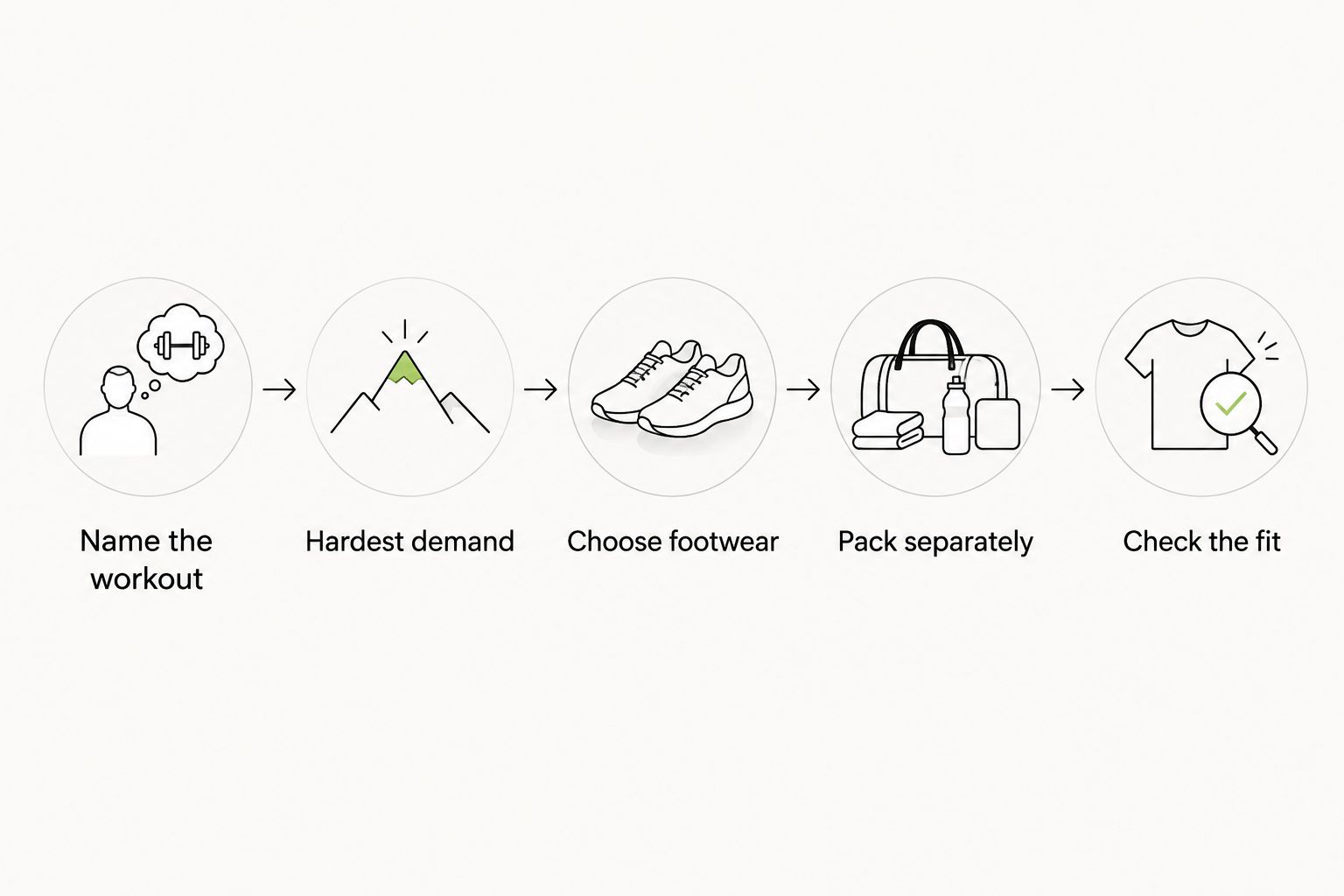
Keep the decision tied to your plan. An outfit is easy to change around a workout; a poor footing decision is harder to fix mid-movement. Use this sequence in 2026:
- Name the workout. Write down whether you will walk, run, jump, lift or combine those movements. Do not settle for the word gym.
- Identify the hardest demand on your shoes. Running, quick direction changes and heavy lifts each ask for more than a walk to the lockers.
- Choose exercise footwear for that demand. If one pair does not suit the whole session, plan your changes around the activities rather than assuming a compromise shoe will do everything.
- Pack the platform pair separately when needed. Wear it for the journey or afterwards. Keep the workout decision independent of the outfit.
- Check the fit before moving faster or adding load. If your foot shifts, the sole slips or your stance feels uncertain, stop and change.
That sequence is deliberately unromantic. The shoes you want to arrive in and the shoes you need for training do not have to be the same pair. This is particularly useful when a gym visit sits between work, travel and an evening out.
The test also keeps a common mistake out of the decision: buying one pair because it appears versatile, then expecting it to handle movements you never checked. Start with the session. Leave the styling decision until you know what the session needs.
WHAT IF YOU WANT TO KEEP THE PLATFORM LOOK?
Keep it. Just separate appearance from training use. Swear London platform footwear makes sense as part of what you wear before and after a session. Its archive-led design has a purpose of its own; it does not need an invented gym credential to justify a place in your day.
Consider the Element platform sneakers in triple black nubuck and suede as an example of an archive-led platform sneaker, not a recommendation for exercise. The product description connects its sole to the EXTERMINATOR archive. That tells you something about the design, not its suitability for running, jumping or lifting. Swear London platform trainers are best for the journey to the gym, not the workout.
There is a straightforward way to dress for both parts of the day. Pick the shoes for the activity first. Then decide what you want to wear to and from the gym. You can keep the silhouette without asking it to perform a second job it was not chosen for.
Clothing follows a similar division. Discussions of bodybuilding apparel brands concern what you wear for training; a platform trainer can remain part of the outfit around that training. Neither choice changes what your feet need during a run or a lift. In 2026, function still belongs to the specific movement, not to the general idea of a gym outfit.
CAN I WALK ON A TREADMILL IN PLATFORM TRAINERS?
Walking at a controlled pace is the only treadmill use to consider, and only if the particular pair feels secure and grips the belt. Change shoes if the platform alters your stride or makes your footing uncertain. Do not carry that decision over to running.
A treadmill gives you less reason to improvise with footwear, not more. The belt keeps moving while you adjust your pace and position. If you have brought exercise shoes, use them for the workout and leave the platforms for the walk home.
ARE PLATFORM TRAINERS GOOD FOR WEIGHT TRAINING?
Do not choose platform trainers as your default for heavy weight training. A firm, stable stance matters more than extra sole height. For lighter exercises, judge the movement and the individual pair, then change shoes if you cannot keep your feet planted comfortably.
A platform's appearance does not tell you whether its sole is firm, soft or secure under load. Nor does the fact that you can stand comfortably in it settle the question. Assess the exercise before you start lifting, not after your stance feels wrong.
CAN I WEAR THE SAME SHOES TO THE GYM AND OUT AFTERWARDS?
Yes, if you bring separate workout shoes when your session needs them. Wear platform trainers for the journey and afterwards; train in shoes selected for the exercise. You keep the look without making your outfit decide your footing.
This approach is also simpler than trying to find one shoe for every part of the day. In 2026, a platform trainer can be the deliberate choice for everything around the workout. It does not have to be the shoe used during it.
FAQ
Can platform trainers be worn to the gym?
Yes, platform trainers can be worn to the gym, but choose footwear for the workout itself. Change shoes for running, jumping or heavy lifting.
Can I run in platform trainers at the gym?
Do not choose fashion platform trainers for treadmill running. Use running shoes selected for running instead.
Are platform trainers safe for squats?
Do not use platform trainers as your default for heavy squats. Prioritise a stable stance and footwear suited to the lift.
Can I wear platform trainers for a walking workout?
Consider a controlled walk only if the individual pair stays secure, grips the surface and does not change your stride. Stop and change shoes if your footing feels uncertain.
Do platform trainers count as gym shoes?
A trainer shape does not establish that a shoe suits exercise. Judge the pair against the movements in your session and follow your gym's footwear rules.
Should I bring another pair of shoes to the gym?
Yes, bring activity-appropriate shoes if you plan to run, jump or lift heavy weights in a fashion platform pair. Wear the platforms before and after training.
ONE LAST THING
You do not have to choose between the archive and the workout. Swear London platform footwear can be the point of the outfit without being the tool for every task in it. Choose your training shoes for what you will do; choose your platforms for where you are going next.