


Most women's vegan trainers cannot be resoled the way a welted leather shoe can. The sole on the majority of vegan trainers, cemented or molded as one unit and bonded straight to the upper, is built for replacement rather than a cobbler's rebuild. Platform and chunky vegan styles sit in a gray zone: a specialist can sometimes rebuild the sole unit, but that's a repair, not a true resole, and it rarely reproduces the original silhouette in 2026.
- Can women's vegan trainers be resoled? Mostly no — cemented unit soles are bonded, not built for replacement layers.
- Platform and chunky vegan trainers can sometimes be rebuilt by a specialist cobbler, but that's not a like-for-like resole.
- Welted vegan shoes are the rare exception and take a genuine resole the same way leather welted shoes do.
- Sole tooling, not the vegan upper material, decides whether a shoe survives a repair shop visit.
WHY THIS MATTERS
Vegan trainers get treated as disposable more often than they should be, and sole construction is the real culprit, not the material itself. A pair with a cemented or bonded sole has no welt for a cobbler to unpick, so once the tread wears through, the shoe is usually finished.
That matters for cost and for what you buy in the first place. A trainer built on a stitched or welted platform can go through multiple soles over its life; one built on a single cemented unit gets one life, full stop. Knowing which construction you own before the sole wears out changes whether you budget for a repair or a replacement.
CAN WOMEN'S VEGAN TRAINERS BE RESOLED?
The honest answer depends entirely on how the sole meets the upper. Three constructions cover almost every vegan trainer and boot on the market in 2026:
| Construction | Resoleable? | Best for |
|---|---|---|
| Cemented / unit sole | No — replace, don't resole | Everyday flat trainers |
| Molded platform or wedge unit | Rebuild only, rarely a true resole | Chunky and platform styles |
| Stitched or welted | Yes — full resole is possible | Classic vegan dress shoes |
A cemented sole is glued as one molded piece. There's no stitching to remove and no channel for a cobbler to work a new sole into, so most repair shops will tell you to replace the shoe rather than repair it. A welted shoe, vegan or not, has a strip of material stitched between the upper and the sole specifically so the sole can be unpicked and swapped. Very few vegan trainers use this construction because it adds cost and bulk that doesn't suit a low-profile sneaker.
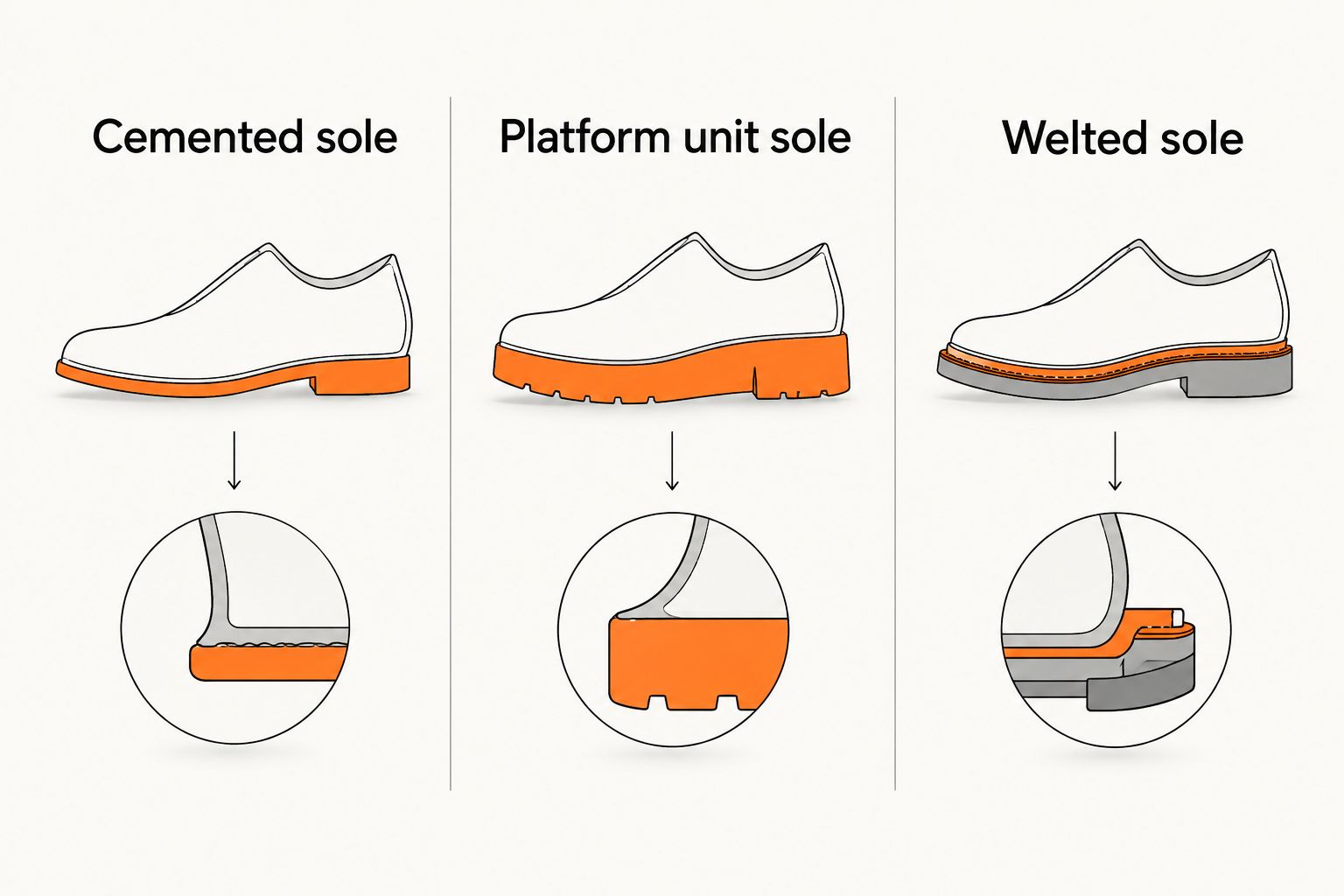
CEMENTED SOLE VEGAN TRAINERS: RESOLING IS LIMITED
Cemented construction is the default for most mass-market vegan trainers because it's cheap to produce and keeps the shoe light. The downside is permanence: once the outsole delaminates or the tread flattens, there's rarely enough material for a cobbler to rebuild against.
Some repair shops will apply a full-sole overlay glued on top of the worn original, which restores grip without replacing the sole unit itself. It's a workable fix for a season, not a genuine resole, and it changes the shoe's height and fit slightly.
Verdict: skip a full resole on cemented trainers — a topy or overlay repair is the realistic option.
PLATFORM AND CHUNKY VEGAN TRAINERS: REBUILD, NOT RESOLE
Platform and chunky silhouettes complicate the picture because the sole is doing structural work, not just providing grip. A stacked wedge or lugged platform unit is molded to an exact tool shape, and that tool belongs to whoever designed the shoe.
The AIR REV. XTRA platform boots from SWEAR London are a useful example of this: the stacked wedge is built on original 1995 moulds, so the sole shape itself is part of what makes the silhouette recognisable. A cobbler working on a shoe like this isn't threading in a generic replacement sole — they're either rebuilding the existing unit with fresh compound or leaving it as is, because a mismatched aftermarket sole would change the shoe's proportions.
That's the trade-off with any platform or chunky vegan trainer: the height and stance that make the shoe distinctive are exactly what makes a like-for-like resole hard to source outside the brand that built the mould.


WELTED VEGAN SHOES: THE RARE EXCEPTION
Stitched or welted vegan construction exists mostly in dress shoes and a handful of boots built to mimic traditional leather footwear repair standards. If your vegan trainer or boot has a visible ridge of stitching running around the edge of the sole, a cobbler can usually unpick it and fit a replacement, the same as they would on a leather welted shoe.
This construction is uncommon on trainers because the extra stitching adds weight and bulk that most sneaker silhouettes are designed to avoid. If you own one, treat it as a shoe built for the long haul rather than a single-season purchase.
Verdict: welted vegan shoes are the one category built for repeat resoling — worth the extra care.
WHY RESOLING RESULTS VARY
A handful of factors decide whether any given pair, vegan or not, can go back to a cobbler in 2026:
- Bonding method — cemented soles are glued as one unit; welted soles are stitched and built to come apart.
- Sole tooling — a platform or wedge shape molded on proprietary tooling has no generic aftermarket replacement.
- Upper material — some vegan uppers bond less predictably to new adhesive than others, which limits what a repair shop will attempt.
- Local cobbler skill and equipment — not every repair shop stocks the machinery for welted resoling, vegan or leather.
- Cost versus replacement — a rebuild on a chunky platform sole can cost close to what a new pair costs, which changes the decision.
RELATED QUESTIONS
Do vegan trainers last as long as leather trainers?
Longevity comes down to construction and material quality on both sides, not the vegan-versus-leather label itself. A well-built cemented vegan trainer and a poorly built leather one can wear out at similar rates, so check the sole construction before assuming either material wins.
How long do vegan platform boots last?
How long do vegan platform boots last depends heavily on how often the pair is worn and how the wedge sole was built in the first place. A stacked wedge built to last generally outperforms a thin molded unit sole because there's more compound to wear through before the shoe needs attention.
Can chunky trainers be resoled the same way as platform boots?
Chunky trainers face the same limitation as platform boots: the tread unit is usually molded on brand-specific tooling, so a generic resole rarely matches the original shape. Rebuild or overlay repairs are the realistic options for both categories.
FAQ
Can women's vegan trainers be resoled?
Most women's vegan trainers cannot be resoled because the sole is a cemented unit bonded to the upper. Platform and welted styles are the exceptions where a cobbler can rebuild or fully resole the shoe.
Is it worth resoling vegan trainers?
It's worth it only on welted vegan shoes or higher-value platform boots where a rebuild costs meaningfully less than a replacement pair. On cheap cemented trainers, replacement usually wins on cost.
Do all vegan platform boots use the same sole construction?
No, sole construction varies by brand and by mould, which is why one platform boot can be rebuilt by a cobbler while another cannot. Check the stitching line around the sole edge to tell them apart.
How do you know if your trainers can be resoled?
Look for a visible stitch line running around the edge where the sole meets the upper. A clean, unbroken glue line with no stitching usually means a cemented sole that isn't built for resoling.
Does vegan leather affect whether a shoe can be resoled?
The upper material has a smaller effect than the sole construction, though some vegan uppers bond less predictably to new adhesive during a repair. Ask a cobbler to inspect the specific pair before committing to a rebuild.
Are chunky vegan trainers harder to resole than flat ones?
Yes, chunky and platform vegan trainers are generally harder to resole because the sole shape is molded on brand-specific tooling. A flat cemented sole is easier to overlay, even if it isn't a true resole either.
ONE LAST THING
The stitch line, or the lack of one, is the fastest way to check any pair before you buy. Flip the shoe over: if you see visible stitching around the edge of the sole, you're looking at a shoe built for repeat repair; a clean glued seam means the pair is built for one life. That five-second check tells you more about a vegan trainer's future than the material label on the box ever will, in 2026 or any other year.