


Men's platform boots last 2 to 5 years of regular wear before the sole needs resoling or the boot gets retired, and that range swings on upper material and how often the wedge takes impact. The number that actually decides lifespan isn't the price tag - it's whether the sole is built to be reworked at all.
- Men's platform boots last 2 to 5 years of regular wear before the sole needs resoling.
- Vegan and synthetic uppers resist water well but crease at flex points, same as leather.
- A resoleable sole adds years; a glued sole usually means the boot is disposable.
- Wear frequency and platform height affect longevity more than the label price does.
- Swear London's Air Rev. Xtra Vegan Platform Boots use a stacked wedge built for daily rotation.
WHY THIS MATTERS
A platform sole carries more mechanical stress than a flat one. Every step flexes a taller stack of material at the point where the upper meets the sole, and that joint is where most platform boots fail first, not the leather or the vegan upper itself.
Swear London builds platform boots as made-to-order pieces rather than seasonal stock, which puts durability at the center of the buying decision instead of an afterthought. The Air Rev. Xtra Vegan Platform Boots - Black run on a stacked wedge sole shape that's reissued from an original 1995 mould, so the construction behind that wedge has been in circulation far longer than a single trend cycle.
How long that construction holds up is the real question behind most men's platform boot searches in 2026, and it has less to do with brand than with what's under the upper.
HOW LONG DO MEN'S PLATFORM BOOTS LAST?
Platform boots last 2 to 5 years of regular wear on average, based on aggregated durability patterns across the category - shorter for boots worn daily on concrete, longer for boots kept in occasional rotation. The table below breaks down a few common platform boot builds and what each one is actually suited for.
| Boot | Upper material | Sole construction | Best for | Verdict |
|---|---|---|---|---|
| Air Rev. Xtra Vegan Platform Boots - Black | Vegan (artificial) leather | Stacked wedge | Daily wear, vegan wardrobes | Buy - daily rotation |
| Air Rev. Xtra High Vegan Platform Boots - Black | Vegan (artificial) leather, high-cut | Stacked wedge | Extra ankle coverage, colder months | Buy - daily rotation |
| Air Fatalis Nitro Boots - Black | Heritage-inspired synthetic upper | Mid-high sneaker-boot hybrid sole | Rave and heritage-driven looks | Buy - occasional wear |
| Air Revive Vegan Boots - Triple Black | Soft stretch artificial leather | Stacked wedge | Everyday styling, stretch fit | Buy - daily rotation |
Vegan and artificial leather uppers resist rain and scuffing better than most fast-fashion synthetics, but they crease at flex points the same way leather does. The wedge sole underneath is what actually determines whether a boot survives a full 5 years or drops out after one season.
WHY PLATFORM BOOT LIFESPAN VARIES
Six factors decide where a pair lands inside that 2 to 5 year range:
- Wear frequency - daily rotation stresses the sole-to-upper bond faster than weekend-only wear.
- Upper material - vegan and artificial leather resist moisture but crease at flex points; genuine leather molds to the foot but scuffs show sooner.
- Platform height - taller wedges flex more with every step, loading the bond line harder than a flat sole would.
- Sole construction - a resoleable build survives past the first sole failure; a fully glued unit is built to be replaced, not repaired.
- Storage between wears - boots left creased in a bag or stacked under other shoes lose shape faster than boots stored upright.
- Surface contact - concrete and pavement wear a sole down faster than carpet, wood floors, or grass.
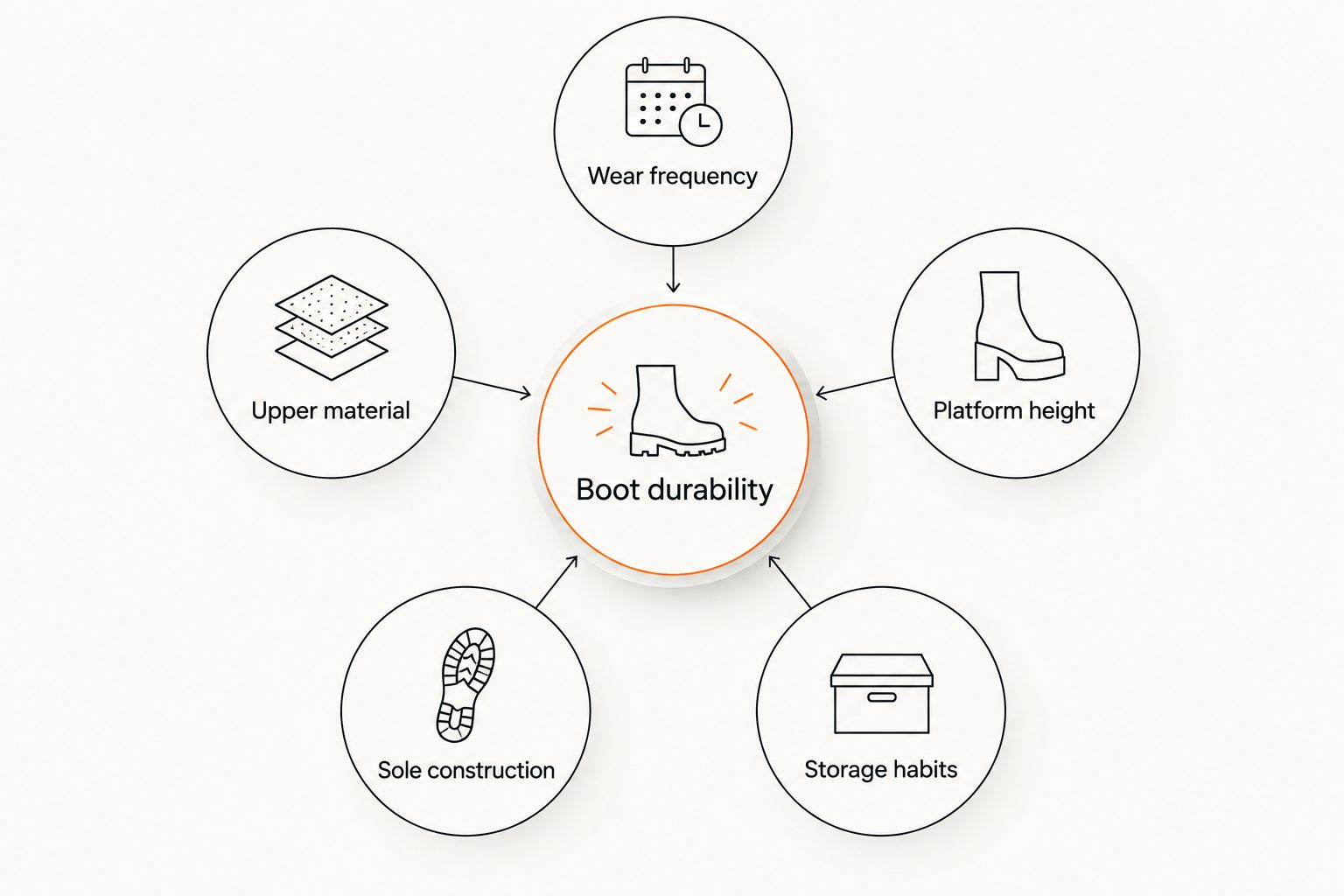
A resoleable sole is what separates a boot that lasts from one that doesn't. If the construction allows it, resole platform boots rather than replacing them outright once the tread wears flat. Cheaper glued builds are also the ones most often flagged when people report vegan boots crack over time - the bonding layer dries out and separates faster than a stitched construction does.
“The sole fails before the leather does, on almost every platform boot.”
SIGNS A PLATFORM BOOT IS NEAR THE END OF ITS LIFE
A platform boot rarely fails all at once. It gives a handful of warnings first:
- The sole edge starts separating from the upper at the toe or heel.
- The wedge shows a visible crack along the main flex crease.
- Stitching at the ball of the foot loosens or pulls through.
- The upper loses its shape even after the boot has dried out.
- The interior lining peels or bunches under the foot.
Once two or more of these show up together, the boot is past the point where cleaning or conditioning fixes it - resoling or retirement are the only options left.
Two of Swear London's platform boots are built specifically for that kind of daily rotation:


DOES PLATFORM HEIGHT CHANGE HOW LONG A BOOT LASTS?
Platform height changes how a boot wears out, even within the same 2 to 5 year range. A taller wedge puts more leverage on the sole-to-upper bond with every step, so tall platforms tend to show wear at that seam before a low-profile chunky boot would.
That doesn't make tall platforms a bad buy. It just means the sole-to-upper joint deserves a check every few months instead of being ignored until it fails outright.
HOW LONG DOES IT TAKE TO BREAK IN PLATFORM BOOTS?
Break-in on a platform boot usually takes a handful of wears, not months - the stacked wedge sole softens with movement well before the 2 to 5 year lifespan clock starts to matter. Rushing the break-in period in wet weather is one of the few things that shortens both the break-in time and the boot's overall life at once.
Give a new pair short wears indoors first. The wedge and the upper both need a few flex cycles before a full day on pavement makes sense.
CAN PLATFORM BOOTS BE RESOLED TO EXTEND THEIR LIFE?
Yes - platform boots with a resoleable sole construction can be resoled to push well past the initial 2 to 5 year window, as long as the sole is attached in a way that allows separation without damaging the upper. A fully glued sole usually can't be reworked, which is why construction matters more than price when shopping for platform boots in 2026.
IS IT WORTH PAYING MORE FOR PLATFORM BOOTS?
Paying more is worth it only when the extra spend buys a different sole construction, not just a different upper finish. A resoleable stacked wedge on a made-to-order boot has a longer realistic ceiling than a mass-produced glued sole, even when both start at a similar price point.
The upper material changes how the boot looks and feels day to day. The sole construction changes how many years you get out of it.
FAQ
How long do men's platform boots last?
Men's platform boots last 2 to 5 years of regular wear before the sole needs resoling or the boot gets retired. Daily wear on concrete sits at the shorter end; occasional wear on softer surfaces sits at the longer end.
Are vegan platform boots as durable as leather ones?
Vegan platform boots hold up as well as leather ones against rain and scuffing, but they crease at flex points the same way leather does over time. The wedge sole underneath, not the upper material, decides most of the lifespan.
What wears out first on a platform boot?
The sole-to-upper bond wears out first on most platform boots, not the leather or vegan upper itself. That joint carries the most mechanical stress with every step on a raised wedge.
Do platform boots need to be resoled?
Platform boots need resoling once the tread flattens or the wedge separates from the upper, but only if the construction allows the sole to be removed without damaging the boot. A fully glued sole usually can't be reworked.
Does platform height affect how long boots last?
Platform height affects where wear shows up, not whether a boot lasts within the usual 2 to 5 year range. Taller wedges put more leverage on the sole-to-upper bond with every step.
Do platform boots crack over time?
Platform boots can crack over time at flex points near the toe and ankle, especially on glued or lower-cost synthetic builds. Stitched or resoleable constructions tend to hold their shape longer before cracking starts.
Is it worth paying more for platform boots in 2026?
Paying more for platform boots is worth it in 2026 when the extra cost buys a resoleable sole construction, not just a different upper material. Construction, not price alone, decides whether a boot lasts 2 years or 5.
Can you extend the life of platform boots by rotating pairs?
Rotating between two pairs of platform boots extends the life of both, because the sole gets time to decompress between wears instead of compressing under back-to-back use. It's a habit, not a purchase, and it costs nothing.
ONE LAST THING
Rotating between two pairs of platform boots is the easiest way to add years to both of them - the sole gets time to decompress between wears instead of compressing under back-to-back daily use. It costs nothing and it changes the 2 to 5 year range more than any upper material choice.
Check the sole-to-upper joint every few months, not just when something already looks wrong. That's where a platform boot fails first, and it's the one spot most people never think to look.