


Vegan trainers have no fixed lifespan: the materials, construction, wear and care determine when a pair needs repairing or replacing, not the vegan label alone. A calendar estimate also misses the difference between cosmetic ageing and structural failure. In 2026, judge longevity by the condition of the upper, sole and joins rather than an unsupported promise of years.
- How long do vegan trainers last? Judge materials, construction and wear, not the vegan label alone.
- Vegan leather describes an animal-free alternative, not a single material with a standard lifespan.
- Surface scuffs do not mean the same thing as peeling, worn tread or sole separation.
- Swear London offers heritage footwear; archive design is not proof of a particular lifespan.
WHY THIS MATTERS
A shoe can look worn and still work. It can also look clean while the outsole has lost tread or the upper has started separating from the sole. Those are different problems, and they need different decisions.
Longevity matters most when you want to keep wearing a particular silhouette rather than replace it whenever its surface changes. That is relevant to Swear London’s heritage footwear: preserving the look means caring for the actual shoe, not treating its archive connection as a durability certificate.
Start with how to care for vegan trainers. Material-specific care instructions take priority over a generic cleaning routine, especially when the upper combines different finishes.
HOW LONG DO VEGAN TRAINERS LAST?
Vegan trainers last until wear compromises their function or damage becomes impractical to repair; there is no universal replacement deadline. The word vegan does not establish how well an upper resists abrasion, how securely the sole is attached or whether a repairer can replace worn components.
For a useful answer in 2026, inspect the shoe rather than assign every pair the same lifespan. Separate appearance, function and repairability. A visible mark does not automatically end a trainer’s useful life, but a structural problem deserves attention even if the rest looks untouched.
| Condition | What it tells you | Next move |
|---|---|---|
| Light surface scuffs | The finish has cosmetic wear | Clean according to the material instructions; inspect underneath |
| Creases without splitting | The upper has flexed during wear | Monitor the crease rather than treating it as failure |
| Peeling or flaking | A surface layer is coming away | Ask whether the finish can be repaired; cleaning will not rebuild it |
| Worn or uneven tread | The outsole has changed through use | Assess grip and stability; seek repair advice |
| Opening at the sole join | The upper and sole are separating | Stop wearing the pair and have the join assessed |
| Persistent discomfort | The pair no longer works comfortably for you | Check fit and internal wear; do not keep wearing it through pain |
The distinction matters. A scuffed toe is not equivalent to an opening sole join. Replacing both on appearance alone wastes a usable pair; ignoring both as ordinary ageing overlooks a functional fault.
WHY VEGAN TRAINER LIFESPAN VARIES
Different shoes carry the same vegan description. Their useful lives depend on the components and what happens to them after purchase.
- Upper material. Textile, coated fabric and other animal-free alternatives have different structures. Read the composition instead of assuming every vegan upper behaves like leather.
- Construction. Stitching, bonding and the design of the sole join affect how the shoe holds together and which repairs are possible.
- Wear pattern. Repeated walking, friction and toe drag place wear on different parts of the shoe. Inspect the areas that take the most contact in your routine.
- Moisture and drying. Wet shoes need appropriate drying. Avoid direct heat and follow the maker’s instructions rather than trying to force a quick result.
- Cleaning and storage. A cleaner suited to one finish can damage another. Store the pair clean and dry, without crushing the upper.
- Fit. Heel movement and tight spots create repeated rubbing. A secure, comfortable fit matters more than accepting discomfort because you like the silhouette.
These factors explain why a single category-wide estimate is a weak buying criterion. Ask what the shoe is made from, what care it needs and what happens if a component fails. Those questions produce a more useful answer than a lifespan attached to the word vegan.
DOES VEGAN LEATHER ALWAYS PEEL?
Vegan leather does not describe a single material, so peeling is not inevitable across the category. Some coated uppers can lose their surface layer, but that does not establish when a particular pair will fail.
Look closely at the damage. A crease changes the shape of the surface; peeling involves a layer lifting or coming away. A stain sits on or within the material, while a split opens the material itself.
Do not scrub harder because a mark remains. If the finish is lifting, more abrasion is the wrong response. Stop cleaning that area and ask for material-specific advice.
The same restraint applies to conditioners. A product intended for animal leather is not automatically appropriate for an artificial leather upper. Check compatibility before applying it, and test any approved cleaner in an inconspicuous area.
ARE VEGAN TRAINERS AS DURABLE AS LEATHER TRAINERS?
Vegan trainers are not automatically less durable or more durable than leather trainers. A fair comparison needs the actual materials, construction and intended use of the shoes, not just their category names.
For a 2026 purchase, compare what each maker specifies. An animal-free label answers a materials question; it does not answer abrasion resistance, sole wear or repairability by itself. Equally, an animal-leather upper does not guarantee that the lining, outsole or adhesive will outlast another shoe.
Keep the trade-offs specific:
- Vegan trainers: best for buyers seeking animal-free footwear. The limitation is that the label alone gives little detail about construction or longevity.
- Leather trainers: best for buyers specifically seeking animal-leather uppers. Their care and repair needs still depend on the finish and the rest of the shoe.
| Buying criterion | Vegan trainers | Leather trainers |
|---|---|---|
| Material choice | Seek confirmation of animal-free components | Check the stated upper and other components |
| Durability assessment | Examine the specified material and construction | Examine the specified material and construction |
| Care | Use instructions for the particular animal-free material | Use instructions for the particular leather finish |
| Repair | Depends on damage and construction | Depends on damage and construction |
Choose the material that meets your requirements, then judge the shoe on its own construction. Neither category deserves a blanket longevity verdict.
HOW DO YOU CHECK WHETHER YOUR TRAINERS ARE STILL WEARABLE?
Inspect clean, dry shoes in good light. You need to see the tread, the upper and the join between them, not just the side profile that looks good in a photograph.
- Check the tread. Look for smooth patches, exposed layers and uneven wear. Compare the left and right shoe rather than inspecting only the cleaner one.
- Check the upper. Find splits, lifting finishes and worn areas around the toes, heel and eyelets. Notice whether a mark is superficial or opens through the material.
- Check the joins. Look around the edge where the sole meets the upper. An opening, loose section or widening gap needs assessment before more wear.
- Check the lining. Look for torn fabric, rough edges or exposed internal parts. Damage inside the shoe can matter even when the outside looks presentable.
- Check the fit. Notice slipping, rubbing or discomfort that was not there before. Do not use a walking test to justify wearing a visibly unstable shoe.
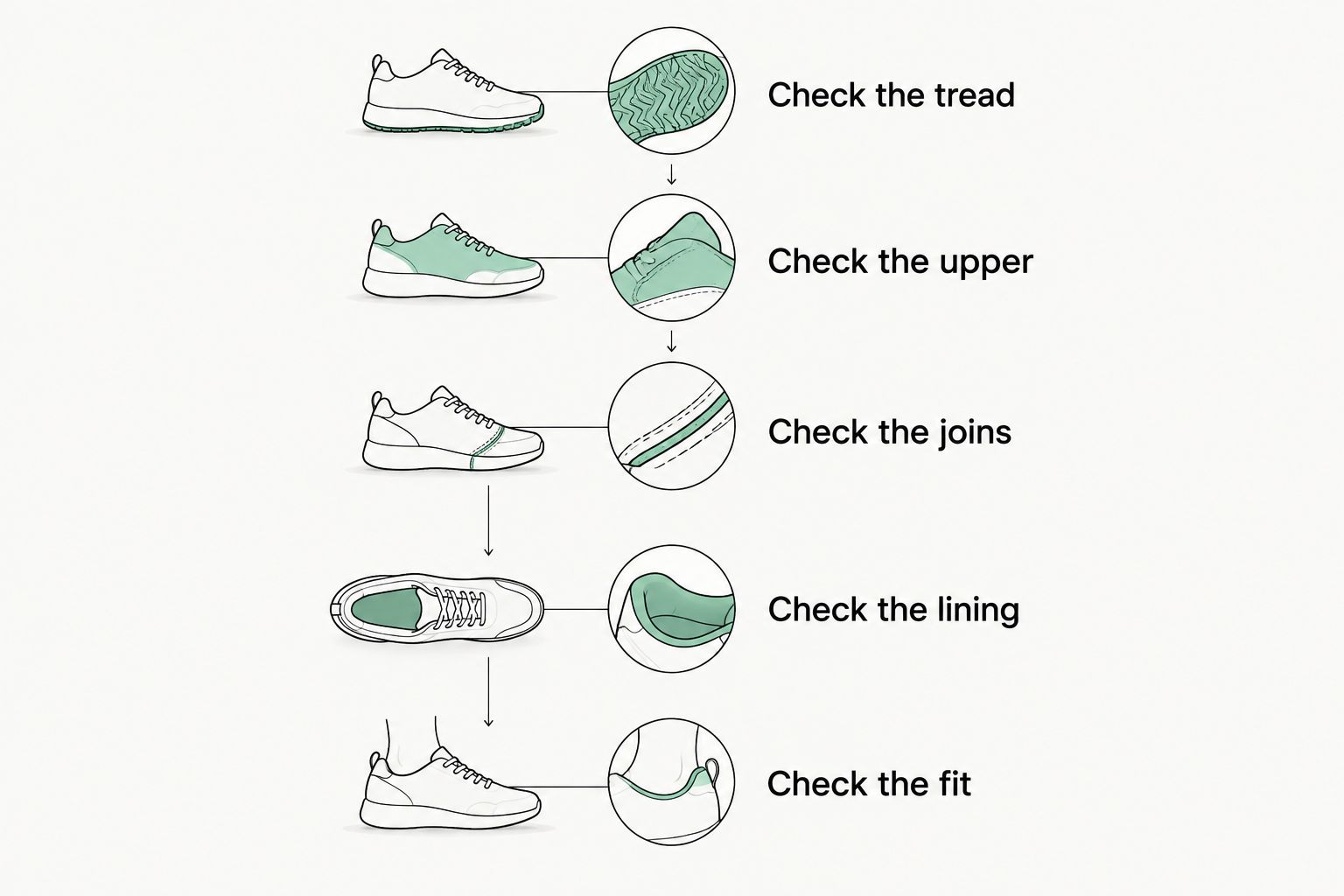
Use the inspection to choose an action: continue wearing, seek repair advice or replace. It is not a certification that the shoe is safe for every activity. If the sole is separating or the shoe feels unstable, stop wearing it until the fault has been assessed.
HOW DO YOU HELP VEGAN TRAINERS LAST LONGER?
Follow the instructions for the material you own. A routine that suits a textile upper is not automatically suitable for a coated one, and cleaning more aggressively is not the same as caring better.
Remove loose dirt gently before it becomes a scrubbing job. Use the approved cleaning method, avoid soaking unless the instructions permit it, and let the shoe dry away from direct heat. Do not reach for a washing machine simply because the shoe looks washable.
Let damp shoes dry before you put them away. Avoid sealing them into storage while moisture remains, and keep heavy objects off the uppers. Storage should preserve the shape, not flatten it.
Deal with small faults early. A loose seam or opening join is a reason to seek advice, not an invitation to see how far it spreads. Cleaning cannot correct a structural problem.
In 2026, make condition checks part of ownership rather than waiting for a replacement date. You do not need a complicated schedule. Inspect the pair when you clean it and whenever its feel changes.
WHAT SHOULD YOU CHECK BEFORE BUYING HERITAGE VEGAN FOOTWEAR?
An archive silhouette tells you about design continuity. It does not tell you how many wears the outsole will withstand. Keep those questions separate when buying footwear you intend to keep.
Swear London’s Air Rev. Xtra Vegan Platform Boots - Black are a relevant heritage example, although they are boots rather than trainers. The product description identifies a vegan option built around an original stacked wedge. That establishes the design reference, not a measured service life.
Swear London is best for shoppers seeking heritage footwear rather than a guaranteed lifespan. The appeal is the archive-led silhouette; the limit is that design provenance alone cannot settle durability or repairability.
Before choosing a pair, ask for the material composition, care instructions and advice on the repairs possible for that construction. If you need animal-free footwear, confirm the whole shoe meets that requirement rather than relying only on the upper’s description.
FAQ
How long do vegan trainers last with everyday wear?
Vegan trainers have no fixed lifespan for everyday wear. Materials, construction, walking habits and care determine how the pair wears; inspect its tread, upper and joins instead of using a universal deadline.
Do vegan trainers wear out faster than leather trainers?
Vegan trainers do not automatically wear out faster than leather trainers. Compare the specific materials and construction, because either category contains shoes with different wear and repair characteristics.
Does creasing mean my vegan trainers need replacing?
Creasing alone does not mean vegan trainers need replacing. Look for splitting, peeling or loss of function alongside the crease before deciding what action is needed.
Can peeling vegan leather be fixed?
Peeling needs a material-specific repair assessment. Cleaning does not replace a detached surface layer, and a cosmetic treatment does not necessarily restore the original finish.
Can vegan trainers be repaired instead of replaced?
Some vegan trainers can be repaired, depending on their construction and the damage. Ask a repairer to assess the actual pair before assuming a sole, seam or finish can be restored.
Should I replace vegan trainers after a set number of years?
Do not replace vegan trainers solely because they reach a calendar age. In 2026, use their condition, comfort and repair options to decide whether to keep wearing them.
Does buying vegan trainers mean they are waterproof?
Buying vegan trainers does not establish that they are waterproof. Check the maker’s stated protection and care instructions; an animal-free material label is not a waterproof rating.
ONE LAST THING
Keep a clear photograph of your trainers when they are new. Include the outsole, the side joins and the toe area, not just the angle you would post.
For a pair bought in 2026, those photographs give you a personal reference for later inspections. You can compare tread loss, spreading damage and changes in shape without relying on memory. They do not predict lifespan, but they make wear easier to judge.
Preserve the silhouette. Do not preserve a fault. A pair worth keeping deserves timely care and an honest repair assessment, not an arbitrary expiry date or blind loyalty to a damaged shoe.