


Chunky trainers are still moving heavy volume in 2026, but durability decides whether a pair earns its place in rotation, not the silhouette. A trainer with a bonded sole and a properly finished upper outlasts several seasons of fast-fashion chunky trainers combined, and that gap is the real cost math behind the question.
- Chunky trainers are worth buying in 2026 when the sole is bonded and the upper resists cracking within a year.
- Fast-fashion chunky trainers lose shape and grip inside one season; heritage pairs built on old moulds hold up for years.
- Cost-per-wear beats sticker price: one pair worn for three years costs less attention than three pairs worn once.
- Resoling ability, not the trend cycle, decides whether chunky trainers bought in 2026 keep any value.
WHY THIS MATTERS
The chunky trainer shape has outlived its original hype window and settled into a permanent wardrobe slot by 2026. That changes the question from "is this trend still alive" to "which version of this shoe survives daily wear". Chunky trainers ranked by weight is a useful starting point, because weight is one of the first tells for how much sole and upper you're actually getting.
Fast-fashion labels reissue the shape every few months with thinner soles and glued uppers that crack inside a year. Heritage and made-to-order labels build on older moulds and expect the shoe to survive years of wear, not one wardrobe cycle. Swear London sits in the second group: soles bonded to 1995-era lasts, made to order rather than produced ahead of demand and stacked in a warehouse.
By the 2000s the brand ran roughly 30 stores and worked with more than 2,000 stockists across 35 countries. Today it sells only through its own site and Farfetch, with no wholesale and no seasonal discount cycle. That shift from mass distribution to a made-to-order model is the clearest signal of how the brand's chunky trainers are actually built.
IS IT WORTH BUYING CHUNKY TRAINERS IN 2026?
Chunky trainers are worth buying in 2026 if the construction supports resoling and the label isn't discounting the same shoe six weeks after launch. The hidden cost the headline question skips: a badly bonded sole delaminates long before the upper wears out, so you're paying for a shoe that dies from the bottom up.
| Factor | Fast-fashion chunky trainer | Made-to-order heritage chunky trainer |
|---|---|---|
| Sole construction | Glued, single-season | Bonded to original mould |
| Upper material | Thin PU or mesh | Vegan leather or nubuck |
| Production model | Mass-produced ahead of demand | Made to order, zero inventory |
| Resoleable | Rarely | Usually |
| Best for | One-season trend wear | Multi-year daily wear |
Most buying regret with this silhouette comes from treating it like a fast-fashion purchase when the shape itself has moved past trend status. A chunky trainer bought for one outfit is a different purchase than a chunky trainer bought to wear three days a week for three years.
FAST-FASHION CHUNKY TRAINERS: BUILT FOR ONE SEASON
Mass-market chunky trainers are produced ahead of demand, priced to move fast, and discounted the moment the season turns. The sole unit is usually glued rather than bonded, which means the first sign of wear is the sole peeling at the toe, not the upper fading.
Verdict: skip if you want more than one season out of the pair. These trainers do a job — cheap access to a silhouette — and they do it fine for a single wardrobe cycle. They are not built to survive a resole, and most factories don't offer one anyway.
MADE-TO-ORDER HERITAGE CHUNKY TRAINERS: BUILT TO OUTLAST THE TREND
Heritage labels working from original moulds treat the chunky silhouette as an archive shape, not a seasonal drop. Swear London's flagship, SMILEY Black, is built on that model: made to order, no seasonal discount, no wholesale distribution diluting the run.
Verdict: buy if you want a shoe that survives repeated wear and can be resoled rather than replaced. The trade-off is patience — made-to-order production means the shoe isn't sitting in a warehouse waiting to ship same-day, and that's the point of the model, not a flaw in it.
WHY VALUE VARIES
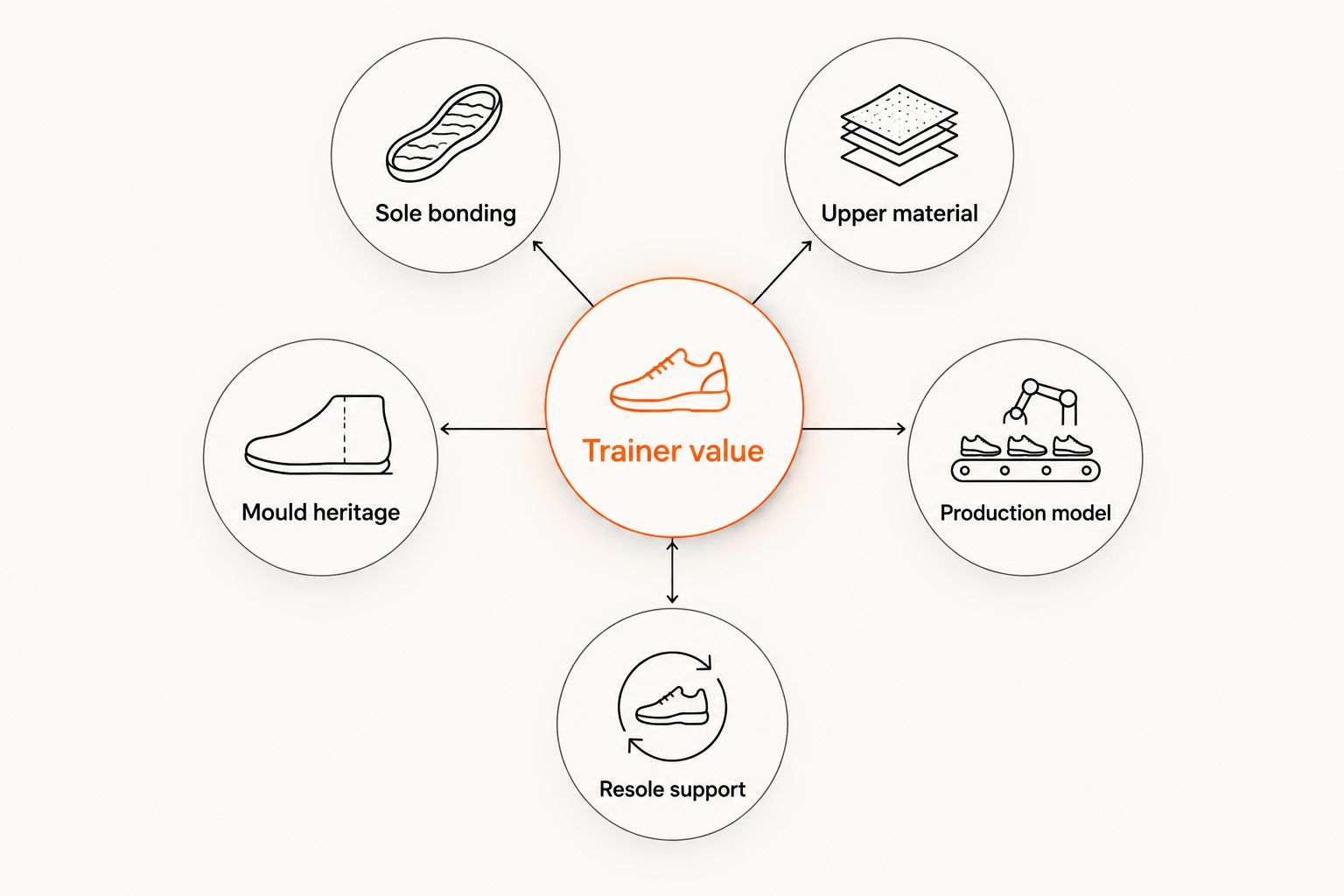
- Sole bonding method — glued soles separate within months; bonded soles hold for years.
- Upper material — thin PU cracks at flex points; full vegan leather or nubuck ages instead of splitting.
- Mould heritage — shoes built on a fixed, original last keep consistent fit across restocks; seasonal lasts change yearly and fit inconsistently.
- Production model — made-to-order runs avoid the overproduction that forces markdown pricing; mass production depends on discounting to clear stock.
- Resole support — a resoleable sole extends the life of the whole shoe; a glued sole means the shoe is disposable the day it delaminates.
- Distribution discipline — brands with no wholesale and no seasonal sale cycle have less incentive to cut corners on construction to hit a price point.
“If the sole can't be resoled, the trainer was never built to last a decade.”
ARE CHUNKY TRAINERS GOOD FOR RUNNING?
No — chunky trainers are built for platform height and street styling, not running mechanics, and the rigid sole unit doesn't flex the way a running shoe midsole does. Wearing them for casual walking is fine; using them for actual running mileage in 2026 puts stress on a sole that was never engineered for it.
DO CHUNKY TRAINERS RUN TRUE TO SIZE?
Sizing varies enough between labels that true-to-size claims don't hold across the category — chunky trainers running true to size depends on the specific last a brand uses. A shoe built on an original archive mould tends to size more consistently across restocks than a mass-market shoe re-cut every season.
CAN CHUNKY TRAINERS BE RESOLED?
Some can, some can't, and that split is the single biggest value differentiator in the category — see can chunky trainers be resoled for what determines it. A bonded sole on a proper last generally accepts a resole; a glued sole unit on a fast-fashion build usually doesn't, because the construction wasn't designed to be opened up again.
See the current archive
Made-to-order heritage sneakers and boots, no season, no discount.
FAQ
Is it worth buying chunky trainers in 2026?
Yes, if the sole is bonded and resoleable rather than glued — that construction detail decides whether the shoe lasts years or one season in 2026.
What makes a chunky trainer last longer?
A bonded sole on a fixed last, a full vegan leather or nubuck upper, and a made-to-order production model that isn't rushed to hit a season deadline.
Are made-to-order chunky trainers better than fast-fashion ones?
For lifespan, yes — made-to-order production avoids the overproduction and discounting that pushes fast-fashion labels toward cheaper glue-bonded soles.
Do chunky trainers go out of style?
The silhouette has held a permanent slot in casual wardrobes since its late-2010s peak and shows no sign of disappearing by 2026, unlike a true seasonal trend.
How do I tell if a chunky trainer sole is resoleable?
Check whether the sole is bonded to the upper rather than glued flat — bonded construction on an original mould is the type most likely to accept a resole.
Why do some chunky trainers crack within months?
Thin PU uppers and glued sole units are built for one season, not repeated flexing, so cracking at the toe box within months is a construction problem, not bad luck.
Is Swear London's SMILEY Black a chunky trainer?
SMILEY Black is Swear London's flagship silhouette, built on an original heritage mould and made to order rather than mass-produced ahead of a season.
ONE LAST THING
The detail most buyers skip: a chunky trainer's resoleability matters more than its upper material, because a cracked sole ends the shoe's life regardless of how good the leather still looks. Check for a bonded sole before checking the finish — that's the part a photo on a product page never shows.