


Swear London is worth the price in 2026 if you want handcrafted, made-to-order footwear with a genuine connection to London club culture and archival design. It is not a universal value buy: the case rests on the silhouette, provenance and how much you will wear it, not a promise of better comfort, longer life or future resale profit.
- Is Swear London worth the price in 2026? Yes, for buyers who value archival footwear and made-to-order construction.
- Original 1995 moulds connect the reissued silhouettes to the archive, rather than an invented heritage story.
- Handcrafted production in Felgueiras, Portugal, supports the provenance argument; it does not guarantee your fit.
- Choose for your wardrobe and actual use, not an assumed resale return.
IS SWEAR LONDON WORTH THE PRICE IN 2026?
Swear London is best for buyers who want handcrafted archival footwear rooted in London club culture. That is the strongest reason to buy. If you want the shoe mainly because it belongs to that history, the proposition makes sense; if that history means nothing to you, it adds little personal value.
The brand offers made-to-order heritage sneakers and boots, including archive silhouettes reissued on original 1995 moulds. Production takes place in Felgueiras, Portugal. Those are concrete features of the offer, not evidence that every model suits every foot.
Before deciding, separate the design question from the fit question. The guide to whether Swear London is true to size addresses the latter; an archive story cannot answer it for you.
| Your buying priority | Best for | What supports the purchase | What argues against it | Verdict |
|---|---|---|---|---|
| Archival design you intend to wear | Buyers with a clear attachment to the silhouette and cultural history | Reissued archive shapes, original moulds and handcrafted production | Provenance does not establish personal comfort or fit | Buy after checking the exact model |
| A practical shoe for a specific activity | Buyers whose main requirement is functional performance | A clear activity brief gives you something concrete to assess | An archive story does not establish suitability for that activity | Hold until the function is confirmed |
| A pair bought mainly for future resale | Buyers treating footwear as a collectible asset | Personal collecting interest can justify ownership | Cultural relevance is not a guaranteed financial return | Skip if profit is the main reason |
WHY THIS MATTERS
Designer footwear gets judged through several different questions. Is it well made? Does it have a meaningful design history? Will you actually wear it? Treating those as the same question produces a weak purchase decision.
Here, the inner story is the archive: original moulds, reissued silhouettes and a connection to 90s London club and rave culture. The wider question is how to buy fewer, more deliberate pieces without confusing a compelling backstory with practical suitability.
For a 2026 purchase, start with the thing you want to own. A shoe that fits your existing wardrobe has a stronger personal case than one bought because you feel you should appreciate its history. Respecting the archive does not require buying it.
THE ARCHIVE: A REASON TO BUY, NOT A PERFORMANCE CLAIM
Original 1995 moulds give the reissued silhouettes a specific connection to earlier footwear design. That matters if you care about the shape itself, rather than just a general vintage mood. The archive is part of the object, not merely the language around it.
The cultural context matters too. The brand is rooted in London club and rave culture, with designer, artist and musician collaborations forming part of its identity. That makes provenance a more useful comparison point than the logic of a mainstream sneaker release.
Buy archival footwear because you want the design to remain in your life. Do not turn its history into claims about cushioning, support or lifespan. Those are separate questions about the particular shoe and the person wearing it.
There is also a simple limit to the heritage argument. If you do not like the silhouette, knowing where it came from will not make it work with your clothes. Historical interest and wardrobe interest can coexist without becoming a purchase.
HANDCRAFTED PRODUCTION: KNOW WHAT YOU ARE VALUING
The footwear is handcrafted in Felgueiras, Portugal. For a buyer who cares about how and where a shoe is made, that is a substantive part of the offer. It gives you a production location and a stated method to consider alongside the design.
Handcrafted does not mean automatically comfortable for everyone. It also does not establish a fixed service life, repair outcome or fit. Keep those judgements attached to the exact model rather than the production label.
Your decision is stronger when you can say what this construction approach means to you. Perhaps you want to support that kind of production. Perhaps the archive silhouette is the main attraction and the making process is secondary.
Neither position needs embellishment. Pay for the characteristics you genuinely value, not for conclusions that the word handcrafted cannot support on its own. A precise reason to buy is more useful than a long list of assumed benefits.
MADE TO ORDER: A DIFFERENT WAY TO BUY FOOTWEAR
Made-to-order production is central to Swear London footwear. The brand describes a zero-inventory model rather than a conventional cycle of continually changing collections. That is relevant if you want your purchase to follow a deliberate choice rather than a constant search for something new.
The advantage is the alignment between the business model and the archive. A silhouette can matter because of its history and design, without needing to be replaced by a newer idea. For the buyer, that shifts attention back to the pair itself.
The limitation is equally clear. Made to order does not answer your questions about delivery timing, sizing or the terms attached to an order. Read the current information before committing, especially if you need the footwear for a particular occasion.
Do not interpret made to order as made to measure. Treat the listed size and the production method as distinct information. Your feet still need the right fit, whatever happens behind the workshop door.
WHY THE VALUE VARIES BETWEEN BUYERS
The same pair can be a good purchase for one person and an unnecessary one for another. In 2026, the useful distinction is not whether everybody agrees it is worth buying. It is whether the documented characteristics match your reasons for wanting it.
- Archive interest. Original moulds and reissued designs add personal value when the history matters to you. They do not add the same value to someone seeking an anonymous everyday shoe.
- Production preference. Handcrafted, made-to-order footwear is relevant when you care about that approach. It should not substitute for checking the actual model.
- Wardrobe fit. Your existing clothes determine whether the silhouette has a natural place. Choose for outfits you already wear, not a wardrobe you would need to invent.
- Intended use. A design-led purchase and an activity-led purchase require different evidence. Decide which question you need the shoe to answer.
- Ownership motive. Wearing a pair, collecting a pair and hoping to resell a pair are different goals. Be clear about which one is yours.
The best value argument is specific: you want this silhouette, understand its production model and have a real use for it. If your reasoning stays vague, pause the purchase rather than borrowing someone else's enthusiasm.
HOW TO DECIDE BEFORE ORDERING
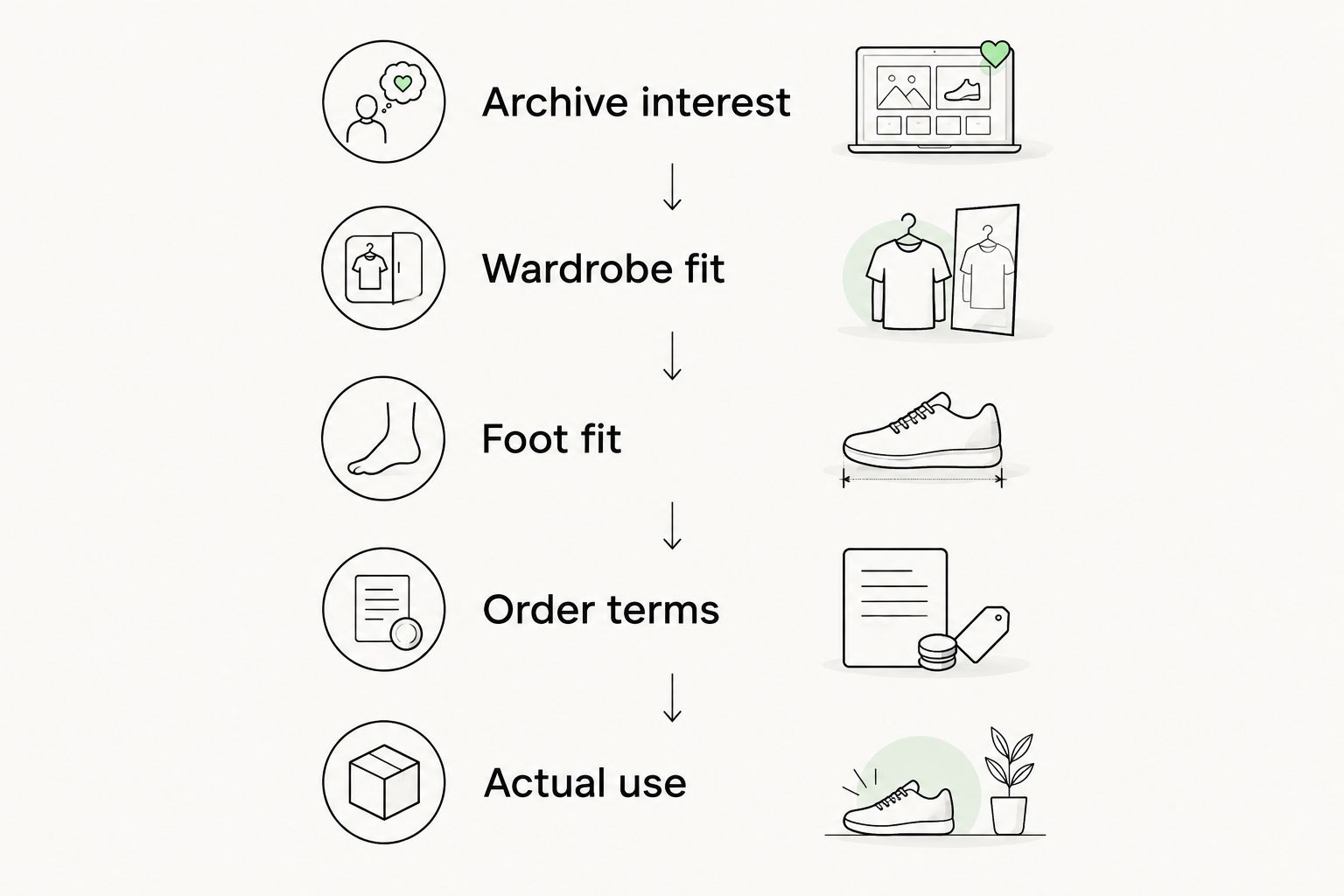
Use this sequence to turn an attractive archive shoe into a clear decision. It is not a quality score or a prediction of future wear. It is a way to separate preference from assumption.
- Archive interest. Name what attracts you: the silhouette, its cultural background or the reissue itself. If the answer is only that other people recognise it, reconsider your motive.
- Wardrobe fit. Look at the trousers, dresses or other pieces you actually wear. Decide whether the shoe belongs with them without requiring a complete change of style.
- Foot fit. Check the current sizing information for the exact model. Do not assume another designer shoe, or another model from the same brand, settles the question.
- Order terms. Read the information attached to the purchase. Resolve delivery and policy questions before paying, rather than relying on expectations from another retailer.
- Actual use. Identify where you intend to wear the pair. If you cannot name a credible use, treat it as a collecting decision instead of pretending it is an everyday essential.
The sequence ends with a simple choice. Buy when the design and the practical checks agree. Hold when an unanswered fit or order question sits between you and a confident decision.
SMILEY BLACK: WHEN THE SPECIFIC DESIGN IS THE POINT
The SMILEY Black illustrates the design-led case. The supplied product description identifies an archive design rebuilt with sharper lines and a sleeker profile, with the signature smiley detail reissued on a reworked oversized sole. It is a re-edition with changes, not a claim that nothing has moved since the original.
Best for: buyers who specifically want the smiley detail and the reworked archive silhouette. Its strongest advantage is that distinct design identity. You have a reason to choose the pair beyond a general wish to own designer footwear.
Its limitation is the same boundary that applies to the wider argument. The archive description does not tell you how it will fit your feet or feel during your intended use. Those questions need their own checks.
The useful recommendation is therefore narrow. Buy for that design after resolving fit and order questions. Hold if you like the history but remain undecided about the actual shoe.
WHEN THE PURCHASE DOES NOT MAKE SENSE
Skip the purchase if you want the archive story to justify a silhouette you do not enjoy wearing. You are buying footwear, not completing a reading list. Cultural importance does not create an obligation to own the object.
Hold if you need a specific functional outcome that the model information does not establish. That includes choosing footwear for a sporting activity or a medical requirement. A designer label is not a substitute for the relevant specification or professional advice.
Also hold if you are relying on future resale to make the decision acceptable. Your enjoyment and your financial expectations should stand separately. A pair can be culturally interesting without being a sound purchase for someone seeking a return.
For 2026, the clearest reason to walk away is a mismatch between the shoe and the job you expect it to do. Do not buy an archive piece to solve a problem that its archive cannot answer.
DOES MADE TO ORDER MEAN BETTER VALUE?
Made to order is a production model, not a universal measure of value. It strengthens the case for buyers who want that approach, but it does not establish comfort, fit or how often you will wear the pair.
Judge it alongside the design. If both matter to you, the reasons reinforce each other. If neither matters, the production model alone is not a convincing reason to buy.
IS ARCHIVAL FOOTWEAR AN INVESTMENT?
Archival footwear is a collecting interest, not a guaranteed financial investment. Buy because you want to wear or keep the object, rather than assuming its cultural history will produce a profitable resale.
Personal value can be substantial without becoming financial value. Keeping those meanings separate makes the decision cleaner.
SHOULD I BUY IF I ONLY WANT AN EVERYDAY SHOE?
An everyday purchase needs to work with your feet, wardrobe and intended use first. The archive can add meaning, but it cannot replace those requirements.
In 2026, choose the pair you can justify through actual wear. If the design is the reason you keep reaching for it, the history supports the purchase rather than carrying it alone.
FAQ
Is Swear London worth the price in 2026?
Swear London is worth considering in 2026 if you value handcrafted, made-to-order archival footwear and genuinely want the silhouette. It is not a universal recommendation for comfort, durability or resale returns.
What makes the archive relevant to the purchase?
Reissued silhouettes on original 1995 moulds give the footwear a concrete connection to the archive. That supports a provenance-led decision, not an assumption about personal fit or performance.
Where is the footwear made?
The footwear is handcrafted in Felgueiras, Portugal. Consider that production background alongside the exact model, sizing information and intended use.
Does made to order mean the shoes are made to measure?
Made to order does not itself mean made to measure. Check the listed sizing information and do not assume the production model provides a personalised fit.
Will archival trainers hold their resale value?
Do not base the purchase on an assumed resale return. Buy archival trainers because you want to wear or collect them, with any future financial outcome kept separate from that decision.
What should I check before ordering?
Check the exact model, sizing information, order terms and your intended use before ordering. The archive story answers the provenance question, not every practical ownership question.
ONE LAST THING
The most useful test happens away from the product description. Picture the shoe beside the clothes you wore recently. Does it belong there, or do you only like the idea of being the person who wears it?
An archive is worth preserving. Your wardrobe is still yours. Buy the pair when those two things meet; leave it alone when they do not.